
Aegirine
Dark, sharply formed and wonderfully mineral-looking, Aegirine is a sodium-iron pyroxene known for deep green to almost black prismatic crystals. Browse natural Aegirine specimens and clusters, including pieces associated with pale Orthoclase matrix. Within crystal traditions, Aegirine is commonly linked with protection, strength, boundaries, grounding and focused personal energy.
Showing all 3 resultsSorted by latest
A Crystal That Actually Looks Like a Mineral Specimen
Aegirine has very little interest in pretending to be soft or sugary.
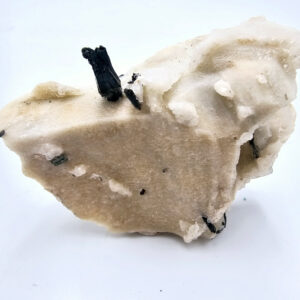
It commonly forms as long, sharply defined prismatic crystals in dark green, green-black, brown or almost black tones. Against a pale mineral matrix, those crystals can look like tiny blades or needles rising from the surface.
That contrast is part of what makes Aegirine especially satisfying as a specimen.
You are not simply buying a colour.
You are looking at crystal habit, matrix and mineral association all at once.
What Exactly Is Aegirine?
Aegirine is a sodium-iron silicate mineral belonging to the pyroxene group.
Its chemical formula is NaFe³⁺Si₂O₆, with sodium and ferric iron playing an important part in its mineral chemistry.
Pyroxenes are a large group of silicate minerals found in many igneous and metamorphic rocks, but Aegirine is one of the more visually distinctive members because of its dark colour and often elongated crystal form.
Aegirine is therefore not a trade name invented for the crystal market.
It is a recognised mineral species in its own right.
If you enjoy stones where the mineral structure is more important than a polished finish, our Selected Crystals – Rough collection is a useful next place to browse.
Those Dark Needles Are Part of the Appeal
Aegirine often appears in slender, elongated crystals.
Some specimens show individual prismatic crystals clearly standing away from the surrounding matrix, while others have denser sprays or intergrown formations.
Colour can range from deep green through green-black and brownish shades to material that appears almost black unless it is held in stronger light.
That means a photograph may not reveal every bit of colour in a dark Aegirine specimen.
Turn the piece.
Look at the crystal edges.
Watch where dark green or brown becomes visible against the light.
It is one of those minerals that can reveal considerably more in person than a flat patch of black in a product thumbnail suggests.
Aegirine With Orthoclase
Some current HIH Aegirine specimens are labelled with Orthoclase, giving this category an especially attractive light-against-dark contrast.
Orthoclase is a potassium feldspar mineral, commonly pale, cream, white or pinkish in appearance depending on the specimen.
When dark Aegirine crystals sit against a paler Orthoclase matrix, the individual prisms become much easier to see.
This is also useful shopping information.
If you want a specimen where the Aegirine itself stands out dramatically, look for strong contrast between the dark crystals and lighter matrix.
If you prefer a denser, moodier mineral piece, a specimen with darker or more tightly packed crystal growth may appeal more.
Cluster, Matrix or Single Crystal?
Mineral specimen terminology can become confusing when several crystals are growing together.
A cluster usually refers to multiple visible crystals occurring together.
A matrix specimen keeps the surrounding host material or associated minerals on which the crystals formed.
An individual Aegirine specimen can be both.
The matrix is not necessarily something that should be removed. In many collector pieces, it helps tell the geological story and can make the Aegirine itself more dramatic.
HIH's current Aegirine listings include clustered pieces, so the wider Crystal Clusters collection is useful if you enjoy minerals in naturally grouped formations rather than polished shapes.
Aegirine or Black Tourmaline?
At first glance, dark elongated Aegirine crystals can remind shoppers of Black Tourmaline.
They are not the same mineral.
Aegirine is a sodium-iron pyroxene.
Black Tourmaline, usually Schorl, belongs to the tourmaline mineral group and has very different chemistry.
Both can form elongated dark crystals, which is where the visual confusion begins.
Black Tourmaline often shows strong vertical striations and chunky prismatic growth, while Aegirine can form particularly slender, sharp crystals and sprays.
The easiest rule is not to identify either mineral purely by colour.
If Black Tourmaline is the stone you were actually looking for, browse the separate Black Tourmaline collection.
Aegirine and the Name Acmite
Older mineral literature and specimen labels may sometimes use the name Acmite.
Historically, Acmite was often used for browner, sharply terminated material, while Aegirine was more often associated with green to green-black material.
Modern mineral classification does not treat Acmite as a separate mineral species.
The name was formally discredited as a separate species during the modern reclassification of pyroxenes, with Aegirine retained as the accepted end-member mineral name.
So if you encounter an older specimen labelled Acmite, it may relate to material now classified as Aegirine.
That is useful collector history — but not a reason to rename the HIH category.
Aegirine is the correct modern category name.
Protection With a Sharper Edge
Within modern crystal traditions, Aegirine is strongly associated with protection, energetic boundaries, strength, confidence and releasing influences that do not feel personally aligned.
Its dark colour and blade-like crystal habit have helped it develop a particularly strong protective personality within contemporary metaphysical practice.
Some practitioners use Aegirine when working with grounding or personal boundaries, while others associate it with confidence and staying centred around demanding people or environments.
Those are traditional and modern metaphysical associations rather than properties of the mineral that can be measured geologically.
The stone is interesting even if you simply love mineral specimens.
The symbolism is an additional layer, not the only reason to own one.
How to Choose an Aegirine Specimen
With Aegirine, look closely at the crystal formation.
Choose a specimen with clearly visible individual prisms if you enjoy structural detail.
Choose a piece with pale Orthoclase or other light matrix if strong visual contrast is important to you.
Look for a denser cluster if you prefer a darker, more dramatic appearance.
Also consider the overall shape of the specimen rather than weight alone. A lighter piece with well-exposed crystals may be visually more interesting to you than a heavier specimen where much of the weight comes from matrix.
For collectors who like browsing stones according to mineral identity rather than shape, the wider Crystal Names collection keeps the HIH mineral range organised alphabetically.
Caring for Aegirine Clusters
Aegirine crystals can be relatively slender and projecting.
That means the main care concern is often physical damage, not complicated crystal rituals.
Handle clusters by the solid matrix where possible rather than gripping delicate projecting crystals.
Avoid dropping or knocking the specimen against harder objects.
For dust, a soft dry brush is generally gentler than aggressive scrubbing.
If the specimen contains several different minerals, care should be based on the most delicate material present rather than assuming every part of the cluster has identical properties.
And if you have a particularly fine crystal spray, resist the urge to test how sharp or strong every point is.
Minerals are very patient.
Tiny crystal terminations are less so.
Frequently Asked Questions
Is Aegirine a real mineral?
Yes. Aegirine is a recognised mineral species in the pyroxene group and has the chemical formula NaFe³⁺Si₂O₆.
What colour is Aegirine?
It commonly occurs in dark green, green-black, brown to almost black colours. Very dark pieces can reveal more green or brown when viewed in stronger light.
Is Aegirine the same as Black Tourmaline?
No. They are different minerals. Aegirine is a sodium-iron pyroxene, while Black Tourmaline usually refers to Schorl, a member of the tourmaline group.
What is Acmite?
Acmite is an older mineral name historically used for certain brown, sharply terminated material now classified as Aegirine. It is no longer recognised as a separate mineral species.
What is Aegirine traditionally associated with?
Within modern crystal traditions, Aegirine is commonly associated with protection, personal boundaries, grounding, strength and maintaining focused energy.