
Ametrine
Purple meets golden yellow inside the same quartz crystal in Ametrine, a naturally bicoloured gemstone combining the distinctive colours associated with Amethyst and Citrine. Each piece can show its own balance, boundary and blend between the two shades. Within crystal traditions, Ametrine is commonly associated with clarity, creativity, confidence, balance and bringing different energies into harmony.
Showing the single result
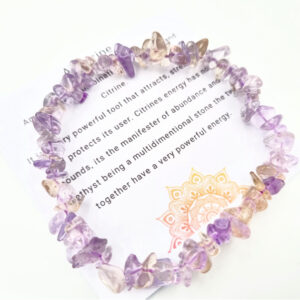
One Quartz, Two Very Different Colours
Ametrine looks almost as though two stones met halfway through formation and decided to share the same crystal.
Purple sits beside yellow, gold or orange-yellow. In some pieces the divide is obvious. In others, the colours drift through one another or appear in uneven zones.
The surprising part is that both belong to the same piece of quartz.
That natural meeting of colour is what gives Ametrine its identity.
What Is Ametrine?
Ametrine is a bicoloured variety of quartz showing both the purple associated with Amethyst and the yellow-to-orange colouring associated with Citrine.
Its name makes considerably more sense once you split it:
AMEthyst + ciTRINE = Ametrine.
It is also sometimes called amethyst-citrine.
Chemically, it is quartz: silicon dioxide, or SiO₂.
What makes it unusual is the colour zoning occurring within the same crystal rather than the basic mineral composition changing from one side to the other.
If the purple side is what catches your eye first, compare it with our wider Amethyst collection.
The Colour Boundary Is Part of the Stone
With Ametrine, colour distribution matters.
One piece might show an almost theatrical division between purple and golden yellow.
Another may have considerably more purple than yellow.
Some show angled sections, patches or softer transitions rather than a perfect half-and-half split.
That variation should not automatically be treated as a flaw.
In fact, the relationship between the two colours is one of the main things worth looking at when choosing Ametrine.
Gem cutters often deliberately orient Ametrine to make both colours visible, while a less heavily shaped piece may reveal the zoning in a much less symmetrical way.
Nature does not have to divide the crystal precisely down the middle.
Is Ametrine Half Amethyst and Half Citrine?
In everyday gemstone language, that is a useful way to understand it.
Both Amethyst and Citrine belong to the quartz family, and Ametrine displays their characteristic purple and yellow-to-orange colour zones within one piece.
But it is better to think of Ametrine as one bicoloured quartz crystal rather than two separate stones glued together.
If you prefer the warmer side of the combination on its own, browse our Citrine collection.
Putting the three beside one another makes the relationship much easier to see:
Amethyst: predominantly purple quartz.
Citrine: yellow to orange quartz.
Ametrine: contrasting purple and yellow-to-orange areas together.
Ametrine Has an Unusually Specific Geographic Story
Many popular crystals occur commercially in numerous countries.
Natural Ametrine is much more geographically distinctive.
The famous commercial source is the Anahí mine in Bolivia, close to the Brazilian border. This locality is internationally known for producing Ametrine as well as Amethyst and Citrine.
That makes genuine natural Ametrine unusual among familiar quartz varieties: its commercial identity is strongly connected with one locality.
For HIH product descriptions, however, individual stock should still only be labelled Bolivian when the supplier provenance supports it.
A mineral being famous from Bolivia does not replace actual stock provenance.
Purple Here, Golden There — But Why?
The colour zoning in Ametrine develops because different sectors of the quartz crystal experience conditions that produce different colour expressions.
Iron plays an important role in those colours, but the process is more interesting than simply having “more iron” on one side.
Different crystal-growth sectors and the state of iron within the quartz contribute to the contrasting purple and yellow-orange appearance.
That is why the colours can form surprisingly distinct zones even though the entire piece remains quartz.
It is geology creating a colour-block design without asking a jeweller for help.
What Should You Look For in Ametrine?
Start with the colour contrast.
If you want the classic Ametrine appearance, look for a piece where you can genuinely see both purple and warm yellow-to-orange colour.
Then look at how those colours interact.
Do you prefer a sharp divide?
A softer blend?
More purple?
More gold?
There is no rule saying the colours must occupy exactly equal halves for the stone to be interesting.
Clarity also changes the effect. More transparent material can make the colour boundary particularly obvious, while pieces with internal features can create a softer, more textured appearance.
The important thing is that you are choosing the actual character of the stone rather than expecting every Ametrine to look identical.
Natural Ametrine Should Not Look Factory-Perfect
A perfectly centred 50/50 split can be visually impressive, particularly in a carefully cut gemstone.
But natural material does not begin life as a perfectly divided jewellery design.
Colour zones follow the internal structure and growth of the quartz.
That means uneven proportions, angled boundaries and variations in saturation are perfectly reasonable characteristics to encounter.
This is especially worth remembering when comparing polished gemstones with less heavily shaped crystal pieces.
Cutting can deliberately reveal and emphasise Ametrine's two-colour effect.
Ametrine and the Quartz Family
Ametrine becomes even more interesting when you stop treating quartz as one colourless crystal.
The quartz family includes an extraordinary range of appearances.
Clear Quartz removes most obvious colour from the equation.
Amethyst brings violet and purple.
Citrine moves into yellow and orange.
Smoky Quartz takes quartz through grey and brown.
Ametrine manages to put two familiar colour expressions into the same stone.
For a wider look at stones organised by their individual mineral and trade names, browse the full Crystal Names collection.
What Does “Bolivianite” Mean?
You may occasionally see Ametrine marketed as Bolivianite or Bolivianita.
The name refers to Bolivia and has been promoted commercially for Ametrine from the country.
For HIH, however, Ametrine is the cleaner primary category name.
It is internationally recognised, it appears in the keyword workbook, and it immediately communicates the Amethyst-Citrine relationship.
If Bolivianite appears in supplier information, it can be explained as a trade synonym rather than replacing Ametrine as the principal product name.
Two Colours, Two Symbolic Traditions
Within crystal traditions, Ametrine naturally inherits symbolism associated with both sides of its appearance.
Amethyst is traditionally linked with calm, intuition, reflection and clarity.
Citrine is commonly associated with confidence, optimism, creativity and abundance.
Ametrine is therefore often interpreted as a stone of balance, clarity, motivation, creativity and bringing seemingly different qualities together.
Some practitioners particularly enjoy its symbolism when they want thought and action to work together rather than pulling in opposite directions.
These are traditional metaphysical associations rather than scientifically demonstrated effects of quartz.
The physical bicolour stone remains interesting regardless of whether you work with that symbolism.
Caring for Ametrine
Ametrine has the everyday durability associated with quartz, but sensible crystal care still applies.
Protect polished surfaces and crystal points from hard knocks.
Avoid harsh household chemicals on jewellery, particularly where metal, elastic, adhesive or other components are involved.
Strong heat is especially unnecessary because colour in quartz varieties can respond to temperature.
For ordinary cleaning of a simple polished stone, gentle methods are preferable to aggressive chemical treatments.
If a piece contains another mineral, coating, setting or decorative treatment, care should also take those materials into account.
Choosing Ametrine
Choose with your eyes first.
Look for both purple and golden-yellow colour if the classic bicolour appearance is what attracted you.
Then decide whether you prefer a dramatic colour boundary or a more irregular blend.
Do not assume that more purple means better Ametrine, or that a perfect 50/50 division is compulsory.
Ametrine's charm comes from two colours occupying the same quartz crystal — and every piece gets to negotiate that arrangement a little differently.
Frequently Asked Questions
Is Ametrine a real natural gemstone?
Yes. Natural Ametrine is a bicoloured quartz displaying purple and yellow-to-orange colour zones within the same material.
Is Ametrine the same as Amethyst?
Not exactly. Amethyst is purple quartz. Ametrine contains both Amethyst-like purple and Citrine-like yellow-to-orange colour zones in one piece of quartz.
Is Ametrine the same as Citrine?
No. Citrine is yellow-to-orange quartz, while Ametrine displays both purple and yellow-to-orange colour zones.
Does Ametrine have to be half purple and half yellow?
No. Natural colour zoning can vary considerably. Some pieces have a strong division, while others contain unequal proportions or more irregular boundaries.
What is Ametrine traditionally associated with?
Within crystal traditions, Ametrine is commonly associated with balance, clarity, creativity, confidence and combining the reflective symbolism of Amethyst with the more energetic symbolism traditionally associated with Citrine.