
Ancestralite
Dark, earthy and metallic, Ancestralite is a crystal-trade name used for iron-rich material commonly associated with hematite and ancient banded formations. Browse polished tumble stones and wearable chip jewellery with naturally varied grey, black and reddish tones. Within crystal traditions, Ancestralite is commonly associated with grounding, protection, ancestral connection, reflection and releasing old patterns.
Showing all 3 resultsSorted by latest
A Stone With an Ancient-Looking Character
Ancestralite has a very different personality from bright, transparent crystals.
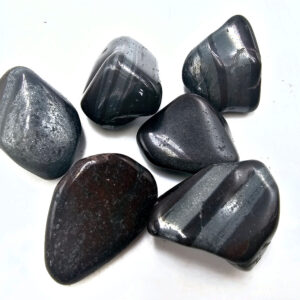
Its appeal comes from weight, metallic-looking areas, dark iron-rich tones and earthy red or brown patterning.
Some pieces can appear almost steel-grey or black, while others reveal more obvious red-brown sections once polished.
That contrast makes Ancestralite especially interesting in small tumble stones and irregular chip jewellery, where several parts of the material can be seen at once.
What Is Ancestralite?
Ancestralite is best understood as a crystal-trade name, rather than the name of a single formally defined mineral species.
Material sold under the name is commonly described as iron-rich rock containing hematite or martite-related material, often with reddish siliceous or iron-rich sections.
Because trade-name material can vary, it is better to describe the appearance and verified composition of a particular batch than to pretend every Ancestralite specimen everywhere has exactly the same mineral recipe.
That makes accurate supplier information especially useful for this category.
Why Does It Look Metallic?
Much of Ancestralite's distinctive appearance comes from iron-rich minerals.
Hematite can show metallic steel-grey or silvery surfaces when polished, while iron-rich earthy material can create deep red and brown tones.
That means one Ancestralite stone may look darker and more metallic while another shows more obvious earthy banding.
Polishing often makes those contrasts easier to see.
If you enjoy small polished stones where colour, pattern and weight can be appreciated in the hand, browse the wider Tumbled Stones collection.
Ancestralite and Hematite Are Related, But Not Identical Names
Ancestralite is often described in the crystal trade through its relationship with Hematite.
That does not mean the two names should simply be used interchangeably.
Hematite is a recognised iron oxide mineral.
Ancestralite is a trade name applied to a particular iron-rich stone or rock material sold within the crystal market.
That distinction matters for accurate product copy.
Rather than writing:
“Ancestralite is Hematite.”
a better description is:
“Ancestralite is a trade-name material commonly associated with iron-rich Hematite or Martite-bearing formations.”
This keeps the wording useful without making a stronger mineralogical claim than the material identification supports.
What Does Martite Mean?
You may see the word Martite in descriptions of Ancestralite.
Martite refers to Hematite that has replaced Magnetite while retaining the outward form of the earlier mineral.
This type of replacement is called a pseudomorph.
The word can sound complicated, but the basic idea is simple:
one mineral originally forms the structure, another mineral later replaces it, and part of the original form is preserved.
That is one reason iron-rich geological material can have such interesting internal textures and structures.
Ancient Banded Iron Associations
Ancestralite is frequently marketed in connection with very old iron-rich geological formations.
Banded iron formations are ancient sedimentary rocks characterised by repeated iron-rich and silica-rich layers.
That general geological association helps explain why Ancestralite is often described with words such as ancient, layered, iron-rich and earthy.
However, HIH should only give a precise age or named geological formation for an individual product when its source has actually been verified.
“Ancient-looking” and “associated with ancient iron-rich formations” are much safer than assigning every piece an unsupported age of several billion years.
Tumbled Ancestralite
HIH currently carries Ancestralite Tumble Stones.
Tumbling smooths the surface and rounds the edges, which can bring out metallic grey, deep red and darker colour contrasts more clearly.
A polished tumble is also a practical way to appreciate a dense iron-rich material without needing a large specimen.
Because natural patterning varies, one tumble may show mostly dark metallic areas while another has stronger reddish or mottled sections.
That is normal variation rather than a reason to expect every stone to match the product photograph exactly.
Ancestralite in Chip Jewellery
HIH also carries Ancestralite Stone Chip Bangles.
Chip jewellery is especially well suited to materials with varied patterning because each irregular piece can show a different section of the stone.
One chip may be darker.
Another may show more red-brown material.
Another may catch the light with a more metallic-looking surface.
If you enjoy that irregular style, compare it with the wider Gem Chips Bangles collection.
The result is less uniform than perfectly round beads, but that is part of the appeal.
Heavy Does Not Mean Fake
Iron-rich stones can feel surprisingly substantial for their size.
That density can be noticeable when you compare Ancestralite with lighter quartz-based material.
Weight alone, however, is not enough to identify a stone.
Colour, streak, mineral structure, magnetism and supplier provenance can all matter when distinguishing iron-rich materials.
That is particularly important with trade names because the commercial name itself does not function as a laboratory identification.
Ancestralite and Grounding Traditions
Within modern crystal traditions, Ancestralite is commonly associated with grounding, protection, ancestral connection, reflection and releasing patterns connected with the past.
Its name has naturally encouraged themes involving lineage, memory and ancestral work.
Some practitioners use it symbolically when reflecting on family patterns or personal history.
These are metaphysical traditions rather than scientifically demonstrated effects of the stone.
It is important to make that distinction especially clear with emotionally sensitive language.
Ancestralite should not be described as a treatment for trauma, traumatic memories or psychological conditions.
Why “Ancestral” Became Part of the Name
Unlike mineral names that come from chemistry, crystal structure or a formally recognised locality, Ancestralite's commercial name reflects the symbolism attached to it.
Its ancient-looking iron-rich character has made it a natural fit for themes of history, ancestry and the deep past.
That story can be interesting without turning the name into geological proof.
The word Ancestralite tells us how the material is marketed.
It does not by itself prove a particular age, mine or exact geological formation.
Choosing Ancestralite
Start with the form.
Choose a tumble stone if you want a compact polished piece that makes the material's weight and pattern easy to appreciate.
Choose chip jewellery if you prefer something wearable and enjoy seeing several irregular sections of the stone together.
Then look at the individual pattern.
Some pieces are darker and more metallic.
Some reveal more red or brown.
Some show stronger contrast between the two.
There is no need for every Ancestralite piece to have identical banding.
Caring for Ancestralite
Because material sold as Ancestralite is iron-rich, gentle dry care is a sensible default.
Use a soft cloth for ordinary cleaning.
Avoid prolonged soaking unless the exact mineral composition of the piece is known.
Keep jewellery away from harsh household chemicals and dry it after accidental contact with moisture.
For chip bracelets, also remember that the elastic or stringing material may require more care than the stone itself.
Frequently Asked Questions
Is Ancestralite a recognised mineral species?
Ancestralite is best treated as a crystal-trade name rather than the name of one formally defined mineral species.
Is Ancestralite the same as Hematite?
Not exactly. Ancestralite is commonly associated with Hematite or Martite-bearing iron-rich material, while Hematite itself is a recognised iron oxide mineral.
Why is Ancestralite red and metallic grey?
Its appearance is commonly linked with iron-rich minerals and contrasting red or siliceous material. The exact pattern can vary between pieces.
What is Martite?
Martite is Hematite that has replaced Magnetite while preserving its earlier outward form, a mineral replacement structure known as a pseudomorph.
What is Ancestralite traditionally associated with?
Within crystal traditions, Ancestralite is commonly associated with grounding, protection, reflection, ancestral connection and symbolically releasing patterns from the past.