
Aquamarine
From misty sea-blue to clearer blue-green tones, Aquamarine is the beautiful blue variety of the beryl mineral family and the traditional birthstone for March. Browse rough Aquamarine alongside earrings, bangles and other wearable pieces, chosen for their ocean-inspired colour and traditional associations with calm, courage and clear communication.
Showing all 7 resultsSorted by latest

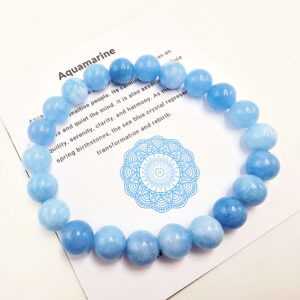
Aquamarine: The Blue Member of the Beryl Family
Aquamarine belongs to the beryl mineral family — the same mineral family that includes Emerald.
What makes Aquamarine distinctive is its beautiful blue to blue-green colouring, which can range from very pale watery shades to stronger blues. Some pieces are transparent and gem-like, while others are cloudier, more included or almost icy in appearance.
That difference is worth knowing when shopping for Aquamarine because the highly transparent blue gems seen in fine jewellery aren't the only way this mineral occurs.
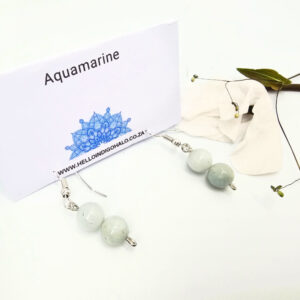
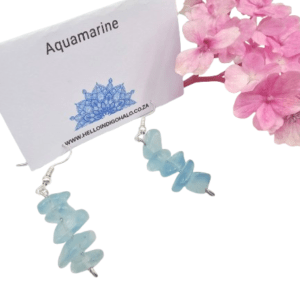
The Aquamarine currently at Hello Indigo Halo includes rough material as well as earrings, bangles and other wearable designs.
Browse our Crystal Names collection if you'd like to compare Aquamarine with the wider range of gemstones and minerals available at HIH.
A Gemstone Named After the Sea
Aquamarine's name comes from Latin words associated with sea water, an easy connection to understand when you see its blue-green colouring.
Its watery appearance has helped shape much of the symbolism surrounding the stone.
Aquamarine became traditionally associated with the sea and with sailors, who carried or valued it as a protective talisman for journeys over water. Over time, ideas of safe passage, courage and protection became intertwined with the stone's identity.
Today, its ocean-like colouring remains one of the simplest reasons people fall in love with it — whether or not they attach any spiritual meaning to the stone.
Why Aquamarine Doesn't Always Look Bright Blue
One of the most useful things to know before choosing Aquamarine is that natural colour varies considerably.
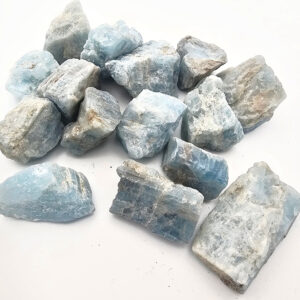
Some pieces can be a recognisable pale blue. Others lean blue-green, grey-blue or almost colourless, particularly in rough and heavily included material.
Clarity varies too.
Fine transparent Aquamarine is highly prized for faceted gemstone jewellery, but crystal collectors may encounter pieces containing visible inclusions, cloudy areas, internal fractures and irregular colour.
These characteristics don't automatically make a piece poor-quality or inauthentic. Rough mineral specimens and crystal jewellery are simply being chosen for different reasons from precision-cut transparent gemstones.
Photographs, dimensions and individual product descriptions are therefore more useful than expecting every Aquamarine stone to match one ideal shade of ocean blue.
March's Birthstone
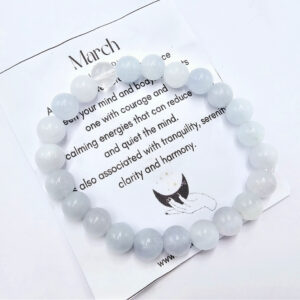
Aquamarine is the traditional modern birthstone for March, making Aquamarine jewellery particularly meaningful as a birthday gift.
HIH's current collection includes a dedicated March Birthstone Aquamarine bangle alongside other Aquamarine bracelets and earrings.
Birthstone jewellery doesn't have to be reserved for birthdays, though. Some customers choose their own birthstone, while others select the stone connected with a partner, child, friend or another important person.
That gives Aquamarine jewellery two different kinds of appeal: the beauty of the gemstone itself and the personal symbolism attached to the month of March.
Aquamarine Jewellery: From Rough to Polished
The current HIH Aquamarine assortment is particularly strong in jewellery.
Smooth beads create a softer, more uniform appearance, while chips and rough pieces preserve more of the irregular shape and natural variation of the mineral.
That means two Aquamarine bangles can feel surprisingly different even when they're made from the same stone.
A polished bead bracelet puts colour and repetition centre stage.
A chip bracelet looks more organic.
A rough-stone design celebrates uneven surfaces and variation.
And earrings allow Aquamarine's pale blue tones to become a smaller, easy-to-wear accent.
Browse our Bangles & Bracelets collection if you'd like to compare Aquamarine with the many other gemstone bracelet styles available at HIH.
Aquamarine in Crystal Traditions
Aquamarine's connection with water has carried strongly into its modern metaphysical identity.
Within crystal traditions, it is commonly associated with calm, courage, clarity, emotional balance and peaceful communication.
It is also frequently connected with the Throat Chakra, where it is used symbolically around honest expression, speaking clearly and communicating with confidence.
Some people choose Aquamarine during meditation or periods when they want to bring a calmer, more flowing quality to their thoughts and communication. Others simply wear it because those meanings resonate with them.
Our Chakra Balance collection offers another way to explore crystals, jewellery and spiritual tools associated with different chakra traditions.
Aquamarine Can Occur Beside Other Minerals
Aquamarine can become particularly interesting when it is encountered as part of a natural mineral specimen rather than an isolated polished stone.
The HIH collection has included Aquamarine associated with minerals such as Black Tourmaline, feldspar and quartz. These specimens show something jewellery can sometimes hide: crystals develop within geological environments alongside other minerals.
If that more natural side of collecting interests you, explore our Selected Crystals – Rough collection for individually selected mineral specimens and unusual natural formations.
Choosing Aquamarine
With Aquamarine, start with the feature you actually care about.
If colour matters most, look closely at whether you prefer pale watery blue, blue-green or a slightly greyer tone.
If natural character appeals to you, rough pieces, chips and included material may be more interesting than perfectly uniform beads.
If you're buying for March, a birthstone design makes the symbolism immediately recognisable.
If you want something to wear regularly, consider the jewellery style as much as the stone itself.
And if you're choosing Aquamarine for its metaphysical meaning, select the piece you're naturally drawn to rather than assuming that a darker or clearer specimen somehow carries “more” of its traditional energy.
Caring for Aquamarine
Aquamarine is a relatively hard gemstone, measuring around 7.5–8 on the Mohs hardness scale, but that doesn't make every piece indestructible.
Rough material and stones with natural fractures or inclusions may have more vulnerable areas than a flawless faceted gem.
Avoid hard knocks and sudden temperature changes, and take the construction of jewellery into account when cleaning it. Elastic, wire, metal components and adhesives may require more caution than the Aquamarine itself.
For routine care, gentle cleaning is preferable to harsh chemicals or abrasive methods.
Frequently Asked Questions
Is Aquamarine the same mineral as Emerald?
They are different gemstones but belong to the same mineral family. Both are varieties of beryl: Aquamarine is known for blue to blue-green colouring, while Emerald is the famous green variety.
Does pale Aquamarine mean the stone is fake?
No. Natural Aquamarine can be extremely pale, and some material may appear almost colourless depending on its thickness, lighting and mineral characteristics. Colour intensity alone isn't an authenticity test.
Is Aquamarine only for people born in March?
Not at all. March gives Aquamarine an additional birthstone meaning, but anyone can wear or collect it for its colour, mineralogy or metaphysical associations.
Why do some Aquamarine stones have cracks or cloudy areas?
Natural inclusions, internal fractures and variations in clarity can occur as the crystal forms. These characteristics are particularly visible in rough and less heavily processed material and don't automatically indicate damage or poor authenticity.