
Black Moonstone
Dark charcoal tones, subtle markings and flashes that appear as the stone moves give Black Moonstone its wonderfully moody character. This trade-named feldspar is especially popular within crystal traditions for its associations with intuition, new beginnings, shadow work and the cycles of the moon. Turn it in the light and look for the unexpected.
Showing the single result
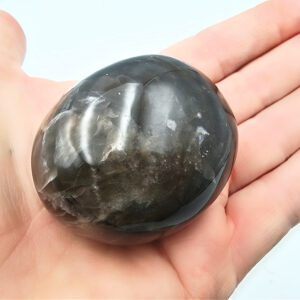
Black Moonstone: A Darker Side of the Feldspar Family
Black Moonstone has the kind of appearance that rewards movement.
At first it can look charcoal, smoky grey, brown-black or almost completely dark. Turn it towards the light and lighter markings, silvery areas or flashes can suddenly become visible.
It belongs to the feldspar family, the same enormous mineral family that gives us Moonstone, Labradorite, Sunstone and several other familiar gemstones.
The name Black Moonstone is used commercially for dark feldspar material rather than one precisely defined mineral variety, so individual material sold under the name can differ in its exact feldspar composition and optical character.
That's part of why two pieces labelled Black Moonstone can look surprisingly different.
For other stones organised by name, browse our Crystal Names A–Z.
Why Does Black Moonstone Flash?
Feldspar is particularly good at playing with light.
Very fine internal structures within feldspar can interact with incoming light and produce the shifting sheen associated with different members of this mineral family.
Traditional Moonstone is famous for adularescence — the soft, floating glow that seems to move beneath the surface as the stone turns.
Labradorite is known for labradorescence, which can produce much stronger flashes of blue, green, gold and other colours.
Material sold as Black Moonstone doesn't always fit neatly into one optical box. Some pieces have a softer silvery sheen, while others can appear more reminiscent of dark Labradorite.
The easiest approach is to look at the individual stone rather than expecting every Black Moonstone to perform exactly the same way.
Black Moonstone and Moonstone Aren't Quite the Same Thing
The names make them sound like simple colour variations.
The mineral trade is messier than that.
Classic Moonstone is a feldspar valued for its characteristic floating adularescence. Black Moonstone is a commercial name applied to dark feldspar material, and the precise mineralogical identity of material sold under that name can vary.
They are related through the feldspar family, but we shouldn't assume that every Black Moonstone is simply ordinary white Moonstone coloured black.
Visually, the difference is often obvious too. Classic Moonstone can be pale, translucent and softly glowing. Black Moonstone has a darker, earthier character, with its lighter flashes and markings emerging against grey, charcoal and near-black backgrounds.
Compare it with our wider Moonstone collection to see how varied the feldspar family can be.
A Stone Closely Connected With the Moon
This is where Black Moonstone's modern crystal story becomes particularly appealing.
Moonstone has been surrounded by lunar symbolism for centuries, and Black Moonstone has developed its own place within contemporary crystal traditions.
It is commonly associated with the New Moon — the dark phase of the lunar cycle when the Moon is positioned between Earth and the Sun and its illuminated side faces away from us.
Within modern spiritual practice, the New Moon is often treated symbolically as a point of beginnings, intention, possibility and the start of another cycle.
Black Moonstone fits beautifully into that symbolism.
Some people work with it when setting intentions for a new lunar cycle, beginning something unfamiliar or moving through a period of personal change.
These are spiritual and symbolic traditions rather than scientific properties of the mineral, but they have become an important part of why Black Moonstone is so popular.
Black Moonstone Meaning
Within crystal traditions, Black Moonstone is associated with intuition, emotional grounding, new beginnings and inner reflection.
It is also frequently connected with the subconscious and the parts of ourselves that aren't always immediately visible.
That connection has made Black Moonstone particularly popular for shadow work.
In modern spiritual practice, shadow work generally refers to intentionally exploring hidden, uncomfortable or less acknowledged aspects of ourselves — patterns, emotions, fears or reactions that may be easier to avoid than examine.
Black Moonstone doesn't do that work for you.
Instead, some crystal practitioners use it symbolically during journalling, meditation or reflection when exploring those deeper parts of themselves.
Its combination of dark colouring and lunar associations makes the connection easy to understand.
The Dark Moon, Intuition and the Feminine
Black Moonstone also carries many of the broader symbolic associations traditionally attached to Moonstone.
Across different crystal and spiritual traditions, Moonstone has long been linked with intuition, lunar cycles and feminine energy.
Black Moonstone takes those associations into slightly darker territory.
Rather than the bright Full Moon, it is commonly connected with the New Moon and the unseen — the quiet period before something begins to emerge.
Some contemporary practitioners therefore choose it for periods of transition, inner work and times when the next step isn't completely clear yet.
You don't need to follow lunar practice to appreciate the stone, but understanding this symbolism explains a great deal about its popularity in modern crystal culture.
Black Moonstone or Labradorite?
Put certain pieces beside each other and the question becomes understandable.
Both belong to the feldspar family. Both can have dark body colour. Both can reveal flashes as they move through the light.
But Labradorite is particularly famous for labradorescence — often dramatic flashes of blue, green, gold, orange or combinations of colour.
Black Moonstone is generally sold for its darker appearance and more subdued silvery or pale flashes, although trade naming isn't perfectly consistent.
If dramatic colour-changing feldspar is what attracts you, it's worth comparing the two.
Browse our Labradorite collection to see just how theatrical feldspar can become.
Choosing Black Moonstone
Don't choose only according to how black the stone looks.
Look for what happens when it moves.
Turn it slowly beneath the light and watch for silver flashes, pale areas, subtle banding, smoky tones and changes across the surface.
One piece may be relatively quiet and dark.
Another might reveal strong pale markings.
Neither needs to look like the other.
If you're drawn to Black Moonstone for its metaphysical associations, you may simply find that one particular piece catches your attention more than the rest.
That's as good a way to choose as any.
Caring for Black Moonstone
Feldspar is reasonably durable for ordinary handling, but it isn't as hard as Quartz and can be scratched or chipped.
Avoid hard knocks, abrasive cleaning and harsh household chemicals.
For polished pieces, a soft cloth and gentle handling are usually all that's required for everyday care.
If you carry a stone with you, avoid keeping it loose beside harder crystals or objects that may scratch its polished surface.
Frequently Asked Questions
Is Black Moonstone a natural stone?
Yes. Material sold as Black Moonstone is natural feldspar, although Black Moonstone is a trade name rather than one precisely defined mineral species.
Why is Black Moonstone associated with the New Moon?
Within modern crystal and lunar traditions, its dark appearance has led to a strong symbolic connection with the New Moon. That phase is commonly associated with beginnings, intention-setting, inward reflection and the start of a new cycle.
What is shadow work and why is Black Moonstone used for it?
Shadow work is a modern term for intentionally exploring less acknowledged thoughts, emotions and behavioural patterns. Some crystal practitioners use Black Moonstone during journalling, meditation and reflection because of its traditional associations with intuition, the subconscious and inner exploration.
Does every Black Moonstone have a flash?
The appearance can vary considerably. Some pieces show noticeable silvery or pale flashes, while others are more subdued. Viewing a stone from different angles and under changing light can reveal features that aren't immediately visible.