
Blue Howlite
Bright turquoise-blue colour crossed with dark, web-like veining gives Blue Howlite its instantly recognisable look. The blue colour is created by dyeing naturally pale Howlite, a treatment that transforms its appearance while preserving the stone’s characteristic patterning. Within crystal traditions, Howlite is associated with calm, patience and thoughtful communication.
Showing all 5 resultsSorted by latest
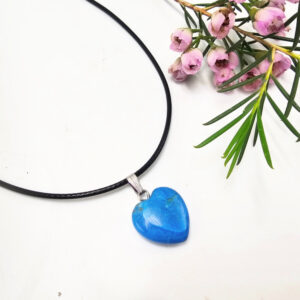
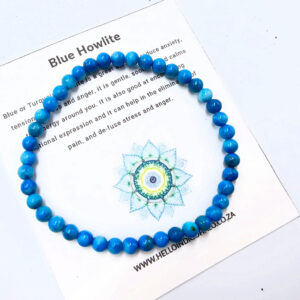
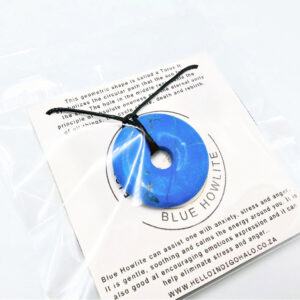
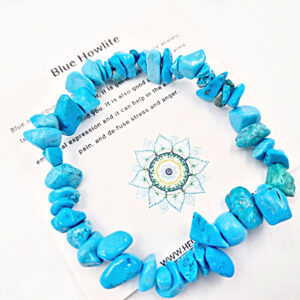
Blue Howlite: Natural Stone, Brilliant Blue Treatment
Blue Howlite doesn't naturally grow in that vivid turquoise-blue colour.
Natural Howlite is typically white to creamy white, often crossed by grey or dark vein-like markings. Because the material is porous, it accepts colour particularly well and has long been dyed in bright blues, greens and other shades for beads, tumble stones, carvings and jewellery.
The result is Blue Howlite: a treated stone with bold colour and the distinctive web-like patterning people associate with Howlite.
So the stone and its pattern are natural; the blue colour is created through treatment.
That's useful information rather than something that needs to be hidden.
For other stones arranged by name, browse our Crystal Names A–Z.
Why Is Howlite Dyed Blue?
There's a historical reason blue became such a popular choice.
White Howlite can have dark matrix-like veining that resembles the patterning seen in some Turquoise. Once dyed blue, that resemblance becomes much stronger.
For decades, dyed Howlite has therefore been used in the lapidary and jewellery trade as an inexpensive Turquoise lookalike.
You'll sometimes encounter names such as Turquenite, Turquoise Howlite or Blue Howlite for this type of treated material.
That history has occasionally caused confusion when dyed Howlite has been presented as genuine Turquoise.
We prefer the straightforward approach.
If it's sold as Blue Howlite, enjoy it as Blue Howlite.
It doesn't need to pretend to be Turquoise.
The Pattern Is Part of the Appeal
Blue Howlite isn't interesting because it's perfectly blue.
Look closely and you'll usually see contrasting veins, lines and irregular markings running through the material.
Dye can emphasise that pattern dramatically.
Some pieces have broad dark lines. Others develop a finer web-like effect, and the intensity of the blue can vary between pieces and batches.
That combination of bright colour and unpredictable pattern is why Blue Howlite works particularly well in polished forms and jewellery.
Even small beads can show plenty of character.
Is Blue Howlite Really Howlite?
Usually, that's what the trade name is intended to mean — dyed Howlite.
But the modern crystal trade has an identification complication.
Howlite and Magnesite can look remarkably similar in their massive white forms. Both are relatively soft, porous materials that can be cut, polished and dyed easily.
As supplies of traditional lapidary Howlite became more limited, dyed Magnesite became increasingly common in the decorative-stone trade and is sometimes sold under Howlite-related names.
Without testing the actual material, visual appearance alone isn't always enough to distinguish the two.
For that reason, HIH shouldn't make highly specific mineralogical claims about an individual Blue Howlite product unless its material has been reliably verified.
The important customer-facing point remains simple: the vivid blue is a treatment, not Howlite's natural colour.
Blue Howlite Meaning
Within modern crystal traditions, Howlite is strongly associated with calm, patience, reflection and emotional awareness.
It is often chosen during periods when someone wants to slow down before reacting, think more clearly about what they're feeling or approach communication with a little more patience.
Blue Howlite has also developed additional associations because of its colour.
Within chakra traditions, blue stones are commonly connected with the Throat Chakra, giving Blue Howlite associations with communication, expression and speaking thoughtfully.
Some practitioners therefore see its symbolism as an interesting combination:
calm first, communicate second.
These are metaphysical traditions rather than scientifically demonstrated effects, but they're an important part of Blue Howlite's popularity in the crystal world.
A Colour Made for the Throat Chakra
Colour plays a significant role in modern chakra crystal traditions.
The Throat Chakra is conventionally represented by blue, so Blue Howlite is frequently chosen for meditation, jewellery and crystal practices centred around communication and self-expression.
What's interesting is that this association comes from the stone's treated colour.
Natural white Howlite is generally given somewhat different chakra associations, while dyeing it blue has allowed the material to develop another metaphysical identity within contemporary crystal culture.
That doesn't make the tradition invalid.
It simply makes it modern.
If you enjoy choosing stones through chakra symbolism, browse our Chakra Balance collection.
Blue Howlite or Turquoise?
They may look similar, but they're not the same material.
Turquoise is a naturally occurring copper aluminium phosphate mineral whose famous blue-to-green colour forms naturally.
Blue Howlite gets its blue colour from dye.
The dark patterning can make the resemblance surprisingly convincing, particularly in polished beads and tumble stones, which is precisely why dyed Howlite became such a popular Turquoise substitute.
Neither needs to be judged by pretending they're interchangeable.
Natural Turquoise has its own mineralogical identity and history.
Blue Howlite gives you the vivid blue-and-black appearance at a much more accessible level and has developed its own place within jewellery and crystal culture.
Choosing Blue Howlite
Start with the pattern.
If you like dramatic contrast, look for pieces where the darker veining travels strongly through the blue.
If colour is more important, you may prefer an especially vivid turquoise-blue piece.
Natural variation in the underlying material combined with differences in dye uptake means pieces won't necessarily be perfectly identical.
That's especially noticeable in beads, chips and tumble stones, where several pieces can show different concentrations of colour and veining beside one another.
Caring for Dyed Howlite
The treatment matters when it comes to care.
Avoid harsh chemicals, abrasive cleaners and prolonged soaking, as these may affect treated stone or its finish.
For jewellery, it's sensible to remove Blue Howlite before swimming, showering or using household cleaning products.
A soft dry or slightly damp cloth is usually enough for ordinary cleaning.
And because Howlite itself is a relatively soft mineral, protect polished pieces from hard knocks and from rubbing repeatedly against harder stones.
Frequently Asked Questions
Is Blue Howlite naturally blue?
No. Natural Howlite is generally white or creamy white with grey or darker veining. Blue Howlite is dyed to produce its vivid blue or turquoise-like colour.
Is Blue Howlite the same as Turquoise?
No. Turquoise is a different naturally occurring mineral. Dyed Howlite has historically been used as a Turquoise lookalike because its dark veining can create a similar appearance once the stone is coloured blue.
Does dyeing Howlite change its crystal meaning?
There isn't one universal rule within crystal traditions. Many practitioners retain Howlite's traditional associations with calm and patience while also connecting Blue Howlite with communication and the Throat Chakra because of its blue colour.
Why do different Blue Howlite pieces look different?
The natural veining varies from piece to piece, and porous material can also absorb dye somewhat differently. This creates variations in blue intensity, pattern and contrast.