
Blue Tigers Eye
Deep blue-grey bands and a silky flash give Blue Tigers Eye its unmistakable character. Also widely known as Hawk’s Eye, this chatoyant quartz material can shift from steel blue and slate to darker tones as it moves through the light. Within crystal traditions, Blue Tigers Eye is commonly associated with focus, perspective, confidence, calm thinking and grounded awareness.
Showing all 3 resultsSorted by latest
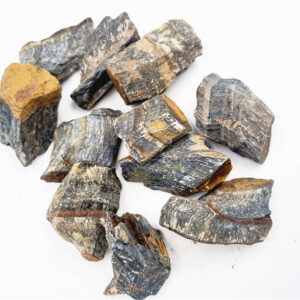
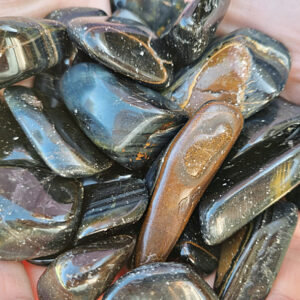
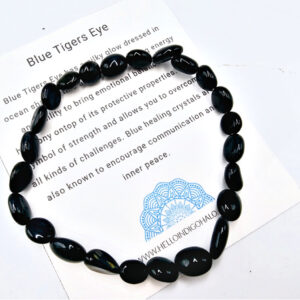
Blue Tigers Eye Is a Stone That Likes to Move
Blue Tigers Eye can look relatively dark and quiet until the light catches it.
Then a silky band appears to travel across the surface.
That shifting optical effect is known as chatoyancy, and it is one of the defining characteristics of the Tiger's Eye family.
Polishing makes the effect particularly easy to see, which is why Blue Tigers Eye can look dramatically different as a stone, bead or piece of jewellery is turned in the hand.
What Is Blue Tigers Eye?
Blue Tigers Eye is the blue to blue-grey member of the chatoyant quartz material commonly associated with Tiger's Eye.
It is also widely known as:
Hawk's Eye
and, less consistently depending on region:
Falcon's Eye
The familiar golden-brown Tiger's Eye and its blue counterpart are closely related materials.
The difference in colour is connected with the degree of alteration and oxidation that occurred during the material's geological history.
Why Does Blue Tigers Eye Have a Silky Flash?
The most interesting feature of Blue Tigers Eye is not simply its colour.
It is the moving band of reflected light.
Fine parallel structures within the quartz-rich material interact with light to produce the silky optical effect called chatoyancy.
That is why a polished piece should be judged from more than one angle.
A stone that looks almost charcoal from one direction can suddenly reveal a blue or silvery band when tilted towards the light.
Blue Tigers Eye and Hawk's Eye
If you encounter the name Hawk's Eye, you are not necessarily looking at a different crystal.
Hawk's Eye is a widely used name for the blue material.
Blue Tiger's Eye is especially useful in a retail setting because it immediately tells shoppers that the stone belongs to the broader Tiger's Eye family while distinguishing it from the familiar golden-brown variety.
For a wider selection of the classic golden-brown material, browse Tigers Eye.
Blue Tigers Eye Versus Golden Tigers Eye
The easiest difference to notice is colour.
Classic Tiger's Eye is famous for golden, honey and brown bands.
Blue Tigers Eye leans towards navy, slate, steel blue, blue-grey and darker tones.
Both can display the characteristic silky movement of light.
That means they can look quite different on a product page while still belonging to the same broader material story.
For HIH taxonomy, keeping them as separate colour categories makes sense because a shopper deliberately looking for a blue stone may have very different intent from someone searching for traditional golden Tiger's Eye.
Choosing Blue Tigers Eye
Look at three things:
Colour, chatoyancy and pattern.
Some pieces may show an obvious blue flash.
Others can be much darker and reveal their colour mainly when moved under light.
The bands may be narrow and precise or broader and more blended.
If you're choosing jewellery or polished stones, look closely at the photographs and remember that lighting angle can strongly influence how the chatoyancy appears.
Natural variation is part of what makes this material interesting.
For other stones organised by their mineral and trade names, browse the Crystal Names collection.
Is Blue Tigers Eye Naturally Blue?
Natural blue Tiger's Eye material does exist.
However, colour treatments are also possible within the wider gemstone trade.
For HIH product descriptions, do not automatically label a piece natural untreated Blue Tigers Eye unless the supplier information supports that statement.
Likewise, there is no need to assume a stone has been treated simply because the blue is strong.
When treatment status is unknown, describe what can actually be seen:
blue-grey colour, silky bands and chatoyant movement.
That is accurate without making an unsupported treatment claim.
Blue Tigers Eye in Crystal Traditions
Within crystal traditions, Blue Tigers Eye is commonly associated with focus, perspective, confidence, calm thinking and grounded awareness.
Its blue colouring also gives it symbolic connections with communication and thoughtful self-expression in modern metaphysical practice.
These are traditional spiritual associations rather than scientifically demonstrated effects of quartz.
Its unusual optical character gives the stone plenty of appeal even without metaphysical interpretation.
Caring for Blue Tigers Eye
Blue Tigers Eye is quartz-rich material and is reasonably durable for normal handling, but polished surfaces can still become scratched or chipped through careless storage.
Use a soft cloth for routine cleaning.
Avoid harsh household chemicals and unnecessary abrasive scrubbing.
With jewellery, remember that elastic, cord, metal settings and adhesives may require gentler treatment than the stone itself.
Frequently Asked Questions
Is Blue Tigers Eye the same as Hawk's Eye?
Yes. Hawk's Eye is a widely used alternative name for the blue form of Tiger's Eye material.
Why does Blue Tigers Eye seem to move in the light?
Its fine parallel internal structure produces a silky optical effect called chatoyancy, causing a band of reflected light to appear to move as the stone is turned.
Is Blue Tigers Eye the same as regular Tigers Eye?
They are closely related materials. Blue Tigers Eye retains blue to blue-grey colouring, while familiar Tiger's Eye typically displays golden-brown tones.
Is all Blue Tigers Eye treated?
No. Naturally blue material exists. Treatment is also possible in the gem trade, so individual treatment status should follow reliable supplier information rather than assumption.
What is Blue Tigers Eye traditionally associated with?
Within crystal traditions, Blue Tigers Eye is commonly associated with focus, perspective, confidence, calm thinking and grounded awareness.