
Bumblebee Jasper
Bold yellow, orange and black bands give Bumble Bee Jasper its unmistakable bee-like appearance. Despite the name, it isn’t actually a true Jasper but an unusual carbonate-rich material found in a volcanic region of West Java, Indonesia. Within crystal traditions, Bumblebee Jasper is associated with confidence, motivation, creativity and having the courage to move forward.
Showing all 5 resultsSorted by latest
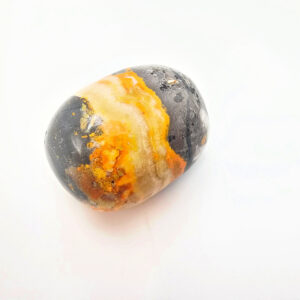
Bumble Bee Jasper: The “Jasper” That Isn't Really Jasper
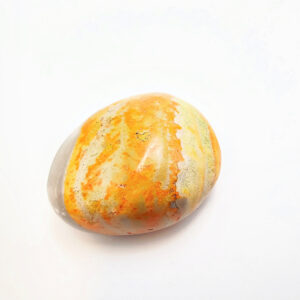
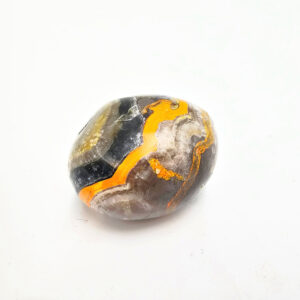
With bands of yellow, orange, cream, grey and black, Bumble Bee Jasper has one of the most recognisable colour combinations in the crystal world.
Its patterns can look remarkably like the markings of a bumblebee — hence the name.
But the second half of that name is misleading.
Despite being sold as Jasper, Bumblebee Jasper isn't a conventional Jasper at all. True Jasper is a silica-rich material closely related to Chalcedony, whereas Bumblebee Jasper is a carbonate-rich rock containing several different mineral components.
That unusual composition, dramatic colour and Indonesian origin give it an identity completely separate from ordinary Jasper.
Browse our Crystal Names A–Z to discover more unusual stones by name.
Where Does Bumblebee Jasper Come From?
Bumblebee Jasper is associated with West Java, Indonesia, where the material is mined in the Kuningan area on the lower slopes of the Mt Ciremai volcanic region. Its surroundings are an important part of its geological story.
Rather than forming as an ordinary Jasper deposit, the material developed in an environment influenced by volcanic and hydrothermal activity. That helps explain why its composition and appearance are so unusual.
The vivid layers can move through bright yellow and orange into cream, grey and almost black, sometimes creating sweeping bands and sometimes much more irregular patterns.
It's a stone that looks dramatic before you know anything about it — and considerably stranger once you do.
What Makes Bumblebee Jasper Yellow and Orange?
Those extraordinary colours aren't dye.
Research into material from West Java has identified a carbonate-rich rock, with Calcite making up an important part of the material and arsenic sulphide minerals such as Realgar occurring within it.
Different mineral components contribute to the contrasting bands and patches that give Bumblebee Jasper its characteristic appearance.
This is also why we shouldn't describe every yellow section simply as “sulphur”.
You'll often see Bumblebee Jasper described online as a mixture of volcanic lava and sulphur, but its actual mineralogy is more complicated than that.
The colourful pattern comes from multiple mineral components formed within an unusual geological environment.
Why Is It Called Jasper If It Isn't Jasper?
Crystal and gemstone names aren't always written by mineralogists.
Trade names often develop because of appearance, tradition or simply because a name becomes popular with buyers.
“Bumblebee Jasper” stuck.
It's memorable, it describes the colouring beautifully and it's now the name most people recognise when they see the material.
That doesn't mean HIH needs to rename it.
Instead, we can use the established Bumblebee Jasper name while explaining what the material actually is. In fact, knowing that it's the Jasper that isn't really Jasper makes it considerably more interesting.
Bumblebee Jasper Meaning: Confidence With Momentum
Within modern crystal traditions, Bumblebee Jasper is strongly associated with confidence, motivation, courage, creativity and taking action.
It's not generally treated as a quiet, retreat-from-the-world sort of stone.
Its symbolism is much more about getting moving.
Some practitioners choose Bumblebee Jasper when beginning something unfamiliar, pursuing an ambitious idea or trying to move beyond hesitation and self-doubt.
Its bold yellow colouring has also encouraged associations with optimism, enthusiasm and personal power.
These are metaphysical traditions rather than scientifically established effects, but they've become a major part of Bumblebee Jasper's popularity.
The Solar Plexus Connection
It's hardly surprising that a stone this yellow became associated with the Solar Plexus Chakra.
Within chakra traditions, the Solar Plexus is represented by yellow and connected symbolically with confidence, willpower, personal identity and the ability to act.
Bumblebee Jasper's traditional associations fit that symbolism particularly well.
Some practitioners use it during meditation, intention-setting or periods when they want to stop endlessly considering an idea and finally do something with it.
For crystals and spiritual tools organised around chakra traditions, browse our Chakra Balance collection.
A Stone With a Very Appropriate Symbol
The bumblebee connection doesn't have to stop at colour.
Within modern symbolism, bees are frequently associated with industry, determination, community, productivity and making something happen.
That makes an interesting companion story for a crystal already associated with motivation and action.
Some people also enjoy the apparent contradiction embodied by the bumblebee itself: a relatively chunky little insect somehow capable of surprisingly agile flight.
You don't need to treat any of this as an ancient crystal tradition.
It's modern symbolism — but it's easy to understand why Bumblebee Jasper has become associated with doing the thing you weren't entirely sure you could do.
Every Pattern Is Different
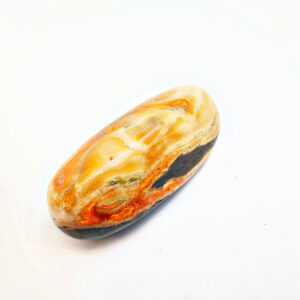
Bumblebee Jasper can be spectacular when polished because the pattern runs through the material.
One piece may have broad yellow and black bands.
Another may be dominated by orange, cream or grey.
Some pieces show dramatic sweeping lines, while others have smaller patches and more complicated patterns.
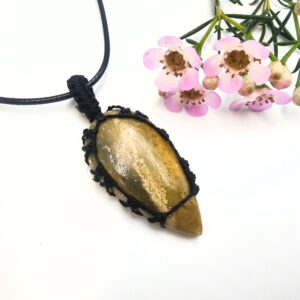
That variation makes larger polished pieces particularly interesting, but it also works beautifully in jewellery.
A cabochon can capture an entire miniature landscape of colour in a very small space.
For more stones transformed into wearable pieces, browse our Gem & Crystal Necklaces.
Choosing Bumblebee Jasper
Start with the pattern rather than trying to find the “best” colour.
If the classic bumblebee appearance attracts you, look for strong yellow-and-black contrast.
If you prefer something warmer, orange-rich pieces can be spectacular.
Cream, grey and darker sections can also make the brighter colours stand out much more dramatically.
With larger polished pieces, look at several sides if possible. A pattern that seems relatively simple from one direction can become completely different when the stone turns.
And if you're choosing according to crystal traditions, confidence, motivation, courage and forward movement are the associations most strongly connected with Bumblebee Jasper.
Caring for Bumblebee Jasper
Bumblebee Jasper deserves more thoughtful handling than ordinary Jasper.
Because it is a relatively soft, carbonate-rich material containing several mineral components, avoid harsh chemicals, acids, abrasive cleaners and prolonged soaking.
Use a soft cloth for ordinary cleaning and protect polished pieces from hard knocks and scratches.
There is another practical consideration: Bumblebee Jasper can contain arsenic-bearing minerals such as Realgar.
A finished polished piece can be handled normally, but don't grind, drill, sand or create dust from Bumblebee Jasper without appropriate lapidary knowledge and safety precautions. Wash your hands after extensive handling, particularly before eating.
This is especially relevant if you're buying rough material for cutting rather than simply enjoying a finished polished stone or piece of jewellery.
Frequently Asked Questions
Is Bumblebee Jasper actually Jasper?
No. Despite its established trade name, Bumblebee Jasper isn't a conventional silica-rich Jasper. It is a carbonate-rich material containing several mineral components and is associated with a volcanic region of West Java, Indonesia.
Is Bumblebee Jasper naturally yellow?
Yes. Its yellow, orange and dark patterning comes from the mineral components within the natural material rather than being created with blue, yellow or orange dye.
Why does Bumblebee Jasper look like a bee?
Its characteristic combination of bright yellow or orange with dark grey and black bands can closely resemble bumblebee markings. That striking colour combination gave the material its popular trade name.
What is Bumblebee Jasper traditionally associated with?
Within modern crystal traditions, Bumblebee Jasper is associated with confidence, motivation, creativity, courage and taking action. Its strong yellow colouring also connects it with Solar Plexus Chakra traditions.
Is Bumblebee Jasper safe to handle?
Finished polished Bumblebee Jasper can be handled normally, but the material may contain arsenic-bearing minerals such as Realgar. Avoid creating or inhaling dust by cutting, grinding or sanding it without appropriate lapidary safety measures, and washing your hands after extensive handling is a sensible precaution.