
Celestite
Pale blue crystals, glassy faces and delicate natural formations give Celestite its unmistakably airy appearance. Also mineralogically known as Celestine, this strontium sulfate mineral can range from soft sky blue to almost colourless tones. Within crystal traditions, Celestite is commonly associated with peaceful reflection, communication, spiritual awareness, meditation and a sense of calm.
Showing the single result
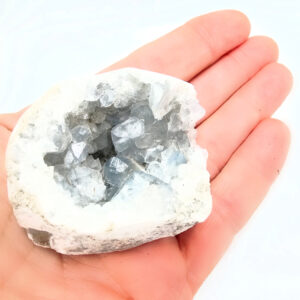
Celestite Looks Almost Like Its Name
There is something wonderfully fitting about Celestite.
Its pale blue crystals can look like fragments of sky caught inside a mineral cluster, which is particularly appropriate considering that its name was inspired by a word meaning celestial.
But Celestite is more than simply another blue crystal.
It has its own mineral chemistry, crystal structure and surprisingly delicate physical character.
What Is Celestite?
Celestite is the widely used commercial and collecting name for the mineral Celestine.
Its chemical formula is:
SrSO₄
That makes it a strontium sulfate mineral.
Celestite commonly forms transparent to translucent crystals with a glassy or sometimes pearly lustre.
Although pale blue is the colour most strongly associated with it, natural Celestite can also be colourless, white, greyish and occasionally show other subtle shades.
Celestite or Celestine?
You may see both names.
Celestine is the accepted mineral name.
Celestite is a recognised synonym and is especially common in crystal shops, collector terminology and everyday search language.
For Hello Indigo Halo, keeping Celestite as the main category name makes sense because it matches the established customer search term and your existing keyword structure.
The educational copy can simply explain that the two names refer to the same mineral.
Why Is Celestite Often Pale Blue?
The classic Celestite appearance is a soft, cool blue that may range from barely tinted to more noticeable sky-blue tones.
Colour can vary naturally between specimens and even across different areas of the same cluster.
That means a Celestite piece does not need to be intensely blue to be genuine or interesting.
Some of the most attractive specimens combine clear or almost colourless crystal faces with gentle patches of blue.
When shopping online, judge each piece by its actual crystal formation, colour, transparency and overall character rather than expecting every Celestite specimen to match one standard shade.
Celestite Clusters and Natural Crystal Formations
Celestite is especially attractive when its individual crystals grow together into clusters or line cavities in the host material.
Those formations create lots of crystal faces at different angles, allowing the surface to catch and reflect light as the piece is moved.
A cluster may contain small tightly packed crystals, larger individual points or a combination of both.
Natural edges, matrix, fractures and uneven areas are part of a mineral specimen rather than defects that every piece needs to hide.
For a wider way to browse minerals and stones according to their names, visit the Crystal Names collection.
Celestite Is Not Angelite
Their soft blue colouring can make Celestite and Angelite look related at first glance, but they are different minerals.
Celestite is a strontium sulfate mineral.
Angelite is the commercial name commonly used for pale blue anhydrite, a calcium sulfate mineral.
Celestite is also frequently seen with more obvious crystal faces and cluster formations, while Angelite sold for crystal use is often more massive, opaque and polished.
Colour alone is therefore never a good reason to merge the two categories.
Celestite Is Softer Than It Looks
Celestite has a Mohs hardness of only about 3 to 3½.
It also has prominent cleavage and is brittle.
That means those lovely glassy crystal faces deserve considerably gentler treatment than a hard Quartz specimen.
Do not allow Celestite clusters to knock against harder stones during storage.
Avoid abrasive cleaning, scrubbing and unnecessary handling of delicate crystal edges.
For display specimens, a soft dry brush used very gently around the crystals may be preferable to aggressive cleaning.
Celestite in Crystal Traditions
Within crystal traditions, Celestite is commonly associated with peaceful reflection, spiritual awareness, communication, meditation and calm.
Its pale blue colouring and celestial name have also led to longstanding modern associations with angelic symbolism and the Throat and Crown Chakras.
These are metaphysical traditions rather than scientifically demonstrated effects of strontium sulfate.
The mineral remains fascinating without those beliefs thanks to its colour, crystal habit, chemistry and delicate natural formations.
Choosing Celestite
With Celestite, look beyond size alone.
Consider:
Colour — pale blue, nearly colourless or a mixture.
Crystal formation — fine crystals, broader faces or an open cluster.
Lustre — how strongly the crystal faces reflect light.
Matrix — how the crystals interact with the surrounding natural material.
Condition — Celestite is delicate, so naturally broken or cleaved areas can occur.
Two specimens of similar weight can look completely different, which is part of the fun of choosing mineral specimens individually.
Frequently Asked Questions
Are Celestite and Celestine the same thing?
Yes. Celestine is the accepted mineral name, while Celestite is a recognised and widely used synonym for the same mineral.
What is Celestite made of?
Celestite is strontium sulfate with the chemical formula SrSO₄.
Is Celestite always blue?
No. Celestite is famous for pale blue crystals but can also occur colourless, white, greyish and in other subtle shades.
Is Celestite the same as Angelite?
No. Celestite is strontium sulfate, while Angelite is a commercial name for pale blue anhydrite, a calcium sulfate mineral.
What is Celestite traditionally associated with?
Within crystal traditions, Celestite is commonly associated with peaceful reflection, communication, meditation, spiritual awareness and calm.