
Charoite
Swirls of violet, lilac, white and deep purple make Charoite one of the most distinctive purple minerals you can collect. Found in a remarkable geological setting in Russia, its flowing patterns can look almost painted. Within crystal traditions, Charoite is associated with transformation, courage, intuition and embracing change rather than resisting it.
Showing all 4 resultsSorted by latest
Charoite: The Purple Mineral With an Extraordinary Origin
Few stones look quite like Charoite.
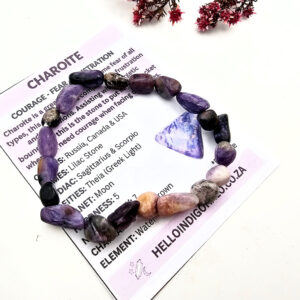
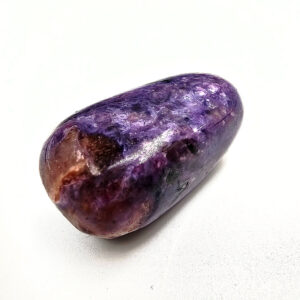
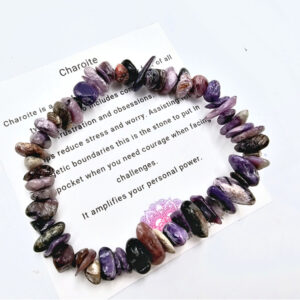
Its colour can move through lavender, lilac and rich violet into much deeper purple, often mixed with white, cream, grey or dark mineral markings. Even more distinctive is the pattern: flowing, swirling and sometimes fibrous-looking structures that can make a polished piece appear almost silky.
And unlike some crystal trade names we've encountered recently, Charoite is a recognised mineral species.
Its geological story is unusually specific too.
Charoite is famously associated with the Murun Massif in Russia, where an unusual combination of geological processes produced this extraordinary purple mineral.
Browse our Crystal Names A–Z for more minerals and gemstones organised by name.
Why Is Charoite So Unusual?
Charoite formed in a geological environment that isn't exactly commonplace.
The Murun alkaline complex contains unusual potassium-rich rocks and has been affected by intense interactions between hot fluids and surrounding rock.
Charoite developed through this complex geological activity rather than simply crystallising as an ordinary purple crystal in an open cavity.
That helps explain its frequently intergrown, fibrous and swirling appearance.
The result can look remarkably dynamic once polished.
Instead of a single flat purple colour, you may see streaks, curls, feather-like structures and patches of different tones moving through one another.
It's one of those minerals where the pattern can be every bit as important as the colour.
Charoite Comes From a Very Particular Part of the World
Charoite's best-known occurrence is in the Murun Massif of Russia, around the Chara and Tokko river region.
That restricted geological association has contributed enormously to its appeal among mineral collectors.
The mineral was formally described and named during the 20th century, although the purple rock had been encountered before its mineralogical identity was properly established.
Its name is commonly connected with the nearby Chara River.
There's also a wonderfully appropriate linguistic coincidence: the Russian word chary relates to charms or enchantment.
Whether you're interested in the geography or simply enjoy the coincidence, Charoite is a remarkably suitable name for something that looks this strange.
What Creates Charoite's Swirling Patterns?
Charoite rarely needs help looking interesting.
The purple mineral can occur in masses of interlocking fibres, creating flowing textures that become especially obvious after cutting and polishing.
Charoite-bearing rock can also contain other minerals.
Depending on the specimen, these associated minerals can contribute pale, dark, greenish or contrasting areas alongside the purple Charoite.
That's why two pieces can look so different.
One may be dominated by intense purple swirls.
Another might contain much more white or cream.
Some pieces show dramatic dark inclusions, while others have a softer lilac appearance.
Those differences aren't imperfections to eliminate. They're part of what makes individual Charoite pieces worth examining.
Charoite Meaning: Transformation Without Running From It
Within modern crystal traditions, Charoite is strongly associated with transformation, courage, intuition and accepting change.
It's often described as a stone for periods when life is moving in a direction you didn't necessarily plan.
Rather than symbolising change for its own sake, Charoite is traditionally connected with meeting change with courage.
Some practitioners choose it when letting go of old patterns, beginning a new stage of life or working through uncertainty about what comes next.
Others use it during meditation or reflection when they feel caught between what is familiar and what they know needs to change.
These are metaphysical traditions - they've become central to Charoite's identity in contemporary crystal culture.
From Fear to Courage
One of Charoite's most persistent metaphysical themes is the idea of transforming fear.
Some crystal traditions describe it as a stone that encourages people to acknowledge what frightens them rather than allowing fear to determine what happens next.
That's an important distinction. The symbolism isn't really about becoming fearless. It's about moving even when you're not completely fearless.
That fits beautifully with Charoite's broader associations with change, transition and personal transformation.
For someone choosing a crystal during a major move, new beginning, career change or period of personal reinvention, it's easy to understand why Charoite's story resonates.
Charoite, Intuition and the Higher Chakras
Purple has long carried spiritual symbolism, so Charoite naturally found a place within modern chakra traditions.
It is most commonly associated with the Crown Chakra, with some traditions also connecting it to the Third Eye.
Those associations link Charoite with intuition, spiritual awareness, inner understanding and seeing beyond immediate fear or confusion.
Some practitioners use it during meditation or keep it nearby when journalling, reflecting or working through an important decision.
If chakra symbolism is part of how you choose crystals, explore our Chakra Balance collection.
Charoite Isn't Sugilite
Two vivid purple stones are easily confused online.
Charoite and Sugilite are completely different minerals.
Charoite is especially recognisable for its flowing, fibrous-looking swirls and lilac-to-violet colour variation.
Sugilite can also be intensely purple, but its appearance and mineral composition are different.
The confusion is understandable from photographs, particularly when both have been polished into jewellery or cabochons.
But once you've spent time looking at good Charoite, those characteristic purple currents and swirling textures become surprisingly recognisable.
Charoite in Jewellery
Polishing can reveal Charoite beautifully.
A pendant gives the pattern enough surface area to become part of the design, while smaller polished stones can capture miniature swirls of purple, white and darker material.
The current HIH collection includes Charoite in polished pieces as well as wearable forms such as pendants and necklaces.
Natural pattern variation means jewellery made with Charoite doesn't need to be perfectly matched.
In fact, the individual pattern is often exactly what makes a piece worth choosing.
For more stones transformed into wearable pieces, browse our Gem & Crystal Necklaces.
Choosing Charoite
Start with the pattern. If intense colour is what attracts you, look for pieces dominated by rich violet or purple.
If you love complicated minerals, choose something with contrasting white, cream or darker inclusions and plenty of visible movement.
Then turn the piece through the light. Fibrous structures and changes in orientation can make different areas appear brighter or more dimensional from different angles.
There's no single ideal Charoite pattern. The best piece is usually the one whose particular combination of colour, movement and markings keeps pulling your eye back.
Caring for Charoite
Charoite is softer than Quartz, so polished pieces and jewellery deserve reasonably gentle treatment.
Avoid hard knocks, abrasive cleaners and harsh household chemicals.
Don't store Charoite jewellery loose against harder gemstones that may scratch its polished surface.
A soft cloth is generally enough for ordinary cleaning.
Frequently Asked Questions
Is Charoite a natural purple stone?
Yes. Charoite is a naturally occurring mineral and its purple colour is natural rather than created through dyeing or coating.
Why is Charoite associated with transformation?
Within modern crystal traditions, Charoite is strongly connected with change, courage and moving beyond fear. Some practitioners choose it symbolically during major transitions or periods of personal growth.
Is Charoite the same as Sugilite?
No. Both can be vivid purple, but Charoite and Sugilite are different minerals. Charoite is particularly recognisable for its flowing, swirling and often fibrous-looking purple patterns.
Why does one Charoite look so different from another?
Charoite can occur with other minerals and its fibrous structures can create very different patterns from piece to piece. Colour may range from soft lilac to deep violet, with white, cream, grey and darker areas adding further variation.