
Desert Rose Selenite
Formed like tiny stone flowers, Desert Rose Selenite develops when Gypsum crystals grow with sand trapped between their blades, creating beautiful natural rosettes. Each formation has its own layers, curves and sandy colouring. Within crystal traditions, Desert Rose is associated with clarity, grounding, purification and finding direction when things feel uncertain.
Showing all 2 resultsSorted by latest
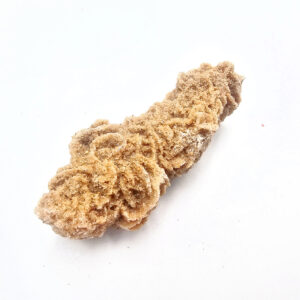
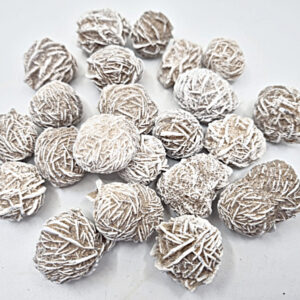
Desert Rose Selenite: Crystals Shaped Like Flowers in the Sand
At first glance, Desert Rose Selenite can look almost carved.
Thin crystal blades overlap and radiate outward, forming natural rosettes that resemble stone flowers opening in the sand.
But nobody creates those petals. Desert Roses form naturally when crystals grow in sandy, usually arid environments. Sand becomes trapped within and around the developing crystals, contributing to the beige, cream and sandy-brown colouring that makes these formations so distinctive.
Every Desert Rose develops differently, so irregular edges, uneven petals and trapped grains of sand are all part of its natural character.
Explore more minerals and stones in our Crystal Names A–Z.
What Exactly Is a Desert Rose?
Desert Rose isn't a separate mineral species.
It's the name given to rose-like crystal formations that develop with sand incorporated into them.
Most classic Desert Roses are formed from Gypsum, the same mineral family associated with Selenite and Satin Spar. This is why you'll commonly encounter names such as Desert Rose Selenite, Gypsum Rose and Sand Rose.
There is an interesting catch, though. Not every Desert Rose in the world is Gypsum. Similar rosette formations can also develop from minerals such as Baryte.
For the familiar pale, sandy formations sold as Desert Rose Selenite, Gypsum Rose is the more mineralogically informative description.
How Does a Desert Rose Form?
The flower shape begins below or close to the surface in dry, sandy environments.
Mineral-rich water moves through the sediment. As conditions change and water evaporates, Gypsum crystals can begin to grow within the sand. Instead of producing one smooth crystal, flat crystal blades intersect and cluster together.
Sand grains become incorporated as they grow. Over time, those overlapping blades create the characteristic petal-like rosette.
Studies of Desert Roses from Saudi Arabia have documented Gypsum rosettes growing in loose sand close to the surface, with sand grains enclosed within the crystals themselves.
So when you're holding a Desert Rose, the sandy texture isn't dirt that needs to be scrubbed away.
The sand is part of the formation.
Is Desert Rose the Same as Selenite?
They're closely related, but the names describe different things.
Gypsum is the mineral.
Selenite is a crystalline variety of Gypsum traditionally associated with clear or transparent crystals.
Desert Rose describes a rosette-like formation, usually made from Gypsum crystals containing sand.
And Satin Spar is the fibrous Gypsum material commonly sold commercially under the name Selenite.
That distinction makes Desert Rose especially interesting because it shows just how different the same mineral family can look depending on the conditions in which it grows.
For more pieces from this mineral family, browse our Selenite collection.
Desert Rose Meaning: Clarity With Your Feet on the Ground
Within modern crystal traditions, Desert Rose is associated with clarity, purification, grounding, direction and mental focus.
Its symbolism is slightly different from the bright, luminous energy commonly associated with clear or white Selenite.
Desert Rose literally grows surrounded by sand.
That earthy appearance has encouraged a combination of Selenite's traditional clarity symbolism with a more grounded quality.
Some practitioners choose Desert Rose during periods of uncertainty, particularly when they want to clear away mental clutter and work out what matters next.
It's also sometimes used during meditation, intention-setting or reflection.
These are metaphysical traditions rather than scientifically established effects, but they're an important part of the way Desert Rose is used within contemporary crystal practice.
The Symbolism of a Rose Formed in Harsh Conditions
There's something particularly appealing about a flower-shaped crystal forming in a desert.
For some people, that has made Desert Rose a symbol of resilience, patience and finding beauty in difficult environments.
It doesn't need an invented ancient legend to make that story interesting.
The natural formation already gives us one.
Water, dissolved minerals and sand come together under the right conditions, and something that resembles a delicate flower develops in an environment we usually imagine as dry and unforgiving.
That symbolism is modern interpretation rather than geology, but it's easy to see why the formation has captured people's imaginations.
Choosing a Desert Rose
Don't expect perfect symmetry.
Look at the arrangement of the crystal blades, the number of visible rosettes and the way the sandy material sits between them.
Some Desert Roses form one obvious flower. Others develop into clusters with several overlapping rosettes.
Colour can vary through cream, beige, pale brown and sandy grey depending on the material trapped during formation.
Small chips, incomplete petals and irregular edges can occur naturally because Gypsum is extremely soft.
If you enjoy crystals primarily for their natural structures and formations, browse our wider Crystal Shapes collection.
Desert Rose Needs Gentle Care
This is one crystal you don't want to scrub.
Gypsum is very soft — around 2 on the Mohs hardness scale — and the thin blades of a Desert Rose can be delicate.
Avoid soaking it in water, using chemical cleaners or trying to remove the sand caught between its layers.
Keep it away from harder stones that can scratch or damage the petals.
For ordinary care, gentle handling and a soft, dry brush are usually all that's needed.
Frequently Asked Questions
Is Desert Rose a real crystal?
Yes. Desert Rose is a natural crystal formation. Most classic Desert Roses are formed from Gypsum crystals that grow with sand incorporated into their rosette-like structure.
Why is there sand inside Desert Rose?
The crystals grow within sandy sediment, so grains of sand become trapped and incorporated as the Gypsum develops. The sand is therefore part of the natural formation rather than simply surface dirt.
Are all Desert Roses made from Selenite?
No. Most familiar Desert Roses are Gypsum formations, but rose-like formations can also occur in minerals such as Baryte. “Desert Rose” describes the formation rather than one exclusive mineral species.
Why shouldn't I wash Desert Rose in water?
Gypsum is a very soft mineral, and Desert Rose has thin, delicate crystal blades. Prolonged water exposure and vigorous cleaning can damage the formation, so gentle dry cleaning is preferable.
What is Desert Rose traditionally associated with?
Within modern crystal traditions, Desert Rose is associated with clarity, grounding, purification, focus and direction. Its flower-like growth in sandy environments has also inspired modern symbolism around resilience and growth through difficult conditions.