
Fire Agate
Brown at first glance, Fire Agate can suddenly reveal flashes of gold, orange, red and green as light catches its layered surface. This unusual variety of Chalcedony is prized for its natural iridescent “fire” and swirling botryoidal patterns. Within crystal traditions, Fire Agate is associated with courage, vitality, protection and creative energy.
Showing the single result
-
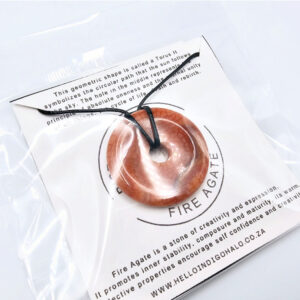
Fire Agate Pi Stone 35mm
Original price was: R139.00.R109.00Current price is: R109.00. Add to basketQuick View
Fire Agate: The Agate That Appears to Glow From Within
At first glance, Fire Agate can look surprisingly understated.
Its base colour is often brown, reddish brown or golden brown.
Then the light catches it. Suddenly, flashes of fiery orange, red, gold and green can appear across the surface, sometimes joined by rarer violet or blue tones.
That shifting colour is what gives Fire Agate its name — and what makes good pieces so fascinating to examine from different angles.
Fire Agate is a variety of Chalcedony, the microcrystalline form of Quartz that also forms the broader Agate family.
Browse more varieties in our Agate collection.
Where Does the “Fire” Come From?
The colours aren't produced by dye, glitter or metallic foil inside the stone.
Fire Agate develops in layers, often over rounded botryoidal surfaces.
Extremely thin iron-rich layers occur within this structure. When light interacts with these layers, optical interference can produce the brilliant colours we perceive as Fire Agate's “fire”.
Red, orange, gold and green are particularly characteristic, although some exceptional material can display violet or blue.
Interestingly, the precise microscopic mechanism behind Fire Agate's iridescence is still being studied. Thin-film interference involving iron oxides or hydroxides is considered the most likely explanation.
So the effect isn't simply pigment.
It's an interaction between light and incredibly fine natural structures inside the stone.
What Does Botryoidal Mean?
Fire Agate often develops over rounded surfaces that look like bubbles, grapes or tiny overlapping hemispheres.
This growth form is called botryoidal.
Those rounded structures are important because layers of Chalcedony and iron-rich material can follow their contours.
When a skilled cutter works with Fire Agate, the aim is often to carefully expose the colourful layers without grinding straight through them.
That's why polished Fire Agate can have such unusual contours.
The cutter is effectively following the natural formation of the stone to reveal the fire hiding beneath the surface.
Fire Agate Comes From a Surprisingly Small Part of the World
Fire Agate has a much more restricted geographic story than ordinary Agate.
Important deposits occur in Mexico and the southwestern United States, particularly Arizona.
Aguascalientes in Mexico is especially famous for spectacular Fire Agate, while Arizona has also produced highly prized material.
That limited geographic occurrence adds to Fire Agate's appeal among collectors.
Fire Agate and Opal Can Put on a Similar Show
Fire Agate is sometimes compared with precious Opal because both can produce remarkable flashes of colour.
But they're very different materials.
Fire Agate belongs to the Chalcedony/Quartz family and has a Mohs hardness of approximately 6.5–7.
Opal has a different structure and is generally softer.
Their optical effects aren't identical either, but the comparison makes sense when you see a particularly colourful Fire Agate moving under light.
Both can turn what initially looks like a relatively dark stone into an unexpected display of colour.
Fire Agate Meaning: Courage, Vitality and Protection
Within modern crystal traditions, Fire Agate is associated with courage, vitality, motivation, protection and creative energy.
Its symbolism naturally draws heavily from fire.
Fire can represent warmth and life, but also action, transformation and the confidence to move forward.
For this reason, Fire Agate is often chosen symbolically when someone feels stuck, hesitant or in need of renewed motivation.
Its darker earthy body colour also gives it a grounding quality within crystal traditions, creating an interesting combination of stability and fire rather than energy without direction.
These are metaphysical traditions rather than scientifically established effects, but they form an important part of Fire Agate's modern identity.
Fire Agate and the Lower Chakras
Fire Agate's brown, red, orange and golden colours connect it particularly strongly with the Root, Sacral and Solar Plexus Chakras within modern chakra traditions.
The Root Chakra brings in themes of grounding, security and stability.
Orange connects naturally with the Sacral Chakra and themes of creativity and passion.
Golden and yellow flashes can be associated with the Solar Plexus Chakra, traditionally linked with confidence, will and personal power.
A single piece of Fire Agate can therefore visually cross several of these traditional colour associations.
Explore more crystals and spiritual tools organised around chakra traditions in our Chakra Balance collection.
Choosing Fire Agate
With Fire Agate, don't judge the stone from one photograph or one angle if you have the opportunity to see it move.
Light matters.
Tilt the piece and look for areas where the colour becomes stronger or where one shade gives way to another.
Some Fire Agates have concentrated flashes in one small area. Others reveal broader bands or multiple pockets of colour.
Look at the botryoidal patterns too.
Rounded contours, eyes, arcs and swirling forms can make a piece interesting even before its brightest colours appear.
And don't dismiss the brown.
That darker Chalcedony body is part of what makes the sudden colour contrast so dramatic.
Caring for Fire Agate
Fire Agate is relatively durable compared with many colourful collector stones.
As a Chalcedony variety, it has a Mohs hardness of around 6.5–7, making it suitable for polished stones and jewellery with ordinary sensible care.
Avoid hard knocks, abrasive chemicals and repeated contact with harder gemstones that could damage the polish.
A soft cloth and gentle cleaning are usually sufficient for polished pieces.
Most importantly, good lighting is part of enjoying Fire Agate. Rotate it slowly rather than expecting the entire colour display to appear from one fixed position.
Frequently Asked Questions
Is Fire Agate a natural stone?
Yes. Fire Agate is a naturally occurring variety of Chalcedony. Its colourful iridescence develops from extremely fine natural structures within the stone rather than glitter or artificial foil.
Is Fire Agate the same as ordinary Agate?
Fire Agate belongs to the Chalcedony and Agate family, but it is distinguished by its characteristic iridescent “fire” and commonly botryoidal structure.
What colours can Fire Agate show?
Fire Agate commonly displays red, orange, gold and green iridescence over a brown to reddish-brown base. Some exceptional pieces can also reveal violet or blue.
Where is Fire Agate found?
Fire Agate is particularly associated with Mexico and the southwestern United States, including Arizona.
What is Fire Agate traditionally associated with?
Within crystal traditions, Fire Agate is associated with courage, vitality, motivation, protection, creativity and grounded personal power.