
Garnet In Limestone
Discover Garnet in Limestone, where deep Garnet contrasts beautifully against a lighter natural rock matrix. This unusual combination brings together two materials with very different origins and character. Within crystal traditions, Garnet is associated with passion, strength and vitality, while the surrounding stone gives each piece its own natural pattern.
Showing all 5 resultsSorted by latest
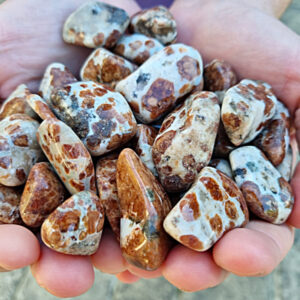
Garnet in Limestone: When Crystals Grow Through Rock
Garnet in Limestone is interesting because you're not looking at one perfectly uniform mineral.
You're looking at Garnet crystals held within a contrasting rock matrix.
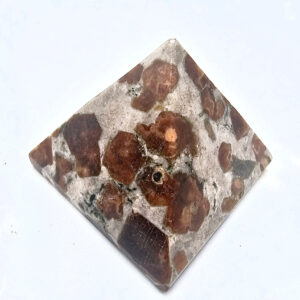
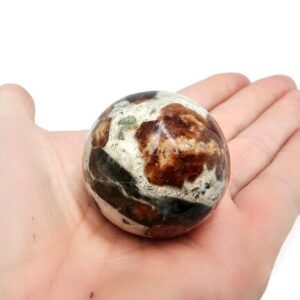
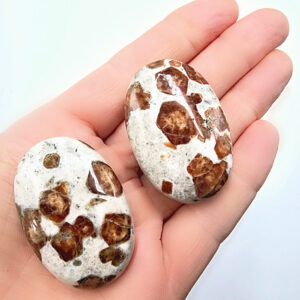
The darker Garnet can appear as spots, patches or distinct crystal areas against the lighter surrounding material, creating patterns that change completely from one piece to the next.
When the material is shaped and polished into spheres, palm stones or tumble stones, those internal relationships become part of the design.
Nothing needs to be painted on.
The pattern was already inside the rock.
Browse more stones and minerals by name in our Crystal Names A–Z.
How Can Garnet Form in Limestone?
This is where the geology becomes particularly interesting.
Limestone is a sedimentary rock composed predominantly of carbonate minerals. Garnet, on the other hand, commonly forms under conditions involving substantial heat, pressure or chemical alteration.
So how do they end up together?
When limestone is affected by heat and chemically active fluids associated with geological processes such as nearby igneous activity, its original minerals can begin to react and recrystallise.
In strongly altered carbonate rocks, this can create calc-silicate minerals including Garnet.
Geologists call some of these altered rocks skarns.
Skarns commonly develop where hot, chemically active fluids interact with carbonate rocks such as limestone, dolostone or marble. Depending on the chemistry involved, Garnet can become one of their prominent minerals.
The exact geological identity of an individual HIH piece should depend on its known provenance and mineral composition, so we shouldn't automatically label every Garnet in Limestone piece as skarn.
But the relationship explains something important:
Garnet doesn't simply sit on limestone like a decoration. Under the right geological conditions, mineral reactions can actually grow Garnet within altered carbonate rock.
Garnet Isn't Just One Mineral
“Garnet” is actually the name of a group of closely related minerals, rather than one single mineral species.
Different Garnets contain different combinations of elements, which is why the Garnet family can produce much more than the familiar dark red stones.
Garnets can occur in shades of red, orange, yellow, green, brown and even nearly colourless, depending on their composition.
Without confirmed mineral analysis or supplier identification, we shouldn't assign the Garnet in these pieces to a particular Garnet species purely from appearance.
For the customer, however, the contrast is the attraction: richer Garnet tones appearing naturally through a much lighter matrix.
From Rough Rock to Sphere, Palm Stone or Tumble
Polishing Garnet in Limestone reveals the material in a completely different way.
A sphere allows the pattern to continue around the entire piece, so turning it in your hand can reveal new areas of Garnet and matrix.
A palm stone gives you a broad polished surface where the contrast between the materials becomes easy to see.
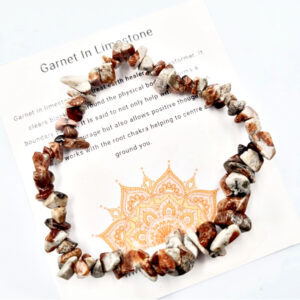
Smaller tumble stones are more compact, but each can still have a completely different balance of Garnet and surrounding rock.
If you enjoy crystals shaped to reveal their natural patterns, explore our wider Crystal Shapes collection.
Garnet in Limestone Meaning
Within crystal traditions, Garnet is strongly associated with passion, vitality, courage, motivation and strength.
Its deep red and earthy colouring also gives it a natural connection with the Root Chakra, traditionally associated with grounding, stability and feeling secure.
Garnet in Limestone is especially interesting symbolically because the Garnet remains visibly surrounded by its host rock.
Rather than seeing only a separated crystal, you're seeing crystal and matrix together.
For some people, that makes it a fitting symbol of strength that develops through experience — something powerful growing within and remaining connected to the material around it.
These are metaphysical interpretations rather than scientifically established effects, but the natural structure of the stone gives the symbolism a little more substance than simply assigning meanings according to colour.
Explore more crystals and spiritual tools associated with chakra traditions in our Chakra Balance collection.
Choosing Garnet in Limestone
With this material, variation is part of the appeal.
One piece may contain obvious Garnet-rich areas, while another may show more of the pale surrounding matrix.
Look at the contrast, distribution of Garnet, natural pattern and shape rather than expecting every piece to look identical.
A sphere with dramatic scattered Garnet may appeal to you more than one with a subtle pattern. Someone else may prefer the quieter balance of stone and matrix in a palm stone.
There isn't one correct ratio of Garnet to surrounding rock.
Choose the piece whose natural pattern catches your eye.
Caring for Garnet in Limestone
Because this material combines different minerals and rock components, treat it according to the more delicate parts of the piece rather than Garnet's hardness alone.
Avoid harsh chemical cleaners, prolonged soaking and knocks against hard surfaces.
A soft cloth is sufficient for routine care, with gentle cleaning when needed.
The natural differences in hardness between Garnet and the surrounding matrix are also part of the reason polished pieces can have small textural variations.
Frequently Asked Questions
Is Garnet in Limestone natural?
Yes. Garnet can occur naturally within metamorphosed or chemically altered carbonate rocks. The contrasting Garnet and surrounding matrix are part of the rock's natural mineral formation.
Is Garnet always red?
No. Garnet is a mineral group containing several species and can occur in red, orange, yellow, green, brown and other colours depending on its composition.
Is Garnet in Limestone the same as ordinary Garnet?
It contains Garnet, but the Garnet remains visibly associated with its host-rock matrix rather than being presented as a separated Garnet crystal or gemstone.
Why does every Garnet in Limestone piece look different?
The amount, size and distribution of Garnet naturally varies throughout the rock. Cutting and polishing different sections therefore reveals completely different patterns.
What is Garnet traditionally associated with?
Within crystal traditions, Garnet is associated with passion, vitality, courage, motivation, grounding and strength, with red varieties particularly connected with Root Chakra symbolism.