
Honey Aragonite
Warm golden, amber and honey tones give Honey Aragonite its beautifully earthy appearance. A natural variety of Aragonite, this calcium carbonate mineral is traditionally associated with grounding, patience, confidence and personal strength. Explore Honey Aragonite pieces chosen for their natural colour, texture and individual mineral character.
Showing the single result
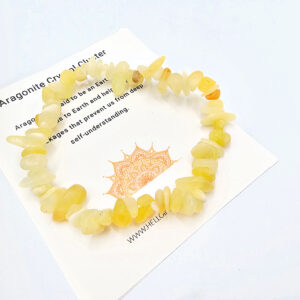
Honey Aragonite: Warm Colour, Fascinating Crystal Structure
With shades ranging through golden cream, caramel, amber and warm honey, Honey Aragonite has an earthy appearance that suits the mineral beautifully.
But colour is only part of what makes Aragonite interesting.
Aragonite is a naturally occurring form of calcium carbonate (CaCO₃) — exactly the same chemical formula as Calcite.
Yet Aragonite and Calcite are not the same mineral.
The reason lies in how their atoms are arranged.
Aragonite & Calcite: Same Formula, Different Minerals
Aragonite and Calcite are polymorphs.
In mineralogy, polymorphs are materials that share the same chemical composition but have different crystal structures.
Both Aragonite and Calcite are composed of calcium carbonate, CaCO₃.
Calcite crystallises in the trigonal crystal system.
Aragonite crystallises in the orthorhombic crystal system.
That difference in internal structure gives the two minerals different crystal habits and physical properties even though their basic chemistry is the same.
It's a wonderful example of why identifying a mineral involves more than simply knowing which elements it contains.
Explore the wider Aragonite collection to see more expressions of this fascinating mineral family.
How Did Aragonite Get Its Name?
Aragonite has a slightly amusing naming story.
The mineral was named in 1797 by German geologist Abraham Gottlob Werner after its type locality near Molina de Aragón in Spain.
For years, references sometimes connected the name with the wider Spanish region of Aragón.
The more precise story is that it was named for Molina de Aragón, the village associated with the original locality.
So even the mineral's name carries a little piece of geological history.
Aragonite Can Form Remarkable Crystal Shapes
Aragonite doesn't always grow as a simple individual crystal.
It can occur as prismatic crystals, fibres, radiating aggregates, stalactitic formations and other structures.
One of its particularly interesting habits involves crystal twinning.
Individual Aragonite crystals can twin repeatedly in arrangements that produce forms appearing almost hexagonal, even though Aragonite itself belongs to the orthorhombic crystal system.
This is known as pseudohexagonal appearance.
It's another reminder that the outside shape of a mineral doesn't always reveal the underlying crystal system as simply as we might expect.
What Gives Honey Aragonite Its Colour?
Pure Aragonite can be colourless or pale, while natural specimens can occur in a variety of colours because of impurities and other material incorporated during formation.
The name Honey Aragonite is used commercially for material with particularly warm yellow, golden, amber or honey-brown colouring.
Individual pieces can vary considerably.
Some are relatively pale and creamy, while others have deeper caramel tones, translucent areas, bands or contrasting natural markings.
Rather than expecting every piece to match one exact shade, look for the colour and pattern that appeals to you.
Browse more stones alphabetically through our Crystal Names A–Z.
Honey Aragonite Meaning
Within modern crystal traditions, Honey Aragonite is associated with grounding, patience, confidence and personal strength.
Aragonite more broadly has developed a reputation as a grounding stone — something chosen when life feels scattered, busy or difficult to organise.
The warm golden colouring of Honey Aragonite adds symbolism around confidence, motivation and personal power.
This creates an interesting balance.
Rather than the intense, fast-moving energy traditionally attributed to some golden crystals, Honey Aragonite is often associated with steady progress, discipline and building confidence from a grounded foundation.
It can therefore be chosen as a symbolic reminder that meaningful progress doesn't always have to happen quickly.
These are traditional and metaphysical associations rather than scientifically established effects.
Honey Aragonite & the Solar Plexus Chakra
Within contemporary chakra traditions, Honey Aragonite is commonly connected with the Solar Plexus Chakra.
This chakra is traditionally associated with confidence, willpower, motivation, self-belief and personal direction.
Honey Aragonite's golden colour makes that association visually natural, while Aragonite's broader grounding symbolism gives it a slightly different character from many other Solar Plexus stones.
Its symbolism is less about rushing forward and more about finding your footing, deciding where you're going and continuing steadily.
Explore more stones and spiritual tools associated with chakra traditions in our Chakra Balance collection.
Choosing Honey Aragonite
Natural Honey Aragonite doesn't need to be perfectly uniform.
Look for variations in golden colour, translucency, banding, crystal texture and natural pattern.
One piece may appeal because of rich caramel colouring, while another has softer cream-and-honey tones or interesting mineral structures.
If you're choosing it for its traditional symbolism, consider the intention that resonates most strongly with you: grounding, patience, confidence, focus or steady personal growth.
If you're choosing purely because it's beautiful, that's an equally good reason.
Caring for Honey Aragonite
Aragonite is considerably softer than Quartz, measuring around 3.5 to 4 on the Mohs hardness scale.
It's also brittle, so it deserves gentle handling.
Keep pieces away from hard knocks and avoid storing them where harder crystals continually rub against their surfaces.
Because Aragonite is calcium carbonate, acids can react with the mineral, so avoid acidic cleaners and harsh household chemicals.
A soft dry cloth or gentle brush is usually enough for ordinary care.
Frequently Asked Questions About Honey Aragonite
Is Honey Aragonite the same as Calcite?
No. Aragonite and Calcite have the same chemical formula, CaCO₃, but different crystal structures. They are separate minerals known as polymorphs.
Is Honey Aragonite naturally this colour?
Aragonite occurs naturally in a variety of colours. “Honey Aragonite” is a commercial name used for material with warm yellow, golden, amber and honey-brown colouring.
Why can Aragonite crystals sometimes look six-sided?
Repeated crystal twinning can create pseudohexagonal forms. They may look approximately hexagonal from the outside even though Aragonite actually crystallises in the orthorhombic system.
Is Honey Aragonite a hard crystal?
Not particularly. Aragonite measures around 3.5 to 4 on the Mohs hardness scale and is brittle, so it should be handled more carefully than harder stones such as Quartz.
What is Honey Aragonite associated with spiritually?
Within modern crystal traditions, Honey Aragonite is associated with grounding, patience, confidence, personal strength and the Solar Plexus Chakra.