
Nephrite Jade
Smooth, naturally beautiful Nephrite Jade is one of the two materials traditionally recognised as true Jade. Its densely interlocking mineral structure gives it remarkable toughness, helping explain its extraordinary history in tools, carvings and jewellery. Within crystal traditions, Nephrite is associated with harmony, prosperity, protection and good fortune.
Showing the single result
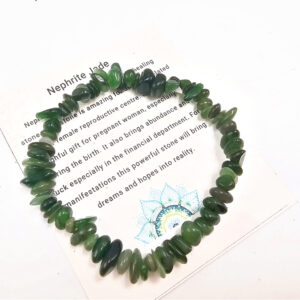
Nephrite Jade: One of the Two True Jades
The word Jade sounds as though it should describe one mineral.
It doesn't.
The name traditionally covers two distinctly different gem materials: Nephrite and Jadeite.
They can share similar colours, take a beautiful polish and have both been treasured for carving and adornment, but their mineral structures are different.
Nephrite has another remarkable quality too.
It is extraordinarily tough.
What Is Nephrite Jade?
Nephrite is a compact material formed from extremely fine, densely interlocking amphibole mineral fibres, principally within the tremolite-actinolite series.
Those microscopic fibres are fundamental to the character of the stone.
Rather than behaving like a mass of easily separated crystals, the fibres interlock in a tightly bound structure.
The result is a material with exceptional resistance to breaking.
This is an important distinction because toughness and hardness aren't the same thing.
A gemstone can resist scratching but still fracture relatively easily. Nephrite became famous for something different: its ability to withstand impact remarkably well.
Browse more individual minerals and gemstones through our Crystal Names A–Z.
Nephrite vs Jadeite: They're Both Real Jade
Nephrite and Jadeite are both legitimately called Jade, but they are not the same material.
Nephrite is composed of densely intergrown amphibole fibres.
Jadeite Jade is principally composed of pyroxene minerals dominated by Jadeite.
For much of history, people didn't have modern mineralogical methods to distinguish the two.
In China, the Jade used for thousands of years was predominantly Nephrite. Jadeite arrived from what is now Myanmar much later, becoming important in China only within the last few centuries.
So when we talk about the exceptionally ancient history of Chinese Jade, much of that story belongs specifically to Nephrite.
Did You Know? Nephrite Was Used for Tools & Weapons
Long before Jade was something we primarily associated with jewellery and decorative carvings, people recognised Nephrite's extraordinary physical properties.
Its toughness made it useful for axes, adzes, blades and other tools, as well as ornaments and ritual objects.
This happened in different cultures around the world.
Producing those objects required enormous patience. Nephrite isn't remarkable because it's easy to break into shape — quite the opposite.
Its densely interlocking structure resists fracture remarkably well.
That creates one of the great contradictions of Nephrite Jade:
a stone beautiful enough for intricate carving, yet tough enough to become a working tool.
Nephrite Jade & More Than 5,000 Years of Chinese History
Nephrite has an extraordinary place in Chinese history and culture.
Evidence of Chinese Nephrite traditions extends back more than 5,000 years, long before Jadeite became an important part of the Chinese Jade market.
Over different periods, Jade became associated with craftsmanship, status, power, ritual, virtue and cultural identity.
It was shaped into jewellery, ceremonial objects, carvings, seals and practical objects.
White Nephrite became particularly revered, while green varieties also developed important collecting and carving traditions.
The history is far richer than simply saying that Jade is a “lucky stone”.
Its modern associations with prosperity and good fortune sit alongside thousands of years of human craftsmanship and cultural symbolism.
Where Does Nephrite Come From?
Nephrite occurs in several parts of the world.
Important deposits have been found in China, Russia, Canada and New Zealand, among other locations.
China's Xinjiang region has an especially famous history of Nephrite production, including material associated with Hotan or Hetian.
British Columbia in Canada and Siberia in Russia have also become major sources of green Nephrite for the modern market.
Unless the locality of an individual Hello Indigo Halo piece is known from supplier information, however, we wouldn't assign it to a particular source simply from colour.
What Colours Can Nephrite Jade Be?
Although green is probably the colour most people immediately associate with Jade, Nephrite has a broader natural palette.
It can occur in shades ranging from creamy white and pale green through stronger greens to very dark green or almost black-looking material.
Colour can be influenced by variations in mineral chemistry and inclusions.
Natural pieces may also contain variations in tone, markings and texture.
This means Nephrite doesn't have to match the vivid emerald-green image people sometimes associate with high-grade Jadeite to be genuine Jade.
Explore another part of the wider Jade story through our Green Jade collection.
Nephrite Jade Meaning
Within contemporary crystal traditions, Nephrite Jade is associated with harmony, prosperity, protection, wisdom, balance and good fortune.
Its long cultural relationship with Jade symbolism has strongly influenced these modern associations.
Green Nephrite is also commonly connected with growth, compassion and maintaining balance while pursuing abundance.
Rather than treating these meanings as universal ancient beliefs, it is useful to remember that Jade symbolism has developed across different cultures and historical periods.
Modern crystal meanings are one part of that much larger story.
Nephrite Jade & the Heart Chakra
Green Nephrite is commonly associated with the Heart Chakra in contemporary crystal traditions.
The Heart Chakra is traditionally connected with compassion, relationships, emotional balance and growth.
Combined with Nephrite's broader symbolism around prosperity and harmony, it has become a popular stone for intentions involving growing something worthwhile without losing balance along the way.
Explore more stones and spiritual tools through our Chakra Balance collection.
Choosing Nephrite Jade
When choosing Nephrite, don't expect every piece to have exactly the same shade of green.
Look at the individual colour, markings, polish and character of the stone.
In jewellery, the design matters too.
A polished Nephrite pendant can emphasise colour and smoothness, while beads and other forms can reveal variations between several individual pieces of stone.
Our Nephrite collection changes as different pieces become available, from natural stone jewellery to other forms when available.
Browse more wearable crystal pieces in our Gem & Crystal Necklaces.
Caring for Nephrite Jade
Nephrite is renowned for toughness, but that doesn't mean it should be treated carelessly.
Protect finished jewellery from unnecessary hard knocks and avoid harsh household chemicals.
Warm water, mild soap and a soft cloth are suitable for ordinary cleaning in many cases, although always consider the other materials used in a finished piece of jewellery.
For wire-wrapped pieces, care for the stone and metalwork together rather than pulling or bending the wire around the Nephrite.
Frequently Asked Questions About Nephrite Jade
Is Nephrite real Jade?
Yes. Nephrite is one of the two principal gem materials traditionally recognised as Jade; the other is Jadeite.
What makes Nephrite so tough?
Nephrite consists of extremely fine amphibole fibres that grow together in a densely interlocking structure. This gives the material exceptional resistance to breaking.
Is Nephrite always green?
No. Nephrite can range from creamy white and pale shades through many greens to extremely dark material. Green is famous, but it isn't the only natural colour.
Is Nephrite the same as Jadeite?
No. Both are genuine Jade materials, but Nephrite is amphibole-rich while Jadeite Jade is principally pyroxene material dominated by Jadeite.
Why was Nephrite used to make ancient tools?
Its exceptional toughness made Nephrite highly resistant to fracture, allowing people in different cultures to fashion it into durable axes, adzes, blades and other objects.