
Opalite
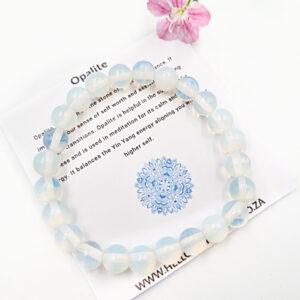
Milky white with an enchanting blue glow and warm golden tones in changing light, Opalite is a beautiful man-made opalescent glass. Loved for jewellery, polished shapes and its almost moonlit appearance, it is traditionally associated with communication, emotional balance, transitions and gentle, uplifting energy.
Showing all 12 resultsSorted by latest
Opalite: The Man-Made Glass With an Otherworldly Glow
Opalite has one of those appearances that seems to change while you're looking at it.
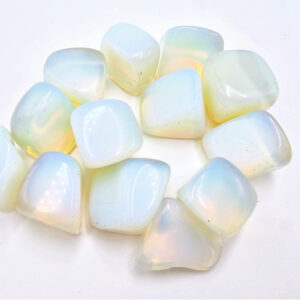
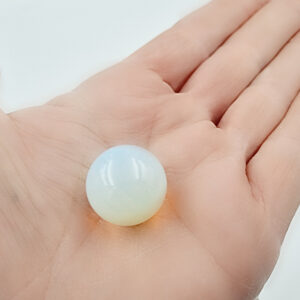
Against one background it can appear milky white with an icy blue glow. Hold it towards the light and warmer yellow, peach or orange tones can suddenly become visible.
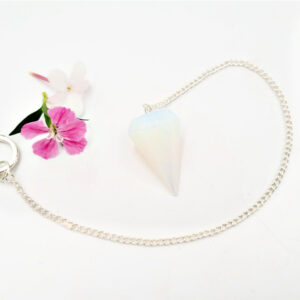
That shifting, luminous appearance is exactly what makes Opalite so popular in jewellery, spheres, hearts, pendulums and other polished shapes.
And there's something important to know from the beginning:
Opalite is man-made.
That isn't a flaw or something that needs to be hidden. It's part of what Opalite actually is.
What Is Opalite?
The material commonly sold today as Opalite is a manufactured opalescent glass.
It is deliberately created to produce the soft, translucent and glowing appearance that has made it popular in jewellery and decorative objects.
Unlike natural gemstones that form through geological processes over millions of years, modern Opalite is produced by people.
That means it doesn't have a mine locality, natural crystal system or geological formation story in the same way that Quartz, Amethyst or Tourmaline does.
Instead, its appeal lies in the way the glass interacts with light.
Explore naturally occurring minerals alongside other crystal-trade materials through our Crystal Names A–Z.
Why Does Opalite Seem to Change Colour?
One of Opalite's most beautiful characteristics is the way its appearance changes with lighting, viewing angle and background.
In reflected light, Opalite often appears milky, pale or bluish.
When light passes through it, warmer yellow, orange or peach tones can become more noticeable.
Place a piece against a dark background and the blue glow can become particularly striking.
Move the same piece towards a bright window and it may suddenly look warmer.
This effect is created by the way light interacts with the tiny structures or particles within the opalescent glass.
So the colour isn't simply painted onto the surface.
The luminous effect happens as light travels through and scatters within the material.
Opalite vs Natural Opal
Despite the similar names, Opalite and natural Opal are not the same material.
Natural Opal is a naturally occurring hydrated silica material that forms through geological processes.
Opalite is manufactured glass.
Precious Opal can display play-of-colour, where spectral colours shift across the stone as it moves. Opalite's characteristic blue and warm orange glow is produced differently and shouldn't be described as natural Opal play-of-colour.
That doesn't mean Opalite is pretending to be Opal.
Today, Opalite has developed a recognisable identity of its own and is widely chosen specifically because people like its distinctive luminous glass appearance.
Why Opalite Works So Well in Jewellery & Polished Shapes
Opalite really comes alive when light can move through it.
A sphere allows light to enter from multiple directions.
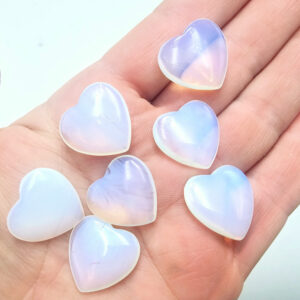
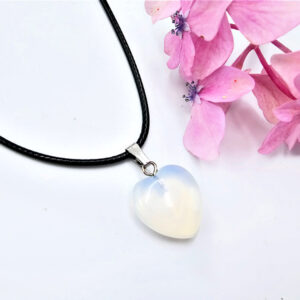
A polished heart creates curves that can emphasise the internal glow.
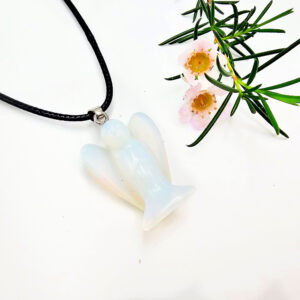
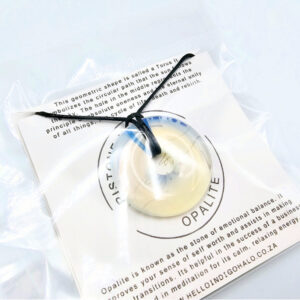
A pendant or necklace moves as you wear it, allowing the material to shift between cooler and warmer appearances throughout the day.
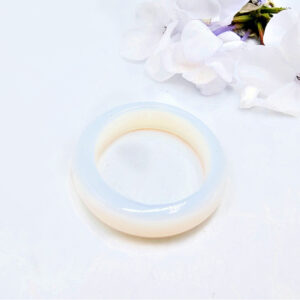
Bangles and rings can look different against skin, fabric and surrounding light.
Even a simple tumbled piece can change noticeably when you move it between your hand, a dark surface and a bright window.
Explore more wearable styles in our Gem & Crystal Necklaces.
Opalite Meaning
Although Opalite is manufactured rather than naturally occurring, it has developed its own place within modern crystal traditions.
It is commonly associated with communication, emotional balance, optimism and transitions.
The changing appearance of Opalite has also encouraged symbolism around moving from one stage of life into another.
A piece can appear cool and blue in one setting and warm and golden in another, making it a fitting visual symbol for change, perspective and adapting to new circumstances.
These are modern metaphysical and symbolic associations rather than scientifically established effects.
Opalite & the Throat Chakra
Within contemporary crystal practice, Opalite is often associated with the Throat Chakra, traditionally connected with communication and self-expression.
Its luminous blue appearance makes this association visually intuitive.
Some people also connect Opalite with the Third Eye or Crown Chakra because of its pale, ethereal appearance.
Rather than treating one association as an ancient rule, it is more accurate to understand these as part of Opalite's modern metaphysical tradition.
Browse more stones and spiritual tools through our Chakra Balance collection.
Choosing Opalite
Choosing Opalite is largely about deciding which form allows you to enjoy its changing light effect most.
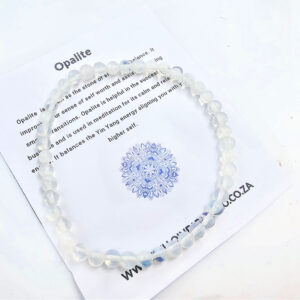
For something wearable, necklaces, bangles and rings allow the glass to move continually through different lighting conditions.
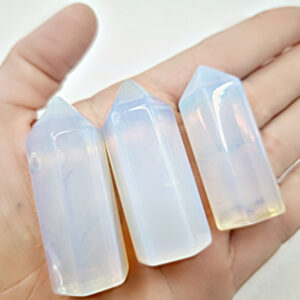
Hearts, spheres and polished pieces work beautifully for display, collecting or simply holding up to different light sources to watch the colours change.
Because Opalite is manufactured, pieces can have a more consistent overall appearance than many natural stones, although individual shapes, colour effects and finishing can still vary.
Browse more smooth handheld and decorative forms through our Crystal Shapes collection.
Caring for Opalite
Treat Opalite as glass rather than as a hard natural crystal.
Protect it from drops and hard impacts that could chip, crack or break the material.
Avoid abrasive cleaning products and harsh household chemicals.
A soft cloth and gentle cleaning are usually sufficient for polished pieces.
For jewellery, remember to consider the metal, wire, elastic or setting as well as the Opalite itself when choosing how to clean and store it.
Frequently Asked Questions About Opalite
Is Opalite a natural crystal?
The Opalite commonly sold in modern crystal and jewellery shops is man-made opalescent glass rather than a naturally formed mineral.
Why does Opalite look blue and orange?
Its appearance changes according to how light interacts with and passes through the glass. Reflected light can emphasise cooler blue tones, while transmitted light can reveal warmer yellow, peach and orange colours.
Is Opalite the same as Opal?
No. Natural Opal is a naturally occurring hydrated silica material. Modern Opalite is manufactured opalescent glass.
Does Opalite still have a crystal meaning if it is man-made?
Within modern metaphysical traditions, yes. Opalite has developed symbolic associations with communication, emotional balance, transitions and optimism despite being a manufactured material.
Is every piece of Opalite exactly the same?
No. Although manufactured material can be more visually consistent than many natural stones, shape, thickness, lighting and viewing angle can all influence how an individual Opalite piece appears.