
Peridot
Fresh yellow-green to olive tones give Peridot a colour unlike almost any other gemstone. The gem variety of Olivine, Peridot is naturally green, with iron playing an essential role in its colour. Browse Peridot stones and jewellery chosen for their lively shades and individual character. Traditionally recognised as an August birthstone, Peridot is associated within crystal traditions with renewal, abundance, growth and positivity.
Showing all 3 resultsSorted by latest
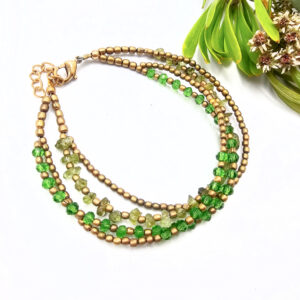
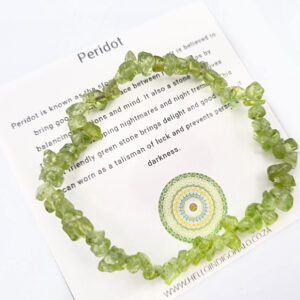
A Gemstone That Is Always Green
Peridot doesn't need treatment or another mineral inclusion to give it its signature colour.
From fresh yellow-green and leafy shades to richer olive tones, green is part of Peridot's natural identity.
That makes colour one of the most enjoyable things to compare when choosing a piece. Some stones appear bright and almost citrus-green, while others have warmer yellow or deeper olive undertones.
What Is Peridot?
Peridot is the gemstone variety of Olivine, a magnesium-iron silicate mineral.
Rather than being a completely separate mineral species called Peridot, the name is used for gem-quality Olivine with its characteristic green colouring.
Iron is an essential part of the story.
While many gemstones receive their colour from trace impurities, iron is part of Olivine's chemistry and is responsible for Peridot's yellowish-green colour.
That natural relationship between mineral composition and colour is one of the features that makes Peridot particularly interesting.
A Gem From Deep Within the Earth
Peridot can have a remarkable geological journey.
Olivine is an important component of Earth's upper mantle, and much gem Peridot originates in mantle material carried towards the surface by volcanic activity.
Pieces of mantle rock can be transported upwards within magma and eventually become enclosed in volcanic rocks such as basalt.
So that small green gemstone in a piece of jewellery can have an origin considerably deeper than its delicate appearance suggests.
Even more unusually, Olivine and gem-quality Peridot can occur in certain meteorites.
Rare extraterrestrial Peridot has even been faceted as gemstones.
Why Is Peridot Green?
Peridot's colour ranges from brownish green through yellow-green to purer green.
Iron within the gemstone is responsible for these shades.
For fine faceted gemstones, richer grass-green colour with little brown is traditionally particularly desirable, although smaller stones commonly show attractive yellow-green tones.
For everyday crystal jewellery, colour preference is much more personal.
A lively lime-green stone can feel completely different from a deeper olive Peridot, so choose the shade that appeals to you rather than expecting every natural stone to match exactly.
Peridot Has an Interesting Optical Trick
Look closely through a transparent faceted Peridot and you may notice something unusual.
Peridot has relatively strong double refraction, also known as birefringence.
Light entering the gemstone can split into two rays, and when viewing through a suitably cut stone this can make facet edges appear doubled.
It is a subtle gemmological characteristic, but one that gives Peridot another interesting identity beyond simply being “the green birthstone”.
Peridot — An August Birthstone
Peridot is traditionally recognised as one of the birthstones for August.
That makes Peridot jewellery a natural birthday-gift choice, particularly when you want something more personal than jewellery chosen purely for colour.
Its birthstone identity also has genuine history.
Peridot has been valued for centuries, including material historically mined on Zabargad Island in the Red Sea.
You don't need an August birthday to wear it, though. Its fresh green colour makes Peridot equally appealing to anyone drawn to natural green gemstones.
Choosing Peridot Jewellery
When comparing Peridot pieces, consider more than the name of the gemstone.
Look at:
Colour — yellow-green, leafy green and olive tones can create very different effects.
Clarity — natural internal characteristics can vary between stones.
Cut and shape — round, oval, marquise and other shapes each show the gemstone differently.
Size — petite stones offer a subtle flash of green, while larger gemstones make colour more prominent.
Metal — warm brass can emphasise Peridot's yellow-green tones, while other metals can create a cooler contrast.
Natural variation — genuine gemstones do not need to be perfectly identical.
HIH currently carries Peridot in wearable designs, including petite gemstone necklaces and bangles.
Peridot in Crystal Traditions
Within crystal traditions, Peridot is commonly associated with renewal, abundance, positivity, confidence, growth and new beginnings.
Its fresh green colouring also encourages symbolic connections with nature and the Heart Chakra.
These are traditional metaphysical associations rather than scientifically demonstrated effects of the gemstone.
Peridot can be meaningful without promising an outcome—the stone's remarkable geological origin, naturally green colour and long history as a gemstone already give it plenty of character.
Caring for Peridot
Peridot measures approximately 6.5 to 7 on the Mohs hardness scale.
That makes it suitable for jewellery, but it still deserves thoughtful care.
Avoid hard knocks, abrasive cleaners and harsh chemicals. Store Peridot jewellery so that gemstones are not repeatedly rubbing against harder stones.
For jewellery combining Peridot with brass, cord or other materials, care for the complete piece rather than considering only the gemstone.
Brass can naturally develop a patina with exposure to air, moisture and skin oils, while delicate settings and small stones should be protected from impacts.
Frequently Asked Questions
What is Peridot?
Peridot is the yellowish-green to green gemstone variety of the mineral Olivine, a magnesium-iron silicate.
Is Peridot always green?
Yes. Peridot is naturally green, although its shades can range from brownish or yellowish green through to richer grass and olive greens.
Why is Peridot green?
Iron is responsible for Peridot's characteristic yellow-green to green colour and is part of the mineral's natural chemistry.
Is Peridot an August birthstone?
Yes. Peridot is traditionally recognised as one of the birthstones for August and is also associated with the 15th wedding anniversary.
Can Peridot really come from meteorites?
Yes. Olivine occurs in certain meteorites, and rare extraterrestrial Peridot crystals can be large and clear enough to facet as gemstones.