
Petrified Wood
Once living wood, now preserved in stone-like form, Petrified Wood carries a remarkable geological story within every grain and pattern. During fossilisation, original plant material is gradually replaced by minerals, often silica such as chalcedony. Browse rough pieces, polished forms and individual specimens chosen for their natural markings and character. Within crystal traditions, Petrified Wood is associated with grounding, patience, stability and ancestral connection.
Showing all 3 resultsSorted by latest
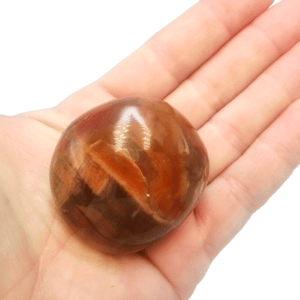
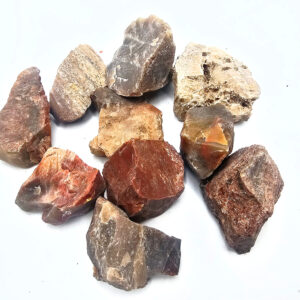
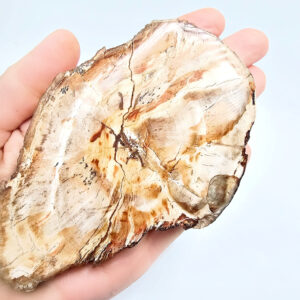
When Wood Becomes Stone
Look closely at a good piece of Petrified Wood and its past can still be visible.
Lines can resemble wood grain, rings may follow the original growth of the tree, and areas that once belonged to bark or internal tissue can remain recognisable even though the original material has undergone an extraordinary transformation.
That meeting of botany and geology is what makes Petrified Wood so fascinating.
What Is Petrified Wood?
Petrified Wood is fossilised wood in which original organic material has been replaced or preserved by minerals.
It is therefore better described as a fossil material than as an individual mineral or crystal species.
Silica is particularly important in many examples. Chalcedony, agate and Quartz can replace or fill the original wood structure, although the precise mineral composition can differ between specimens and localities.
This is why Petrified Wood can feel like stone while still retaining remarkably recognisable features of something that was once a tree.
How Does Wood Become Petrified?
Petrification requires unusual conditions.
Wood first needs to be buried in an environment where rapid decay is restricted. Mineral-rich groundwater can then move through the buried material.
Over long periods, minerals can replace organic tissues and occupy microscopic spaces within the wood.
The result can preserve parts of the original structure in extraordinary detail.
Rather than imagining a wooden branch simply being coated in rock, think of Petrified Wood as a mineralised record of the original plant material.
Depending on the fossilisation process, locality and minerals involved, different specimens can preserve very different levels of detail.
Why Can You Still See Wood Grain?
This is one of the most captivating features of Petrified Wood.
Mineral replacement can occur while microscopic structures within the original wood are retained.
That means a polished cross-section may reveal grain, growth patterns and other structures that still resemble timber, even though much of the original organic material is gone.
Cutting and polishing can make those features particularly easy to see, which is why Petrified Wood slices, palm stones and semi-polished logs can look so different from rough pieces.
Why Does Petrified Wood Have Different Colours?
Petrified Wood doesn't have one compulsory colour.
Pieces can contain cream, tan, brown, grey, black, red and other tones depending on their mineral composition and geological history.
The exact colouring should not be reduced to one universal recipe.
Likewise, a colourful piece isn't automatically dyed simply because it differs from familiar brown wood tones.
When choosing a specimen, look at the individual combination of colour, preserved structure and pattern rather than expecting every piece to match.
Petrified Wood, Agate and Chalcedony
You may see Petrified Wood described as Agatized Wood.
There is a genuine reason for this terminology: some fossil wood has been replaced by or contains chalcedony and agate.
But not every piece of Petrified Wood should automatically be called Agate.
Petrified Wood is the broader fossil-material description, while terms such as agatized or silicified wood tell us more about the mineralisation involved in a particular specimen.
For shopping purposes, Petrified Wood remains the clearest primary name.
Choosing Petrified Wood
Each piece deserves to be viewed as an individual fossil specimen.
Consider:
Preserved grain — some pieces clearly reveal the original wood structure.
Colour — earthy browns can occur alongside cream, grey, red, black and other mineral-derived tones.
Cut — slices can expose internal structures that aren't visible from the exterior.
Polish — polished surfaces often make patterns and colour contrasts easier to see.
Natural shape — rough pieces and log sections can retain more of the fossil's organic-looking character.
Size and weight — larger pieces can become striking display specimens, while smaller pieces are easier to handle or add to a collection.
HIH also carries Petrified Wood within the broader Fossils collection, alongside other remnants and records of ancient life.
A Fossil Rather Than a Crystal Species
Petrified Wood is frequently grouped with crystals and stones in shops, and there is nothing wrong with placing it within a crystal collection.
Scientifically, however, it should not be given its own universal mineral formula.
Different specimens can contain different mineral replacements.
Many are strongly silicified and can contain Quartz, chalcedony or agate, while other forms of mineralisation are possible.
That makes “Fossil material: Petrified Wood” more useful than trying to force every specimen into one mineral identity.
Petrified Wood in Crystal Traditions
Within crystal traditions, Petrified Wood is commonly associated with grounding, patience, stability, resilience, ancestry and connection with the Earth.
Its transformation from once-living wood into fossil material has also inspired symbolic associations with time, endurance, personal growth and respecting the past.
These are metaphysical traditions rather than scientifically demonstrated properties of Petrified Wood.
Claims about unlocking past lives or receiving ancestral knowledge should therefore be presented as spiritual beliefs rather than guaranteed effects of the fossil.
Caring for Petrified Wood
Care should take both the mineralised material and the finish of the specimen into account.
Use gentle cleaning and avoid harsh household chemicals.
Polished slices and palm stones should be protected from hard knocks that could chip edges or damage the polish.
Rough pieces can contain irregular edges or delicate areas, so don't assume a specimen is indestructible simply because it feels stone-like.
Most importantly, preserve the natural surface and structure rather than aggressively scrubbing a specimen in an attempt to make every area look uniformly polished.
Frequently Asked Questions
What is Petrified Wood?
Petrified Wood is fossilised wood in which original organic material has been replaced or preserved by minerals while parts of the original wood structure remain recognisable.
Is Petrified Wood actually wood?
It originated as real wood, but during petrification much of the original organic material is replaced by minerals. What remains is a fossil record of the original plant structure.
Is Petrified Wood a crystal?
Not as a mineralogical classification. Petrified Wood is fossil material and can contain minerals such as Quartz, chalcedony and agate.
Is Petrified Wood the same as Agatized Wood?
Agatized Wood is Petrified Wood in which agate or chalcedony plays an important role in the mineral replacement. Not every piece of Petrified Wood should automatically be described as agate.
What is Petrified Wood traditionally associated with?
Within crystal traditions, Petrified Wood is commonly associated with grounding, stability, patience, resilience, ancestry and connection with the Earth.