
Pink Opal
Blush, dusty rose and creamy pink tones give Pink Opal its wonderfully gentle character. Unlike precious Opal, much Pink Opal is appreciated for its body colour rather than flashes of play-of-colour, with natural markings making individual pieces distinctive. Browse Pink Opal in rough and shaped forms chosen for their colour and character. Within crystal traditions, it is associated with compassion, emotional balance and gentle reflection.
Showing all 2 resultsSorted by latest
Opal Without the Rainbow?
Say “Opal” and many people immediately picture a gemstone flashing with rainbow colours.
Pink Opal can be quite different.
Instead of dramatic play-of-colour, many Pink Opals are loved for their body colour—soft blush, rose, cream and warmer pink tones that can be opaque to translucent.
That quieter appearance gives Pink Opal a character of its own.
What Is Pink Opal?
Pink Opal is a name used for naturally pink opal-bearing gem materials, but not every Pink Opal deposit has exactly the same geological composition.
Well-studied material from Peru and Mexico includes pink opal associated with the clay mineral palygorskite, while material marketed as Pink Opal from Western Australia can have a different geological story.
This means Pink Opal is a category where locality and supplier identification matter.
Rather than assigning one universal microscopic composition to every pink stone carrying the name, product descriptions should follow what is actually known about the individual material.
Pink Opal and Play-of-Colour
One of the most useful things to understand when shopping for Pink Opal is the difference between body colour and play-of-colour.
Body colour is the underlying colour you see in the material—in this case, pink.
Play-of-colour is the shifting spectral display associated with precious Opal.
Many familiar Pink Opals are classed commercially as common Opal and are valued primarily for their natural pink body colour rather than rainbow flashes.
So a Pink Opal without play-of-colour isn't automatically poor quality or “not real Opal”.
Its appeal is simply different.
Where Does Pink Opal Come From?
Peru is particularly well known for Pink Opal, and gemological research has examined naturally pink material from Peruvian deposits.
Pink opal-bearing material is also known from Mexico.
Western Australia produces another material sold as Pink Opal, but this has a different geological identity and is closely associated with the Mookaite deposits.
For HIH, origin should therefore remain product-specific.
If a supplier confirms that a particular piece is Peruvian Pink Opal, that information is valuable. If the locality isn't known, it is better to leave origin unspecified than to assume that every Pink Opal comes from Peru.
What Gives Peruvian Pink Opal Its Colour?
Research into translucent pink opals from Peru and Mexico has found a particularly interesting combination of materials.
These Pink Opals can contain opal-CT together with fine palygorskite fibres.
Research has linked their pink colour to organic compounds known as quinones associated with the material.
This is much more interesting—and more accurate—than simply saying that all Pink Opal is “pink because of trace minerals”.
However, this explanation shouldn't automatically be applied to every commercial Pink Opal unless its material and origin support it.
Pink Opal From Western Australia Is Different
This is where the name becomes particularly interesting.
Material marketed as Pink Opal from the Binthalya prospect near the Mookaite deposits of Western Australia is described as an intensely pink opalised radiolarite and a form related to Mookaite.
That means two stones can both be sold as Pink Opal while having different geological stories.
For collectors, that isn't a problem—it simply makes locality information more important.
For HIH, don't automatically categorise Pink Opal products as Mookaite unless the actual material is verified as the Western Australian variety.
Choosing Pink Opal
With Pink Opal, look at the individual piece rather than searching for one perfect shade.
Consider:
Colour — blush, pale pink, dusty rose and cream can create very different appearances.
Pattern — natural colour changes, veins and markings can add character.
Translucency — some material can appear more opaque while other pieces allow more light through.
Shape — rough pieces retain a more natural appearance, while carvings emphasise smooth surfaces and colour.
Finish — polishing can deepen the apparent colour and make subtle patterns easier to see.
Origin — when reliably known, locality can tell you much more about the particular type of Pink Opal you are buying.
Natural variation is expected and is part of the appeal of the material.
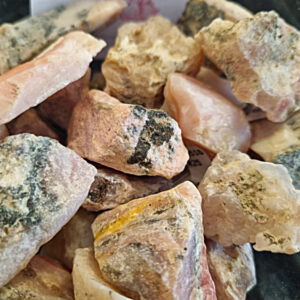
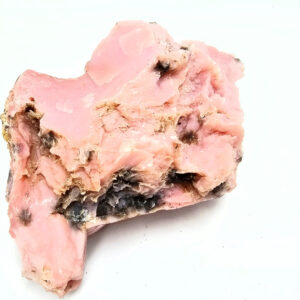
Rough Pink Opal
Rough Pink Opal allows the natural texture, colour variation and irregular shape of the material to remain visible.
A rough piece can reveal pale areas, deeper pink patches, matrix or other geological features that might become less obvious after shaping and polishing.
HIH currently carries Pink Opal in rough form, making it a good choice for collectors who prefer stones with less alteration.
Carved Pink Opal
Polishing and carving reveal another side of Pink Opal.
A smooth surface can make blush and rose tones appear richer, while curved shapes allow colour changes to become visible from different angles.
Small carvings also make Pink Opal an accessible way to enjoy the material beyond traditional tumble stones and jewellery.
The stone itself should remain the focus: colour, finish and natural markings matter more than expecting every carving to look identical.
Pink Opal in Crystal Traditions
Within crystal traditions, Pink Opal is commonly associated with compassion, emotional balance, kindness, love, gentle reflection and the Heart Chakra.
Its soft colour has naturally encouraged symbolic connections with emotional openness and self-compassion.
These are metaphysical traditions rather than scientifically demonstrated effects of Opal.
Avoid promising that Pink Opal will heal trauma, treat anxiety or create a particular emotional outcome.
Its natural colour, unusual geology and gentle appearance already give it plenty of character without medical or psychological promises.
Caring for Pink Opal
Opal deserves gentler treatment than harder Quartz-based stones.
Avoid hard knocks, abrasive cleaning and harsh chemicals.
Don't expose Opal jewellery or polished pieces to sudden extreme temperature changes.
Because different Pink Opal materials can vary in structure and porosity, conservative cleaning is sensible: use a soft, slightly damp cloth rather than prolonged soaking unless you know the particular material is suitable for it.
Carvings should also be protected from drops, particularly where a design contains thin or projecting sections.
Frequently Asked Questions
What is Pink Opal?
Pink Opal is a name used for naturally pink opal-bearing gem materials. Different deposits can have different mineralogical characteristics, so locality can be important when describing a particular specimen.
Does Pink Opal have rainbow colours?
Not necessarily. Much Pink Opal is valued for its pink body colour rather than the play-of-colour associated with precious Opal.
Is all Pink Opal from Peru?
No. Peru is an important source, but Pink Opal material is also documented from Mexico and Western Australia, among other occurrences.
Is Pink Opal the same as Mookaite?
Not generally. However, material marketed as Pink Opal from a particular Western Australian deposit is an opalised radiolarite closely related to Mookaite. This should not be applied automatically to Peruvian Pink Opal.
What is Pink Opal traditionally associated with?
Within crystal traditions, Pink Opal is commonly associated with compassion, love, emotional balance, kindness and gentle reflection.