
Prophecy Stone
Strange ridges, points and sculptural forms make Prophecy Stone look almost otherworldly. Found in Egypt’s White Desert, these natural pseudomorphs form when iron minerals replace earlier Marcasite while preserving its original shape. Crystal traditions associate Prophecy Stone with grounding, insight, meditation and visionary work.
Showing all 3 resultsSorted by latest
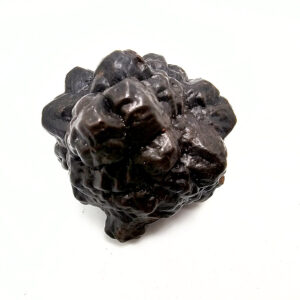
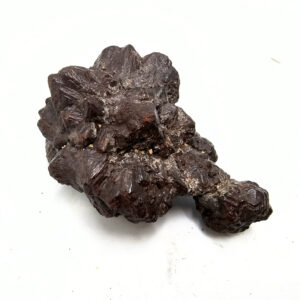
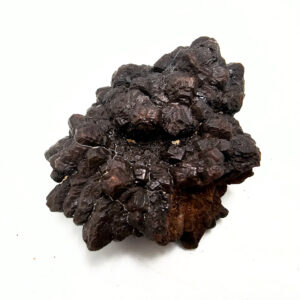
Prophecy Stone: A Geological Shape-Shifter From Egypt
Dark, earthy and covered in strange ridges, points and protrusions, Prophecy Stone can look more like a tiny sculpture than something that formed naturally underground.
But those unusual shapes haven't been carved.
Prophecy Stones from Egypt's White Desert are fascinating examples of pseudomorphism — a geological process in which one mineral is replaced by another while the outward shape of the original crystal survives.
In other words: the mineral changes, but its old shape remains.
What Is Prophecy Stone?
Prophecy Stone is a trade name used for distinctive iron-rich pseudomorphs associated with the White Desert near Farafra in Egypt.
They are commonly described as iron minerals such as Goethite, Hematite and material historically grouped under the name Limonite replacing earlier Marcasite.
Marcasite is an iron sulphide mineral with the formula FeS₂.
During alteration, the original sulphide mineral can be replaced by iron oxide and oxyhydroxide minerals.
Yet the specimen can retain the external form created by the earlier Marcasite.
That's what makes Prophecy Stone so unusual.
What you're holding today isn't necessarily the same mineral that originally created the shape you're looking at.
Browse more unusual natural minerals in our Crystal Names A–Z.
What Is a Pseudomorph?
The word comes from Greek roots meaning roughly false form.
It describes a mineral that has the outward shape associated with another mineral because replacement or alteration occurred after the original crystal had already formed.
Imagine creating a detailed sculpture from one material and then somehow replacing that material particle by particle while leaving the sculpture's shape behind.
Nature can accomplish something remarkably similar.
With Prophecy Stone, the original Marcasite structure acts almost like a geological template.
As alteration takes place, iron-rich minerals replace the earlier material while preserving much of its external form.
It's one of those rare geological concepts that becomes immediately understandable once you have the specimen in your hand.
Did You Know? You're Looking at the Shape of a Mineral That Is No Longer There
This is perhaps the most fascinating thing about Prophecy Stone.
The distinctive form records an earlier stage in the specimen's geological history.
The Marcasite that helped create that structure has subsequently been altered and replaced.
So the shape becomes a kind of mineral memory.
Calling it a “fossil of a crystal” can be a useful visual analogy, although Prophecy Stone isn't literally a fossil.
A more precise description is a pseudomorph after Marcasite.
That's what gives these small, strange specimens such an extraordinary story.
Where Does Prophecy Stone Come From?
The material sold as Prophecy Stone is particularly associated with the White Desert around Farafra in Egypt's Western Desert.
The White Desert is famous for its pale chalk landscape and spectacular naturally eroded formations.
Against that light desert environment, these dark iron-rich mineral forms have an especially unusual appearance.
Hello Indigo Halo's individually selected Prophecy Stone specimens are sourced from Egypt, allowing their origin to form a genuine part of the collection's story rather than simply being assumed from the trade name.
Why Do Prophecy Stones Have Such Strange Shapes?
Prophecy Stones can develop forms that resemble stars, crosses, branching structures, knobbly nodules or tiny objects covered in projecting points.
Those shapes reflect the earlier crystal growth and subsequent pseudomorphic replacement process.
Because the forms are natural, specimens don't need to be symmetrical or perfectly intact.
A broken area can even be useful from a collector's perspective because it may reveal something about the interior structure.
Natural chips, sandy residue, irregular surfaces and variations in colour can therefore be part of the character of an unpolished mineral specimen rather than evidence that it was badly manufactured.
There was no manufacturing process to begin with.
Prophecy Stone, Marcasite & Pyrite
Marcasite and Pyrite have something interesting in common.
Both have the chemical formula FeS₂.
But they are not the same mineral.
They have different crystal structures, which means the atoms are arranged differently even though their basic chemical composition is the same.
This phenomenon is known as polymorphism.
Prophecy Stone is particularly associated with pseudomorphic replacement after Marcasite, so it gives us two fascinating mineralogical ideas in one small specimen:
same chemistry can create different mineral structures, and one mineral can later be replaced while leaving its shape behind.
Is Prophecy Stone the Same as Z-Stone?
Z-Stone is another trade name sometimes used for the material sold as Prophecy Stone.
Neither Prophecy Stone nor Z-Stone is the formal name of an individual mineral species.
They are commercial names used for these distinctive iron-rich pseudomorphic specimens.
For clarity, we use Prophecy Stone as the primary name throughout this collection.
Prophecy Stone Meaning
Within modern crystal traditions, Prophecy Stone is associated with grounding, insight, meditation, inner exploration and visionary work.
Its name reflects its strong contemporary reputation as a meditation stone associated with seeing beyond the obvious and exploring deeper levels of awareness.
Interestingly, its geology gives that symbolism an unusually fitting metaphor.
A Prophecy Stone appears to show one thing on the outside while carrying the record of something that existed before.
For people who work symbolically with crystals, that can lend itself naturally to themes of looking beneath appearances, transformation and discovering what isn't immediately visible.
These are metaphysical traditions rather than scientifically established effects.
Prophecy Stone & the Chakras
Prophecy Stone is commonly associated with the Root Chakra because of its dark iron-rich composition and grounding symbolism.
Modern crystal traditions also connect it with the Third Eye and Crown Chakras, particularly around meditation, intuition, insight and visionary practices.
That creates an unusual symbolic combination:
grounding below while exploring above.
Explore more crystals and spiritual tools through our Chakra Balance collection.
Choosing a Prophecy Stone
Prophecy Stone is a category where the individual specimen matters enormously.
Look at the shape from several directions.
One piece may have long projecting structures. Another may be rounded and knobbly, while another has an almost star-like or mechanical appearance.
Natural surface textures, earthy colours and irregularities are all part of the appeal.
These aren't stones where perfection means every specimen looks the same.
The fascination lies in finding the strange little geological form that appeals to you.
Browse more untouched mineral forms in our Selected Rough Crystals.
Caring for Prophecy Stone
Prophecy Stones are best treated as natural mineral specimens rather than polished everyday stones.
Keep them reasonably dry and avoid soaking, salt water, acids and harsh cleaning products.
The irregular projections and edges can also be more vulnerable to chipping than a rounded polished stone.
For ordinary dust, a soft dry brush is usually the simplest approach.
This also preserves the natural surface rather than trying to make an intentionally rough desert specimen look polished.
Frequently Asked Questions About Prophecy Stone
Are Prophecy Stones naturally shaped?
Yes. Their strange ridges, projections and sculptural forms are natural and relate to the original mineral growth and later pseudomorphic replacement process.
What does “pseudomorph after Marcasite” mean?
It means other minerals replaced the original Marcasite while retaining much of the Marcasite crystal's external form. The chemistry changed, but the earlier shape survived.
Does Prophecy Stone come from Egypt?
The material commonly sold under the Prophecy Stone name is strongly associated with the White Desert near Farafra in Egypt, and the specimens in this Hello Indigo Halo collection are sourced from Egypt.
Is Prophecy Stone the same as Z-Stone?
Z-Stone is another commercial name used for Prophecy Stone material. Neither name represents a formally recognised individual mineral species.
Was Prophecy Stone carved into its unusual shape?
No. That's one of the most fascinating things about it. Its strange geometry is natural and records the mineral growth and replacement processes that produced the specimen.