
Red Calcite
Warm brick red, rust, coral and earthy orange tones give Red Calcite its distinctive character. A natural colour variety of Calcite, it can gain red colouring from mineral inclusions such as Hematite. Within crystal traditions, Red Calcite is associated with vitality, courage, motivation and grounding.
Showing all 2 resultsSorted by latest
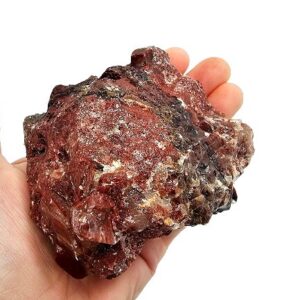
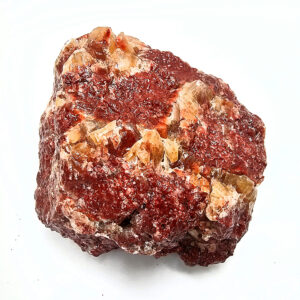
Red Calcite: Earthy Colour in a Classic Carbonate Mineral
From muted rust and terracotta to richer brick red, Red Calcite brings warm earthy colour to one of the world's most fascinating mineral families.
Calcite is calcium carbonate (CaCO₃), but natural specimens can occur in an impressive range of colours.
In Red Calcite, mineral inclusions and impurities can introduce red, reddish-orange and brown tones, sometimes producing wonderfully uneven colour across a single rough specimen.
What Makes Red Calcite Red?
There isn't one explanation that should automatically be applied to every Red Calcite specimen.
Hematite, an iron oxide mineral, is a documented cause of red colouring in some Calcite. Mineralogists even use the variety name Hematoconite for blood-red Calcite coloured by Hematite inclusions.
Other natural material can contain different inclusions and impurities, so we wouldn't identify the exact colouring agent in an individual Hello Indigo Halo specimen simply from its appearance.
What we can see is the result: warm natural colour ranging through red, rust, coral, orange-red and earthy brown.
Why Does Rough Red Calcite Have Flat, Angular Surfaces?
One of Calcite's most characteristic properties is perfect cleavage in three directions.
Cleavage describes the tendency of a mineral to split along particular planes in its crystal structure.
In Calcite, those directions produce characteristic rhombohedral forms.
This means the flat faces and angular edges visible on a rough piece aren't necessarily evidence that somebody has cut it into shape. Some can reflect the way Calcite naturally breaks along its internal structural planes.
It's a useful detail to know when choosing a rough specimen: sometimes the geometry you're looking at is telling you something about the mineral itself.
Explore more natural specimens in our Selected Rough Crystals.
Did You Know? Calcite Can Make One Line Look Like Two
Calcite is famous in mineralogy and optics for double refraction, also called birefringence.
In sufficiently clear Calcite, a beam of light entering the crystal can split into two rays.
Place a clear piece over a printed line and you may actually see two images of that line through the crystal.
The exceptionally clear variety historically known as Iceland Spar became especially important in the study of light and optical behaviour.
Rough Red Calcite is usually too included and opaque for the effect to be displayed as dramatically, but it belongs to the same extraordinary mineral species.
Red Calcite vs Carnelian
Red Calcite and Carnelian can overlap in warm orange-red colouring, but they belong to completely different mineral families.
Red Calcite is calcium carbonate and has a Mohs hardness of approximately 3.
Carnelian belongs to the Chalcedony/Quartz family and is considerably harder, around 6.5–7 on the Mohs scale.
Their surface appearance can also differ. Calcite frequently reveals cleavage surfaces and can look softer, creamier or more opaque, while Carnelian commonly has a waxy lustre and can be translucent around thinner areas.
Colour alone is never the best way to identify a mineral.
Compare the harder Quartz-family stone in our Carnelian collection.
Red Calcite Meaning
Within contemporary crystal traditions, Red Calcite is associated with vitality, courage, motivation, grounding and taking action.
Its symbolism has a more active quality than some of the softer-coloured Calcites.
People are often drawn to Red Calcite when working with intentions around rebuilding momentum, feeling more present and turning an idea into action rather than remaining stuck at the planning stage.
Its earthy red colouring also gives it a natural symbolic connection with physical presence, stability and strength.
These are metaphysical traditions rather than scientifically established effects.
Red Calcite & the Root Chakra
Red Calcite is most commonly associated with the Root Chakra, traditionally connected with grounding, security, stability and our relationship with the physical world.
Its warmer orange-red specimens may also be used in Sacral Chakra traditions involving creativity, enthusiasm and movement.
Natural Red Calcite doesn't need to match one exact shade for crystal practice. A predominantly brick-red piece may feel strongly Root-focused, while warmer coral or orange-red material can lend itself naturally to both associations.
Explore more stones and spiritual tools through our Chakra Balance collection.
Choosing Rough Red Calcite
Rough Red Calcite is particularly good for anyone who enjoys seeing a mineral closer to its natural state.
Look at differences in colour, cleavage surfaces, crystal texture, matrix and natural markings rather than expecting two pieces to match.
One specimen may be dominated by deep earthy red, while another contains orange, cream or brown areas.
Natural fractures and uneven surfaces are also normal in rough Calcite.
Rather than seeking perfect uniformity, choose the specimen whose colour and natural formation appeal most to you.
Caring for Red Calcite
Calcite is relatively soft, measuring approximately 3 on the Mohs hardness scale.
It also has perfect cleavage, so it can scratch and chip more easily than Quartz-family stones.
There is another important characteristic: Calcite is a carbonate mineral and reacts with acids.
Avoid vinegar, lemon juice, acidic cleaners and harsh household chemicals. For ordinary care, gently dust a rough specimen with a soft brush or wipe accessible surfaces with a soft cloth.
Long soaking isn't necessary, particularly with rough specimens whose inclusions or associated minerals haven't been individually identified.
Frequently Asked Questions About Red Calcite
Is Red Calcite naturally red?
Yes. Calcite occurs naturally in several colours, including red. Hematite inclusions are a documented cause of strong red colour in some Calcite, although the exact cause shouldn't automatically be assumed for every specimen.
Is Red Calcite the same as Carnelian?
No. Red Calcite is calcium carbonate, while Carnelian is a Chalcedony variety in the Quartz family. Carnelian is also considerably harder.
Why does rough Red Calcite have flat surfaces?
Calcite has perfect cleavage in three directions, so it can naturally break along smooth, flat planes. Some angular surfaces on rough specimens reflect this internal crystal structure.
Is Red Calcite a soft crystal?
Yes. Calcite measures approximately 3 on the Mohs hardness scale, so it needs gentler handling than harder minerals such as Quartz.
Can Red Calcite be cleaned with vinegar?
No. Vinegar is acidic, and Calcite reacts with acids. A soft dry brush or cloth is a much safer choice for routine care.