
Septarian Dragon Stone
Cracked, filled and transformed over millions of years, Septarian Dragon Stone is famous for its striking natural patterns. Septarian nodules contain mineral-filled fractures that create networks of yellow, brown and earthy tones when cut and polished. Also known as Dragon Stone or Dragon Egg, each piece reveals its own ancient geological pattern.
Showing the single result
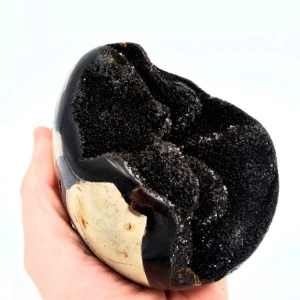
Septarian Dragon Stone: Cracked Open by Nature
Septarian Dragon Stone looks almost deliberately designed.
Golden-yellow areas sit between dark brown lines and earthy grey sections, forming networks that can resemble dragon scales, cracked earth or the shell of some ancient creature.
But those patterns aren't painted or carved into the stone.
They are the result of a geological process in which a sedimentary nodule developed internal cracks that were later filled with minerals.
Cut one open and millions of years of geological change suddenly become visible.
Browse more unusual stones and minerals in our Crystal Names collection.
What Is Septarian?
Septarian isn't one individual mineral species.
It is a type of sedimentary nodule or concretion characterised by internal cracks, known as septa, which become filled with minerals.
The familiar yellow areas are commonly Calcite, while brown areas can contain Aragonite. The surrounding matrix can include limestone, mudstone or clay-rich material, and the exact mineral combination can vary between deposits and individual specimens.
That's why assigning Septarian one simple mineral formula or crystal system doesn't really work.
You're looking at several geological components occurring together.
How Do Septarian Nodules Form?
This is where Septarian gets interesting.
The process begins when sediment becomes cemented into a harder nodule or concretion.
During its geological history, the interior develops shrinkage cracks.
Mineral-rich fluids can then move through those openings, depositing minerals such as Calcite and Aragonite inside the fractures.
Over time, those mineral-filled cracks become the dramatic network revealed when the nodule is sliced, polished or shaped.
Some cavities can remain partly open and develop visible crystal growth inside them, which is why certain Septarian pieces can combine solid patterned stone with sparkling crystalline pockets.
It's essentially a geological crack that became part of the decoration.
Why Is Septarian Called Dragon Stone?
Look at a polished piece and the nickname starts to make sense.
Its dark dividing lines and irregular golden sections can resemble reptilian or dragon scales, while rounded nodules cut or polished into egg shapes naturally lend themselves to the name Dragon Egg.
You'll consequently encounter names including:
Septarian, Septarian Nodule, Septarian Dragon Stone, Dragon Stone and Dragon Egg.
The dragon terminology is a modern descriptive or trade name rather than a geological classification.
The proper geological story is already interesting enough without needing an ancient dragon to explain it.
Septarian Isn't the Only “Dragon Stone”
This is an important distinction when shopping for crystals.
The name Dragon Stone is used for more than one material.
Septarian Dragon Stone usually has the familiar yellow, brown and grey cracked or segmented appearance created by a septarian nodule.
Another material commonly sold as Dragon Stone or Dragonstone Jasper has a very different green and red to reddish-brown appearance.
They aren't simply different colours of the same stone.
When identifying or buying Dragon Stone, look at the full name and the actual material rather than relying on the nickname alone.
What Does a Septarian “Dragon Egg” Look Like Inside?
A rough nodule can hide much of the interesting pattern.
Cutting and polishing across the interior reveals the network of mineral-filled fractures, which is why Septarian is particularly popular for spheres, eggs, slabs and other polished display pieces.
The pattern continues through the material rather than sitting only on the surface.
Turn a sphere and completely different sections of the network can appear.
Egg-shaped pieces make particularly good use of the natural nickname because the combination of rounded form and scale-like pattern really does look as though something mythical might be waiting inside.
Calcite & Aragonite: Same Chemistry, Different Structure
Here's another interesting part of the story.
Calcite and Aragonite have the same basic chemical formula: CaCO₃.
But they're different minerals because their atoms are arranged differently.
Minerals that share the same chemical composition but have different crystal structures are known as polymorphs.
So a Septarian nodule can contain two minerals built from the same basic chemistry while still having different crystal structures and properties.
It's a lovely example of why mineral identification involves more than simply knowing which chemical elements are present.
Septarian Meaning
Within contemporary crystal traditions, Septarian is associated with grounding, confidence, patience, communication and steady personal growth.
Its earthy colours and long geological formation naturally lend themselves to symbolism around stability and staying grounded.
Septarian is also particularly associated with speaking confidently and communicating clearly, which has made it popular for people working around presentations, teaching, meetings and group situations.
These are traditional and metaphysical associations rather than scientifically established effects.
Septarian & the Chakras
Septarian is commonly connected with the Root and Solar Plexus Chakras.
Its earthy brown and grey tones fit naturally with Root Chakra traditions involving grounding and stability, while the golden-yellow Calcite areas are often associated with Solar Plexus themes such as confidence, motivation and personal power.
Some traditions also connect Septarian with communication and the Throat Chakra.
Explore more stones and spiritual tools through our Chakra Balance collection.
Choosing Septarian Dragon Stone
With Septarian, pattern is everything.
Look at how the yellow, brown and grey areas interact.
Some pieces have bold, widely spaced sections. Others contain dense networks of smaller divisions.
Polished pieces can reveal crystal pockets, dramatic dark lines or large golden Calcite areas.
There isn't one ideal pattern.
The attraction is seeing how differently each nodule cracked and mineralised.
If you're choosing a sphere or Dragon Egg, turn it around rather than judging it from one side. The pattern can change dramatically across the piece.
Caring for Septarian
Because Septarian contains several mineral components, it shouldn't be treated as though the entire piece has one uniform hardness.
Calcite is relatively soft at around 3 on the Mohs scale and is sensitive to acids.
Keep Septarian away from vinegar, acidic cleaners and harsh household chemicals.
For normal cleaning, gentle dusting or wiping with a soft, slightly damp cloth is usually sufficient.
Avoid hard knocks too, particularly around natural cavities, crystal pockets or thinner sections.
Frequently Asked Questions About Septarian Dragon Stone
Is Septarian a single crystal?
No. Septarian is a sedimentary nodule or concretion containing several mineral and rock components rather than one mineral species.
Why is Septarian called Dragon Stone?
The nickname comes from its cracked, scale-like pattern, which can resemble dragon or reptile skin. Rounded egg-shaped pieces are also commonly called Dragon Eggs.
What are the yellow parts in Septarian?
The distinctive yellow or honey-coloured areas are commonly Calcite, while darker brown areas can contain Aragonite.
Is Septarian Dragon Stone the same as green Dragon Stone?
No. “Dragon Stone” is used as a trade name for different materials. Septarian and the green-and-red material commonly called Dragon Stone or Dragonstone Jasper should not be treated as the same stone.
Why does every piece of Septarian look different?
The cracks, mineral fillings, cavities and proportions of the different components developed naturally, creating an individual internal pattern in every nodule.