
Shiva Lingam
Sacred in Hindu tradition, Shiva Lingam stones are smooth, elongated stones associated with Lord Shiva and the Narmada River in India. Their earthy markings and distinctive rounded form make every piece unique. Beyond their natural beauty, they are valued for meditation, spiritual practice and symbolism around creation, balance and transformation.
Showing all 3 resultsSorted by latest
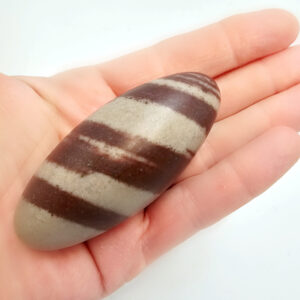

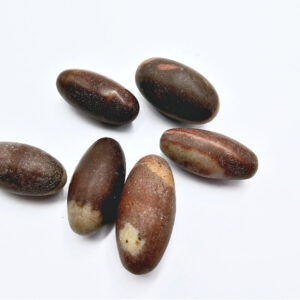
Shiva Lingam: Sacred Stones of the Narmada River
A Shiva Lingam is much more than an unusually shaped stone.
The linga is a sacred symbol of Lord Shiva within Hindu tradition, and naturally rounded stones associated with the Narmada River in India have a longstanding devotional significance.
Their smooth elongated forms, earthy colours and individual markings also make them fascinating natural objects, but their cultural and religious meaning comes first.
For many people, a Shiva Lingam is not simply a crystal or decorative stone. It is a sacred form used in worship, contemplation and spiritual practice.
Explore more stones and minerals in our Crystal Names collection.
What Is a Shiva Lingam Stone?
The Shiva Lingam stones commonly encountered in the crystal trade are associated with the Narmada River in central India.
They are hard, silica-rich stones generally described commercially as cryptocrystalline Quartz-rich material, often with Chalcedony, Jasper-like material and iron-rich markings.
The river naturally rounds and smooths the stones over time. Collected stones may then be further shaped and polished by hand to create the familiar smooth, balanced finish.
Their colours typically move through earthy shades of tan, cream, grey, brown and reddish-brown.
No two markings are expected to be identical.
Why the Narmada River Matters
The Narmada isn't simply a convenient source of attractive river stones.
It is one of India's sacred rivers and holds deep religious significance within Hinduism.
Naturally formed lingam stones from the Narmada are traditionally known as Banalinga or Bana Lingam and are associated with Shiva.
This gives the stone an identity that can't really be separated into “geology over here” and “spiritual meaning over there”.
Its source, shape and religious significance are intertwined.
When Shiva Lingam stones entered the wider crystal and mineral trade, they also developed modern metaphysical associations — but those sit alongside a much older Hindu devotional tradition.
What Does the Shiva Lingam Represent?
The linga is one of the principal symbols of Shiva.
Within Hindu philosophy and worship, its meaning is considerably richer than the oversimplified description of it as merely a phallic symbol.
It can represent Shiva, divine creative power and the formless or transcendent nature of the divine.
The linga is also frequently understood together with the yoni, symbolising the relationship between Shiva and Shakti — consciousness and creative energy, or complementary masculine and feminine principles.
For this reason, ideas of creation, unity and balance have become strongly connected with the Shiva Lingam.
The Shape Isn't Just Decorative
The distinctive elongated oval shape is fundamental to the identity of a Shiva Lingam.
Natural movement in the Narmada helps round the stones before human finishing and polishing refines the form.
This is worth understanding because you'll sometimes see Shiva Lingams described online as though they emerge from the river as perfectly polished, symmetrical eggs.
Nature starts the process.
People finish it.
Small differences in symmetry, markings, shape and surface character are therefore completely normal.
Rather than expecting two Shiva Lingams to match, look at each one as an individual stone.
What Creates the Earthy Markings?
Shiva Lingam stones can show striking combinations of cream, grey, tan, brown, rust and reddish-brown.
Iron-rich minerals and iron oxides contribute to many of the characteristic red and brown markings associated with this material.
Patterns can form patches, lines, swirls and irregular areas across the surface.
The polished shape makes these variations especially visible, but they aren't expected to follow one standard design.
That's why choosing a Shiva Lingam can be surprisingly personal: one stone may have a very quiet pattern while another is dramatically marked.
Shiva Lingam Meaning in Modern Crystal Traditions
Alongside its Hindu religious significance, Shiva Lingam has developed a broad following within contemporary crystal and meditation practices.
It is commonly associated with balance, transformation, vitality, grounding and spiritual growth.
The combination of complementary forces represented through Shiva and Shakti has also made it particularly associated with inner balance and wholeness.
Some people hold a smaller Shiva Lingam during meditation, while larger pieces may be placed on an altar or in a dedicated spiritual space.
These modern metaphysical associations should be understood alongside — rather than as a replacement for — the stone's Hindu religious significance.
Browse more tools for personal spiritual practice in our Esoteric collection.
Shiva Lingam & Kundalini Traditions
Shiva Lingam stones are also used within some contemporary practices involving Kundalini and the Chakra system.
Shiva and Shakti hold important places within traditions surrounding consciousness and divine energy, while Kundalini is symbolically described as energy resting at the base of the spine and rising through the subtle body.
Modern crystal practices consequently connect Shiva Lingam with grounding, vitality and the movement or balancing of energy through the Chakras.
These are spiritual traditions and metaphysical associations rather than scientifically established physical effects.
Explore more tools used in modern Chakra practices through our Chakra Balance collection.
Choosing a Shiva Lingam
There isn't one ideal pattern or colour.
Look at the overall shape, natural markings and size and choose the individual stone that appeals to you.
Smaller pieces are easy to hold during meditation or keep in a personal spiritual space.
Larger Shiva Lingams have more visual presence and allow the natural markings to become a greater part of the piece.
Natural differences in shape, colour and pattern are expected rather than flaws.
Caring for a Shiva Lingam Stone
Quartz-rich Shiva Lingam material is relatively durable, but sensible stone care is still appropriate.
For routine cleaning, wipe the surface gently with a soft damp cloth and dry it afterwards.
Avoid harsh household chemicals and hard impacts.
If your Shiva Lingam is kept as a sacred or devotional object, its spiritual care and handling may naturally follow the particular tradition or practice in which it is being used.
Frequently Asked Questions About Shiva Lingam
Where do Shiva Lingam stones come from?
The Shiva Lingam stones known in the crystal trade are traditionally associated with the Narmada River in India, a river with deep sacred significance within Hinduism.
Is Shiva Lingam a mineral?
Not in the same way that Quartz, Ruby or Calcite are mineral names. Shiva Lingam refers to a sacred form and, in the crystal trade, to the distinctive rounded Quartz-rich stones associated with the Narmada River.
Are Shiva Lingam stones naturally shaped?
The river naturally rounds and smooths the stones, after which collected pieces may be further shaped and polished by hand to create the familiar finished form.
Why does every Shiva Lingam look different?
Natural variations in the stone, iron-rich markings, colour and shape give individual Shiva Lingams their own patterns and character.
What is another name for a Shiva Lingam stone?
Narmada Shiva Lingams may also be referred to as Banalinga, Bana Lingam or Narmada Lingam, particularly in reference to their traditional Hindu context.