
Starburst Jasper
With pale star-like patterns scattered across an earthy brown background, Starburst Jasper has a wonderfully distinctive appearance. Despite its familiar trade name, this patterned stone is more accurately described as a type of Rhyolite rather than true Jasper. In crystal traditions, it is associated with grounding, optimism, confidence and positive forward movement.
Showing the single result
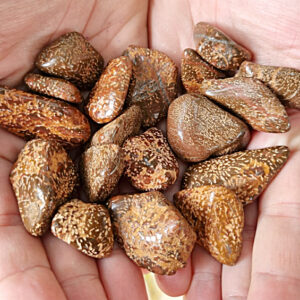
Starburst Jasper: A Volcanic Rock Full of Little Stars
Look closely at Starburst Jasper and its name begins to make sense.
Against an earthy brown background are lighter markings that can resemble tiny stars, flowers or miniature bursts spreading through the stone.
But there is another surprise hidden behind the name.
Despite being widely sold as Jasper, Starburst Jasper is more accurately described as a patterned Rhyolite — a volcanic rock rather than a true Jasper variety.
Explore more unusual stones and trade varieties in our Crystal Names collection.
Is Starburst Jasper Really Jasper?
Not mineralogically.
Starburst Jasper is a trade name, and the material sold under this name is generally identified as Rhyolite.
Rhyolite is a silica-rich volcanic rock composed predominantly of minerals such as Quartz and Feldspar.
Jasper, by comparison, is an opaque variety of microcrystalline Quartz or Chalcedony.
The two can both take an excellent polish and develop beautiful natural patterns, which helps explain why many patterned rocks have acquired “Jasper” names in the crystal and lapidary trade.
So the familiar name isn't something we need to throw away.
Starburst Jasper is the trade name customers know; Rhyolite tells us more accurately what the stone actually is.
What Creates the Starburst Patterns?
The pale markings aren't little fossils, flowers or stars trapped inside the stone.
They're part of the rock itself.
Material sold as Starburst Jasper typically has a darker brown Rhyolite groundmass containing lighter Feldspar-rich patterns.
Because Rhyolite forms from silica-rich magma or lava, different minerals can crystallise as the molten material cools.
The contrasting mineral growth produces the unusual pale shapes that inspired names such as Starburst Jasper and Star Jasper.
Some look remarkably like tiny exploding stars.
Others resemble flowers, spiders or branching shapes.
Nature apparently wasn't particularly concerned about keeping the pattern consistent.
What Is Rhyolite?
Rhyolite is an igneous volcanic rock.
It forms from silica-rich molten material and is often described as the volcanic counterpart of Granite because the two can have broadly similar silica-rich compositions but cool under very different conditions.
Granite generally cools slowly underground, giving its minerals time to develop relatively large visible crystals.
Rhyolitic material cools at or near the Earth's surface, so its mineral grains are usually much finer.
Starburst Jasper's unusual patterning gives us a particularly decorative example of this volcanic-rock family.
Every Starburst Jasper Is Different
Natural pattern variation is one of the best features of this stone.
One piece may contain bold cream or tan stars against dark brown.
Another may have smaller scattered markings.
Some patterns look floral, while others resemble fireworks, tiny spiders or abstract shapes.
Polishing makes the contrast easier to see and can reveal patterns that weren't obvious on the rough surface.
That's why Starburst Jasper tumble stones are particularly appealing — every little stone presents its own version of the pattern.
Browse more individually patterned stones in our Tumbled Stones collection.
Starburst Jasper, Star Jasper & Star Rhyolite
Trade names for patterned stones can become complicated.
You may encounter this material sold as Starburst Jasper, Star Jasper, Starry Jasper or Star Rhyolite.
Of those names, Star Rhyolite is the most informative geologically because it acknowledges the rock's Rhyolite identity.
Starburst Jasper remains useful commercially because it is the name many crystal collectors and shoppers recognise.
Rather than pretending one name doesn't exist, we prefer explaining the difference.
Starburst Jasper Meaning
Within contemporary crystal traditions, Starburst Jasper is associated with grounding, optimism, confidence, motivation and a positive outlook.
Its earthy appearance connects naturally with the grounding symbolism commonly given to Jasper and other brown stones, while its radiating star-like markings have inspired associations with movement, inspiration and possibility.
It is often chosen when the intention is to stay grounded while finding the confidence to try something new, regain momentum or move forward with greater optimism.
These are traditional and metaphysical associations rather than scientifically established effects.
Starburst Jasper & the Root Chakra
Starburst Jasper is commonly associated with the Root Chakra because of its earthy brown colouring and grounding symbolism.
Within modern Chakra traditions, the Root Chakra is connected with stability, security and having a firm foundation from which to move forward.
That gives Starburst Jasper an appealing symbolic combination:
feet on the ground, eyes on what comes next.
Explore more stones and spiritual tools through our Chakra Balance collection.
Choosing Starburst Jasper
With Starburst Jasper, the pattern should guide your choice.
Look at the distribution, size and shape of the pale markings rather than expecting every stone to match a reference photograph exactly.
Some pieces may be predominantly dark and earthy.
Others can contain much more prominent pale patterning.
Neither is inherently better.
Natural differences in colour, shape and pattern are exactly what make polished pieces interesting.
Caring for Starburst Jasper
Polished Starburst Jasper is suitable for normal handling, but like any natural stone it can still chip or fracture if dropped onto a hard surface.
Clean tumble stones with a soft cloth and lukewarm water, using a little mild soap when necessary.
Avoid harsh household chemicals, abrasive cleaners and hard impacts.
Frequently Asked Questions About Starburst Jasper
Is Starburst Jasper a real Jasper?
Starburst Jasper is a genuine natural stone, but despite its commercial name, the material is more accurately classified as patterned Rhyolite rather than true Jasper.
Is Starburst Jasper the same as Star Rhyolite?
These names are commonly used for the same or closely corresponding commercial material. Star Rhyolite is the more geologically descriptive name, while Starburst Jasper is widely used in the crystal trade.
Are the star patterns natural?
Yes. The pale star-like markings are naturally occurring mineral patterns within the rock rather than painted or artificially added designs.
Does every Starburst Jasper have perfect stars?
No. Natural pieces can contain stars, flower-like markings, branching shapes or more abstract pale patterns. Each cut through the rock reveals something slightly different.
Why is it still called Jasper if it is Rhyolite?
Commercial stone names don't always follow strict mineralogical classification. Starburst Jasper became an established trade name because of the stone's appearance and lapidary use, while Rhyolite more accurately describes its geology.