
Tanzanite
Blue, violet and flashes of purple give Tanzanite its unmistakable character. This remarkable gemstone is the blue-to-violet variety of Zoisite and comes from a remarkably restricted source in northern Tanzania. Its colour can shift as the stone is viewed from different directions, adding another layer to its appeal. Browse Tanzanite stones and jewellery for their individual colour and character. Within crystal traditions, Tanzanite is associated with intuition, communication and spiritual awareness.
Showing the single result
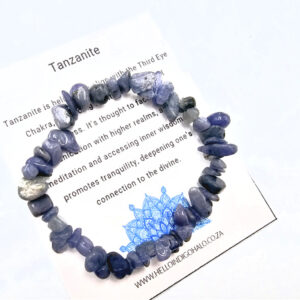
A Gemstone With One Remarkable Home
Few gemstones have a name that tells their story quite as neatly as Tanzanite.
Its blue, violet and purplish colours are immediately distinctive, but its origin makes it even more unusual: Tanzanite is associated with a remarkably restricted gem-producing area in northern Tanzania.
That combination of colour, locality and fascinating optical behaviour has made it one of the modern gem world's most recognisable stones.
What Is Tanzanite?
Tanzanite is the blue-to-violet gem variety of the mineral Zoisite.
Zoisite itself can occur in other colours and forms, but the name Tanzanite is associated with the gem material famous for its violet-blue to bluish-violet appearance and Tanzanian origin.
Its chemical formula is Ca₂Al₃(SiO₄)₃(OH), and it has a Mohs hardness of approximately 6–7.
That makes Tanzanite a genuine mineralogical variety rather than simply a decorative trade name invented for any blue stone.
Why Is It Called Tanzanite?
Tanzanite is a surprisingly recent arrival in the international gemstone world.
Gem-quality blue-violet Zoisite was brought to wider attention during the 1960s, with the important deposits located in the Merelani Hills of northern Tanzania.
The name Tanzanite was introduced in honour of Tanzania and became far more commercially appealing than calling the gemstone “blue Zoisite”.
Its connection with Tanzania isn't merely historical branding. Locality is fundamental to the gemstone's identity.
Tanzanite Changes With the Viewing Direction
One of Tanzanite's most fascinating characteristics is pleochroism.
Pleochroic gemstones can display different colours when viewed along different crystal directions.
In Tanzanite, this can create shifts between blue, violet and other tones.
This also matters when Tanzanite is cut. A cutter can orient a gemstone to emphasise a particular face-up colour, balancing the desired appearance against how much of the original rough can be retained.
So when comparing Tanzanite, don't judge the gemstone from one photograph or one viewing angle alone.
Movement and lighting can reveal much more of its personality.
Is Tanzanite Heat Treated?
Heat treatment is extremely common in Tanzanite.
Much of the material begins with a stronger brownish component. Controlled heating is routinely used to develop the predominantly blue-to-violet appearance associated with Tanzanite in the jewellery trade.
Importantly, this isn't something that should automatically be hidden or treated as evidence of a “fake” gemstone.
Heat-treated Tanzanite is still natural Tanzanite.
Treatment should nevertheless be disclosed accurately when known, and HIH shouldn't advertise an individual product as unheated Tanzanite unless supplier information genuinely supports that statement.
Does Darker Tanzanite Mean Better Tanzanite?
Not automatically.
Colour is extremely important in Tanzanite, and richly saturated blue and violet-blue material can be particularly desirable.
But size also influences how colour appears. Smaller stones can naturally appear paler than larger examples.
When choosing Tanzanite, consider the complete stone:
Colour — look at its balance of blue and violet.
Saturation — compare softer pastel stones with richer, deeper material.
Pleochroism — move the stone and watch for changes in colour.
Clarity — inclusions can influence appearance and durability.
Cut or shape — orientation affects how the colour presents face-up.
Individual character — choose the stone that appeals to you rather than relying solely on commercial quality labels.
Be Careful With AAA Tanzanite Grades
You may see Tanzanite advertised online as A, AA, AAA or AAA+.
These aren't universal gemological grades.
Individual suppliers and jewellery businesses can create their own quality scales, which means one seller's “AAA” isn't necessarily equivalent to another seller's AAA.
For HIH, actual descriptive information is more useful.
Describe the real colour, size, clarity, shape and treatment information available for the product rather than relying on impressive-looking grades without explaining what they mean.
Tanzanite and December Birthdays
Tanzanite is recognised as a December birthstone, alongside other December gems such as Turquoise and Zircon.
It is also associated with the 24th wedding anniversary.
That gives Tanzanite genuine gifting relevance without needing to overwhelm the main category with birthday terminology.
For a December gift, its Tanzanian origin and shifting blue-violet colour also give you a much richer story to tell than simply calling it a birthstone.
Tanzanite in Crystal Traditions
Within crystal traditions, Tanzanite is commonly associated with intuition, communication, insight, spiritual awareness and personal reflection.
Its blue-violet colour also leads to symbolic connections with the Throat and Third Eye Chakras.
These are metaphysical traditions rather than scientifically demonstrated effects of Tanzanite.
Avoid promises that Tanzanite treats anxiety, heals illness, activates psychic powers or guarantees spiritual transformation.
Its extraordinary colour, pleochroism and Tanzanian origin already give the gemstone plenty of magic.
Caring for Tanzanite
Tanzanite needs more thoughtful care than its rich colour might suggest.
Although it has a Mohs hardness of approximately 6–7, hardness isn't the complete durability story. Zoisite has cleavage and Tanzanite can fracture when subjected to hard blows.
Use warm, mild soapy water for cleaning and handle the stone gently.
Avoid ultrasonic and steam cleaners, sudden extreme temperature changes and harsh impacts.
Tanzanite used in earrings and pendants is relatively protected, while rings and bracelets are more exposed to accidental knocks and abrasion.
For chip jewellery in particular, avoid crushing or striking the stones against hard surfaces.
Frequently Asked Questions
What is Tanzanite?
Tanzanite is the blue-to-violet gem variety of the mineral Zoisite, associated with the Merelani mining area of northern Tanzania.
Is Tanzanite only found in Tanzania?
Commercial gem Tanzanite is associated with a remarkably restricted source in northern Tanzania, which is also the origin of its name.
Is Tanzanite naturally blue?
Tanzanite is natural Zoisite, but most commercial Tanzanite is routinely heat-treated to develop or enhance the familiar blue-to-violet appearance from material that initially has a stronger brownish component.
Is Tanzanite a December birthstone?
Yes. Tanzanite is recognised as a December birthstone and is also associated with the 24th wedding anniversary.
Is Tanzanite safe in an ultrasonic cleaner?
No. Warm soapy water is the safer cleaning method. Ultrasonic and steam cleaners are not recommended for Tanzanite.