
Zebra Calcite
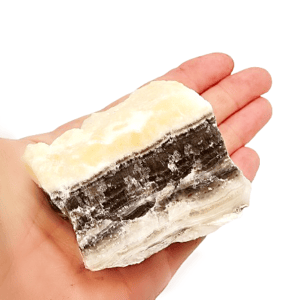
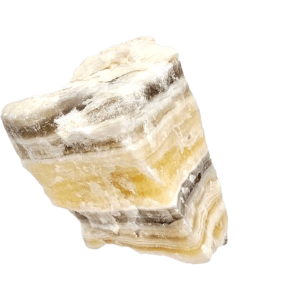
Bands, stripes and sweeping layers give Zebra Calcite its wonderfully graphic appearance, with contrasting cream, white, honey, brown and darker markings creating naturally individual patterns. “Zebra Calcite” is a commercial name used for decorative banded carbonate material, so colour and mineral composition can vary between specimens. Browse Zebra Calcite for its striking natural patterning and earthy character. Within crystal traditions, it is associated with balance, motivation and grounded energy.
Showing all 4 resultsSorted by latest

A Stone Defined by Its Stripes
Zebra Calcite earns its name from pattern rather than one compulsory colour.
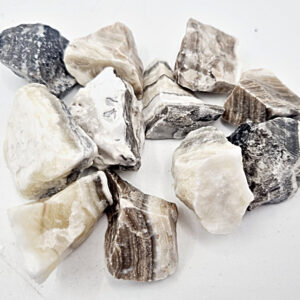
Bands can sweep across the material in cream, white, golden, honey, tan, brown and darker earthy shades, producing everything from relatively straight stripes to flowing, irregular layers.
Cutting and polishing can reveal these patterns beautifully.
One piece may contain broad dramatic bands while another has finer lines and much softer contrast. That variation is exactly what makes this material interesting to browse individually.
What Is Zebra Calcite?
“Zebra Calcite” is best understood as a commercial or lapidary name for attractively banded carbonate material rather than the name of a separate recognised mineral species.
Material sold under this name is commonly associated with Calcite-rich, layered formations, but identification can become more complicated because naturally deposited carbonate material may also contain Aragonite or have a travertine-like structure.
For HIH, the safest approach is to keep Zebra Calcite as the familiar shopping name while making product-level mineral claims only when they are supported by supplier information.
What Creates the Zebra Pattern?
The distinctive appearance comes from repeated layers or zones of differently coloured carbonate material and associated impurities.
Rather than being painted onto the stone, these patterns develop as part of the material's natural formation.
When a piece is cut across those layers, the internal structure becomes visible as stripes, curves and irregular bands.
Different cutting directions can therefore make pieces from similar material look surprisingly different.
That's particularly noticeable in polished points, free forms, spheres and other shaped pieces where the pattern can travel around several surfaces.
Is Zebra Calcite Always Black and White?
No.
The word “zebra” describes the banded appearance, not a compulsory black-and-white colour combination.
Depending on the material, Zebra Calcite can show combinations of white, cream, beige, yellow, honey, caramel, brown and darker earthy tones.
Some specimens may have strong contrast. Others can be much softer.
Colour alone shouldn't be used to decide whether a piece belongs in this category.
The banded structure and reliable material identification are more important.
Is Zebra Calcite a Recognised Calcite Variety?
Not in the same way that Calcite itself is a recognised mineral species.
Zebra Calcite is primarily a descriptive commercial name.
This distinction matters because visually similar banded carbonate rocks and decorative materials can be marketed under overlapping names.
For shoppers, Zebra Calcite remains a useful familiar name.
For detailed specifications, however, avoid presenting “Zebra Calcite” as though it has a unique chemical formula or universally fixed mineral composition separate from Calcite.
Calcite and Aragonite
Calcite and Aragonite are particularly interesting because both are calcium carbonate minerals with the formula CaCO₃, but they have different crystal structures.
Naturally deposited carbonate material can contain one or both depending on its geological history.
This means a decorative piece marketed as Zebra Calcite shouldn't automatically be described as 100% pure Calcite unless its identification supports that claim.
If supplier information identifies a piece as Calcite and Aragonite, disclose both rather than simplifying it for the sake of the product name.
Zebra Calcite or Zebra Stone?
These names shouldn't be treated as synonyms.
Zebra Calcite is a commercial name used for banded carbonate material.
Zebra Stone or Zebra Rock can refer to completely different banded rocks.
A famous Australian Zebra Stone, for example, is a sedimentary rock dominated by Quartz particles and fine mica rather than a variety of Calcite.
The striped appearance creates the similar nickname—the geology can be entirely different.
That makes accurate product naming particularly important.
Choosing Zebra Calcite
This material is best chosen with your eyes.
Consider:
Banding — compare broad layers with fine, closely spaced stripes.
Contrast — some pieces have dramatic dark-and-light patterns while others blend softer earthy shades.
Cut — the direction in which the material is shaped can dramatically change the visible pattern.
Surface — polishing can make colour differences and internal structures easier to appreciate.
Natural features — small cavities, changes in texture and irregular layers may reflect how the carbonate material formed.
Mineral identification — when detailed composition matters to you, check the information supplied for the individual piece.
There is no single “perfect” Zebra Calcite pattern.
Choose the piece whose natural markings appeal to you.
Zebra Calcite in Crystal Traditions
Within crystal traditions, Zebra Calcite is commonly associated with balance, motivation, grounded energy, determination and bringing contrasting energies into harmony.
Its layered appearance naturally lends itself to symbolism around balance and opposites.
These are metaphysical traditions rather than scientifically demonstrated effects of Zebra Calcite.
For product descriptions, keep those traditions separate from geological facts rather than presenting spiritual associations as mineral properties.
Caring for Zebra Calcite
Zebra Calcite should be treated gently.
Calcite itself has a Mohs hardness of only around 3, making it considerably softer than Quartz and many other familiar collection stones.
Use a soft dry cloth for routine dusting. When the individual material is confirmed as Calcite and cleaning is necessary, gentle treatment is preferable.
Avoid harsh chemicals, acids, abrasive cleaners and hard knocks.
Acids are particularly inappropriate for carbonate minerals such as Calcite.
Store polished pieces away from harder stones that could scratch their surfaces.
Frequently Asked Questions
What is Zebra Calcite?
Zebra Calcite is a commercial name commonly used for naturally banded carbonate material with contrasting stripes and layers. The precise composition can vary, so individual product identification is useful.
Is Zebra Calcite a separate mineral?
No. “Zebra Calcite” is a descriptive commercial name rather than a recognised separate mineral species.
Is Zebra Calcite always black and white?
No. It can include cream, white, yellow, honey, tan, brown and darker earthy shades. “Zebra” refers primarily to its contrasting banded appearance.
Is Zebra Calcite the same as Zebra Stone?
No. Zebra Stone is a name used for other banded rocks, including an Australian sedimentary rock that is mineralogically different from Calcite-rich Zebra Calcite.
What is Zebra Calcite traditionally associated with?
Within crystal traditions, Zebra Calcite is commonly associated with balance, motivation, grounded energy and determination.