
Orange Calcite
Warm orange, honey and golden tones give Orange Calcite its bright, uplifting appearance. This colourful variety of Calcite is loved in rough pieces, polished stones and crystal shapes, while modern crystal traditions associate it with creativity, motivation, confidence and positive energy, particularly around the Sacral and Solar Plexus Chakras.
Showing all 3 resultsSorted by latest


Orange Calcite: Warm Colour in a Fascinating Mineral
With shades ranging from soft peach and honey to warm orange and golden amber, Orange Calcite has an unmistakably sunny appearance.
It belongs to the much larger Calcite family — one of the most widespread and fascinating mineral groups — but its warm colouring gives it a very different character from white, clear or green varieties.
At Hello Indigo Halo, Orange Calcite can appear in both its natural rough form and polished crystal shapes, allowing you to see how differently the same mineral can look before and after polishing.
What Is Orange Calcite?
Orange Calcite is a colour variety of Calcite, a calcium carbonate mineral with the chemical formula CaCO₃.
Pure Calcite is colourless or white, but natural Calcite occurs in a surprisingly broad range of colours when other mineral matter, trace elements or inclusions are present.
Orange material can range from pale creamy peach through stronger orange, honey and amber-like shades.
Because the exact cause of colour can vary between specimens and localities, it is better not to claim that every piece of Orange Calcite gets its colour from one particular trace element.
Browse more individual stones and minerals through our Crystal Names A–Z.
Did You Know? Calcite Can Split an Image in Two
One of Calcite's most famous physical properties is double refraction, or birefringence.
In sufficiently clear Calcite, light entering the crystal is split into two rays.
Place a transparent piece over a line of text and you can actually see two images of the same letters.
This effect became particularly famous through clear Iceland Spar, but it comes from Calcite's crystal structure rather than being exclusive to one colour variety.
Orange Calcite is usually less transparent, so your individual piece may not give you the dramatic textbook demonstration.
But mineralogically, it belongs to the same remarkable Calcite family.
Why Does Rough Orange Calcite Look So Angular?
Orange Calcite rough can contain flat faces, steps and angular-looking breaks that are easy to mistake for ordinary fractures.
Many are connected with cleavage.
Calcite has three directions of perfect cleavage and characteristically breaks into rhombohedral forms rather than cubes.
This is why a rough piece can reveal surprisingly geometric surfaces even when it hasn't been deliberately cut into a crystal point.
The natural rough material lets you see some of that mineral structure particularly well, while polishing creates a completely different tactile appearance.
Explore more unpolished specimens in our Selected Rough Crystals.
Orange Calcite Is Softer Than It Looks
Calcite has a Mohs hardness of approximately 3.
For comparison, Quartz is considerably harder at Mohs 7.
That means Orange Calcite can scratch more easily than many familiar crystals and deserves gentler handling.
Its cleavage also means a sharp knock can break the stone along natural structural planes.
This doesn't make Calcite unsuitable for collecting or polished shapes. It simply means that a bright polished palm stone shouldn't be treated as though it has the same durability as Quartz.
Calcite Has Another Famous Trick: It Reacts With Acid
Calcite is a carbonate mineral, and one of the classic ways geologists identify it is through its reaction with dilute acid.
Calcite can effervesce or fizz as carbon dioxide gas is released during the reaction.
It's such a characteristic property that the acid test has long been used in mineral and rock identification.
That does not mean we recommend pouring household acids over your Orange Calcite at home.
The same chemistry is actually a reason to keep Calcite away from acidic cleaners and substances that could dull or damage its surface.
Orange Calcite Meaning
Within modern crystal traditions, Orange Calcite is associated with creativity, motivation, confidence, optimism and emotional movement.
Its bright colouring has naturally encouraged associations with enthusiasm and renewed energy, making it popular when someone feels creatively stuck or wants a symbolic reminder to begin moving forward again.
Orange Calcite is also often chosen around intentions involving enjoyment, inspiration and approaching life with greater spontaneity.
These are traditional and metaphysical associations rather than scientifically established effects.
Orange Calcite & the Sacral Chakra
Orange Calcite is especially associated with the Sacral Chakra in contemporary crystal traditions.
The Sacral Chakra is traditionally connected with creativity, pleasure, emotion, relationships and the ability to embrace change.
Orange is also the colour commonly used to represent this energy centre, making the association with Orange Calcite particularly intuitive.
Some traditions additionally connect its golden-orange shades with the Solar Plexus Chakra, associated with confidence, motivation and personal will.
Browse more crystals and spiritual tools through our Chakra Balance collection.
Choosing Orange Calcite
The best form depends on what you enjoy about the stone.
Rough Orange Calcite preserves natural textures, cleavage surfaces and irregular shapes, making it particularly interesting if you like seeing crystals closer to their unpolished state.
A palm stone brings out the colour differently, with a smooth surface that makes it comfortable to hold and easy to turn in the light.
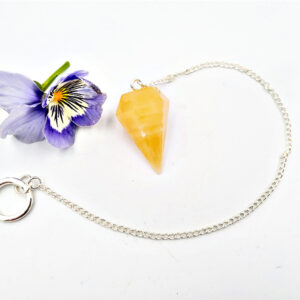
A pendulum combines the warm colouring of Orange Calcite with a traditional divination tool.
Natural pieces can vary in colour, translucency, markings, surface texture and internal features, so variation between individual stones is expected.
Caring for Orange Calcite
Because Calcite is relatively soft, store Orange Calcite away from harder crystals that may scratch it.
Avoid harsh cleaners, acids and prolonged contact with water or cleaning solutions.
For ordinary dust, use a soft dry cloth or gentle brush. If a polished piece needs more cleaning, keep it brief and gentle rather than soaking it.
Take particular care with rough pieces, where natural cleavage edges may be more delicate.
Frequently Asked Questions About Orange Calcite
Is Orange Calcite a type of Calcite?
Yes. Orange Calcite is a naturally coloured form of the calcium carbonate mineral Calcite.
Is Orange Calcite the same as Carnelian?
No. Orange Calcite is calcium carbonate, while Carnelian is a variety of Chalcedony made primarily from silica. Their warm colours can overlap, but they are completely different mineral materials.
Why does Orange Calcite have flat-looking surfaces?
Calcite has perfect cleavage in three directions. Natural breaks along these structural planes can create flat, angular or step-like surfaces in rough specimens.
Can Orange Calcite scratch easily?
Relatively speaking, yes. Calcite has a Mohs hardness of about 3, so it is softer than Quartz and many other common crystals.
What chakra is Orange Calcite associated with?
Orange Calcite is most commonly associated with the Sacral Chakra and is also sometimes connected with the Solar Plexus Chakra in modern crystal traditions.