
Amber
Golden, glowing and millions of years removed from its beginnings as tree resin, Amber is an organic gem rather than a mineral crystal. Browse Amber jewellery and fossil-resin pieces in warm honey, yellow and earthy tones. Within crystal traditions, Amber is commonly associated with warmth, protection, confidence, vitality and the bright symbolism of the Sun.
Showing all 3 resultsSorted by latest
A Gem That Started in a Tree
Amber breaks quite a few of the usual crystal rules.
It does not grow as a mineral crystal underground. It began as resin produced by ancient trees, then hardened and changed through geological processes over millions of years.
That makes Amber an organic gem.
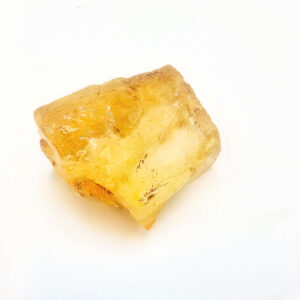
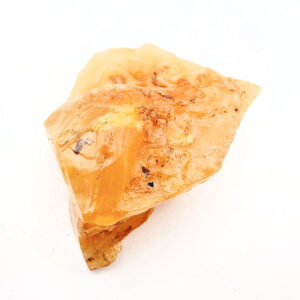
Its origin helps explain why Amber can look so different from mineral gemstones. It can be transparent, cloudy or almost opaque, with colours moving through pale yellow, honey and golden orange into richer reddish and brown tones.
Some pieces even preserve tiny fragments of an ancient world inside them.
Is Amber Actually a Crystal?
Mineralogically, no.
Amber is fossilised tree resin rather than a mineral with an ordered crystal structure.
That does not stop it belonging comfortably within the wider gemstone world. Amber has been used for beads, carvings, jewellery and decorative objects for thousands of years.
At Hello Indigo Halo, the Crystal Names system is also a customer navigation system rather than a strict mineralogical database. It already includes fossils, organic materials and man-made materials alongside minerals.
So Amber makes sense here as long as the product descriptions accurately explain what it is.
If you enjoy browsing materials according to their individual names and stories, our Crystal Names collection brings those different materials together in one place.
Why Does Amber Look So Warm?
The classic Amber palette sits around yellow, honey, orange and golden brown.
That familiar warm glow is one reason Amber has been used decoratively for so long.
But Amber does not have one compulsory colour.
Different material can be pale and transparent, rich golden yellow, cloudy, reddish or much darker. Gas bubbles and other inclusions can also alter its clarity and appearance.
That means a cloudy piece is not automatically inferior to a transparent one.
They simply show different characteristics.
With natural Amber, colour, clarity and inclusions are part of the individual material rather than something every piece should match exactly.
Amber Can Be a Tiny Time Capsule
One of Amber's most famous characteristics is its ability to preserve inclusions.
While tree resin was still sticky, it could trap plant fragments, tiny insects, air bubbles and other debris. As that resin eventually became Amber, some of those inclusions remained sealed inside.
Not every piece contains an insect.
In fact, an ordinary Amber piece should never be marketed as insect-bearing unless an inclusion is genuinely visible and verified.
But the possibility gives Amber an extraordinary connection to the environments in which the original resin-producing trees lived.
That is something a newly formed mineral cannot quite imitate.
Amber and Copal Are Not the Same Thing
This distinction matters when shopping for fossil resin.
Amber is mature fossilised tree resin that has undergone extensive chemical changes over geological time.
Copal is related resin material that is less mature.
Both can be attractive. Both can be used ornamentally. And to an untrained eye, they can sometimes look extremely similar.
But the names should not be treated as interchangeable.
If a piece is known to be Copal, it should be sold as Copal.
If it is verified Amber, it can be sold as Amber.
And if supplier information is uncertain, it is better to investigate the material than turn “Copal Amber” into a convenient catch-all description.
For HIH, this distinction is especially important because current Amber product information uses both terms.
Why Is Amber So Light?
Pick up Amber after handling a similarly sized mineral stone and the difference can be surprising.
Amber is lightweight because it is organic fossil resin rather than dense mineral material.
That makes it particularly appealing for jewellery.
Larger-looking Amber beads or pieces can often be worn without the weight you might expect from similarly sized mineral gemstones.
Its relative softness is the trade-off.
Amber needs gentler treatment than hard quartz jewellery.
Amber Chips in Jewellery
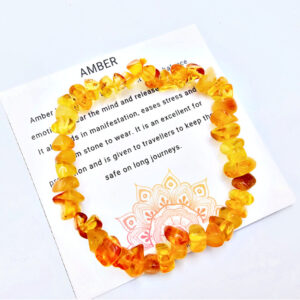
The current HIH range includes Amber in chip-bangle form.
Chips preserve irregular shapes rather than cutting every piece into an identical round bead. That suits Amber particularly well because colour and translucency can vary from piece to piece.
A chip bracelet can therefore create a mixture of golden tones around the wrist instead of presenting one perfectly uniform surface.
If you enjoy that irregular jewellery construction, browse our wider Gem Chips Bangles collection.
The important thing is accurate material identification.
Whether a bracelet contains Amber or Copal matters more than whether every chip matches perfectly.
Amber Belongs With the Fossil Story Too
Although Amber is commonly treated as a gemstone, its fossil origin gives it another natural place in the HIH catalogue.
The Fossils collection contains materials that preserve evidence of ancient life, including ammonites, petrified wood and other fossil specimens.
Amber approaches that idea differently.
Rather than mineralised shell, bone or wood, Amber itself comes from ancient plant resin — and occasionally preserves other organisms within it.
That makes it an interesting bridge between gemstone jewellery and fossil collecting.
Amber, Sunlight and Traditional Symbolism
Within crystal and folk traditions, Amber is commonly associated with warmth, vitality, protection, confidence and positive energy.
Its golden colour has also encouraged longstanding associations with the Sun.
Some traditions use Amber as a protective material for travellers or as a symbolic object for warmth and courage.
These are cultural and metaphysical associations rather than scientifically demonstrated effects of fossil resin.
Amber does not need a medical claim to be interesting.
Its actual geological and organic history is unusual enough.
Baltic Amber Is a Specific Term
“Baltic Amber” should not be used simply because a piece of Amber is golden.
It refers to fossil resin associated with the Baltic region and has particular chemical characteristics.
The Baltic coast has historically been an important source of Amber, but Amber also occurs elsewhere in the world.
So if HIH has verified Baltic material, say so.
If the supplier has only identified a piece as Amber without reliable locality information, simply call it Amber.
Colour alone cannot prove where it came from.
What About “Baltic Gold”?
You may encounter the nickname Baltic Gold in older Amber descriptions.
It is an evocative traditional or trade expression, not a mineralogical name.
The same applies to phrases such as Stone of the Sun.
These can be retained as cultural or trade nicknames where useful, but they should be separated from factual material identification.
A cleaner product structure would be:
Material: Natural Amber
Material type: Organic fossil resin
Origin: Only where verified
Traditional nickname: Stone of the Sun, if desired
That is much clearer than placing scientific identity, trade terms and metaphysical nicknames together under “Other Names”.
Caring for Amber
Amber deserves gentler care than many mineral gemstones.
It is relatively soft and can scratch more easily than quartz.
Keep Amber away from harsh chemicals, solvents and excessive heat. Perfume and hairspray are best applied before putting on Amber jewellery rather than sprayed directly onto it.
A soft cloth is a sensible choice for routine cleaning.
Also avoid treating Amber jewellery as though it were a hard crystal bracelet that can be knocked around without consequence.
Its organic origin is part of its charm — and part of the reason to handle it with a little more care.
Choosing Amber
Start with material identification.
Make sure the piece is genuinely being sold as Amber rather than unidentified young resin or Copal.
Then choose by appearance.
Look for honey-gold tones if you love classic Amber.
Choose clearer material if you enjoy transparency and visible internal details.
Choose cloudier or deeper-coloured pieces if you prefer a warmer, more opaque look.
For jewellery, consider whether you prefer irregular chips, smoother beads or a single focal piece.
And remember that Amber does not need an insect trapped inside to be interesting.
Sometimes millions of years of tree resin becoming an organic gem is quite enough.
Frequently Asked Questions
Is Amber a crystal?
Not scientifically. Amber is an organic gem formed from fossilised tree resin rather than a crystalline mineral.
Is Amber the same as Copal?
No. They are related resin materials, but Copal is less mature than Amber. Correct identification matters when the material is being sold.
Does all Amber contain insects?
No. Amber can contain insects, plant fragments, bubbles and other inclusions, but many pieces contain no visible biological inclusions at all.
Is all Amber from the Baltic?
No. The Baltic region is an important and famous source, but Amber occurs in other parts of the world as well. “Baltic Amber” should be used only when the material's origin is appropriately identified.
What is Amber traditionally associated with?
Within crystal and folk traditions, Amber is commonly associated with warmth, protection, confidence, vitality and solar symbolism.