
Black Lemurian Jade
Dark, earthy and sometimes flecked with tiny flashes of pyrite, Black Lemurian Jade is a distinctive Peruvian stone sold under several trade names. Despite the word “jade”, its precise mineral composition is not consistently defined. Explore its deep black-green colouring, natural variation and modern associations with grounding, protection and inner strength.
Showing the single result
Black Lemurian Jade: A Name With an Interesting Story
Black Lemurian Jade is one of those stones where the name needs a little explanation.
Also sold as Peruvian Black Jade or simply Lemurian Jade, it is a dark stone associated with Peru and the crystal trade.
Despite the word “jade” in its name, Black Lemurian Jade shouldn't automatically be assumed to be Jadeite or Nephrite — the two materials traditionally recognised as true jade. The precise mineral composition attributed to Lemurian Jade also varies between suppliers, making it better understood as a trade-named material rather than a single formally defined mineral species.
That doesn't make the stone any less interesting.
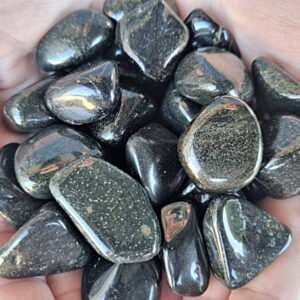
Its appeal lies in the actual material: deep black, charcoal and dark green tones, an earthy finish and, in some pieces, tiny metallic-looking pyrite flecks or lines.
Browse our Crystal Names A–Z to explore other stones by name.
Why Does Some Black Lemurian Jade Sparkle?
One of the details worth looking for is pyrite.
Peruvian Black Jade can contain tiny golden pyrite sparkles or fine pyrite-rich lines. Against such a dark background, even a very small metallic fleck can become surprisingly noticeable when it catches the light.
Not every stone will show those markings in exactly the same way. Some pieces may appear predominantly black or charcoal, while others reveal greenish tones, fine patterning or scattered flashes when turned in the hand.
This is a stone worth looking at closely rather than expecting perfect uniformity.
Black Lemurian Jade Isn't the Same as Black Obsidian
At first glance, several dark stones can look remarkably similar.
Black Obsidian, however, has a completely different geological story. It is natural volcanic glass, formed when silica-rich lava cools rapidly.
Black Lemurian Jade is sold as a Peruvian trade-named stone and generally has a different texture and appearance. It can look softer or more earthy than the characteristically glassy surface of polished Obsidian, and pyrite may also provide a useful visual clue in some pieces.
If you're drawn to deep black stones, compare it with our Black Obsidian collection rather than assuming the two are interchangeable.
Where Does Black Lemurian Jade Come From?
Material sold as Peruvian Black Jade or Lemurian Jade is associated with Peru, including material quarried around Lima.
That Peruvian connection is more useful than trying to build an ancient geological story around the word “Lemurian”.
In modern crystal culture, “Lemurian” is used in the names of several stones and is often connected with metaphysical ideas surrounding the legendary lost civilisation of Lemuria.
Those ideas belong to modern esoteric tradition rather than established geology or archaeology.
So there are really two stories here: the physical Peruvian stone, and the later metaphysical traditions surrounding its trade name.
Black Lemurian Jade Meaning
Within contemporary crystal traditions, Black Lemurian Jade is particularly associated with grounding, protection, resilience and inner exploration.
Its dark colouring naturally places it alongside other stones commonly chosen for grounding practices, while modern Lemurian traditions add associations with intuition, ancient wisdom and deeper spiritual exploration.
Some people use it during meditation or keep a tumble stone nearby as a symbolic reminder to feel centred and steady.
As always, you don't need to choose it for a metaphysical reason.
A dark stone with tiny golden pyrite flashes is a perfectly good reason on its own.
A Tumble Stone Suits This Material Particularly Well
Polishing Black Lemurian Jade into a tumble makes the subtle details easier to appreciate.
The rounded surface is comfortable to hold, while turning the stone through the light can reveal green undertones, textural changes and metallic flecks that may not be immediately visible.
Tumbles are also easy to keep on a desk, beside a bed, in a collection or in a pocket.
If you enjoy this format, browse our wider Tumbled Stones collection for other polished crystals and minerals.
Choosing Your Black Lemurian Jade
With a stone this dark, don't judge only by which piece looks the blackest.
Look at the details. One piece might have obvious golden pyrite flecks. Another may show more dark green. Some can appear charcoal or almost uniformly black until brighter light reveals subtle changes across the surface.
Those variations are part of natural stone rather than flaws that need to be corrected.
Caring for Black Lemurian Jade
Because Black Lemurian Jade is a trade name rather than a precisely defined mineral species, I wouldn't give it an aggressive mineral-specific cleaning routine.
Keep things simple. Avoid harsh household chemicals, prolonged soaking and abrasive cleaning. Wipe polished pieces gently with a soft cloth when needed and protect them from hard knocks that could chip or mark the surface.
Gentle care is particularly sensible when a stone's exact mineral composition hasn't been independently verified.
Frequently Asked Questions
Is Black Lemurian Jade real jade?
The name is used commercially, but Black Lemurian Jade shouldn't automatically be assumed to be Jadeite or Nephrite, the two materials traditionally recognised as true jade. It is better treated as a trade-named Peruvian stone unless the composition of a particular specimen has been independently verified.
Is Black Lemurian Jade naturally black?
Pieces can range through black, charcoal and very dark green tones. Natural variation means the colour and markings won't necessarily be identical from stone to stone.
What are the little gold flecks in Black Lemurian Jade?
Some Peruvian Black Jade contains tiny pyrite inclusions or lines, which can produce small metallic golden flashes against the dark stone.
What makes Black Lemurian Jade interesting to collect?
Its appeal comes from the contrast between its dark colouring and subtle natural details. Look for green undertones, changes in texture and tiny pyrite flashes rather than expecting every piece to be perfectly uniform.