
Blue Apatite
From deep ocean blue to brighter blue-green tones, Blue Apatite brings vivid natural colour to crystals and jewellery. Within crystal traditions, it is especially associated with motivation, communication, learning and turning ideas into action. Explore Blue Apatite in gemstone bangles, earrings and other pieces as the collection grows.
Showing all 6 resultsSorted by latest
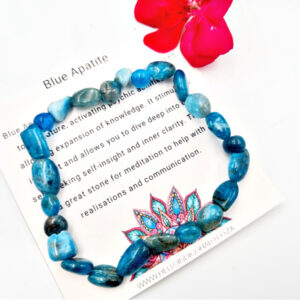
Blue Apatite: Bright Colour With Forward-Moving Energy
Blue Apatite can range from clear ocean blues to deeper teal, blue-green and intensely saturated shades.
It belongs to the Apatite mineral group, a family of phosphate minerals found in many geological environments around the world. Apatite occurs in several colours, including green, yellow, violet and blue, but the vivid blue material has become particularly popular for gemstones and crystal jewellery.
The colour can be striking even in very small pieces, which is one reason Blue Apatite works so well as chips, beads and polished stones.
For other minerals organised by name, browse our Crystal Names A–Z.
Apatite Has a Name With a Surprisingly Good Story
The name Apatite comes from the Greek word apatao, meaning to deceive.
That's because apatite was historically confused with other minerals.
Depending on its colour and crystal form, it can resemble stones such as Beryl, Tourmaline and other gemstones closely enough to cause mistaken identification.
Eventually mineralogists realised these deceptive lookalikes belonged to their own mineral family.
So Blue Apatite's name essentially comes from being good at pretending to be something else.
It's an unusually appropriate name for such a colourful mineral.
Why Is Blue Apatite So Blue?
Blue Apatite isn't one perfectly uniform shade.
Natural specimens can move through pale blue, turquoise-blue, blue-green and much deeper saturated tones.
Colour in Apatite can be influenced by trace elements and defects within the crystal structure, which means specimens from different localities can look noticeably different.
Transparency varies too. Some Blue Apatite can be beautifully transparent and gemmy, while other material is translucent or opaque. In chip and nugget jewellery, those variations can create a mixture of brighter and darker blue across the same piece.
That natural variation is part of the appeal rather than something every stone needs to match.
Blue Apatite Meaning: Ideas That Actually Go Somewhere
Within modern crystal traditions, Blue Apatite is associated with motivation, inspiration, mental focus and personal growth.
There's an energetic quality to the way people talk about this stone.
Rather than simply calming everything down, Blue Apatite is often chosen when someone wants to learn, create, communicate or get moving again.
Some crystal practitioners use it while studying or working towards a goal. Others associate it with overcoming apathy, finding enthusiasm and turning an idea into something more concrete.
Those are metaphysical traditions rather than scientifically established effects, but they have become a major part of Blue Apatite's popularity.
It's easy to see why the stone has developed such a reputation: even visually, that intense blue doesn't exactly fade quietly into the background.
The Throat Chakra Connection
Blue stones are commonly associated with the Throat Chakra within modern chakra traditions, and Blue Apatite is no exception.
It is often chosen for practices involving communication, self-expression and speaking clearly.
Some traditions also connect Blue Apatite with the Third Eye Chakra because of its associations with insight, learning and inner awareness.
That combination gives the stone an interesting metaphysical identity: not simply having an idea or insight, but finding a way to express it and act on it.
If chakra work is part of how you choose crystals, explore our Chakra Balance collection.
A Stone for Curious Minds
Blue Apatite has become particularly popular in crystal traditions surrounding study, concentration and learning.
Some people keep it near a desk, use it during study sessions or choose Blue Apatite jewellery when working on something that requires sustained attention.
It is also associated with curiosity — the desire to keep asking questions, learning and discovering rather than simply collecting information.
There is no need to treat the stone as a substitute for good study habits, of course.
But as a symbolic crystal for “pay attention, get interested and keep going”, Blue Apatite has found a very natural niche.
Blue Apatite in Jewellery
Blue Apatite doesn't need a large polished surface to show off its colour.
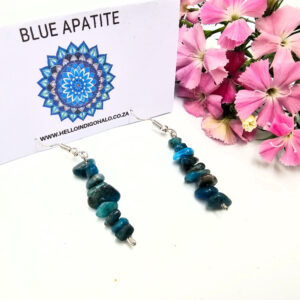
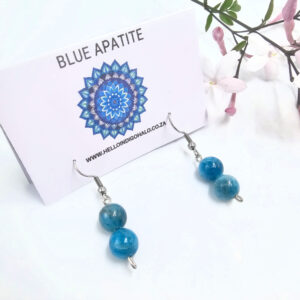
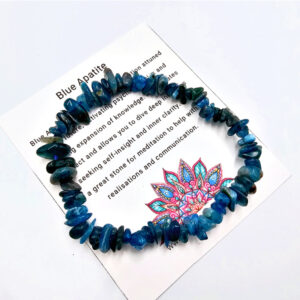
Small chips and nuggets can create flashes of blue, teal and blue-green as they move, making the stone particularly effective in bracelets and earrings.
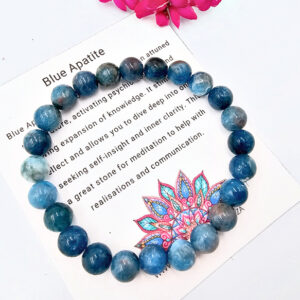
tHIH collection includes Blue Apatite chip earrings as well as chip and gemstone nugget bangles.
Because natural pieces vary, chip jewellery can have a less uniform appearance than jewellery made from perfectly matched synthetic beads — and that's part of its character.
For more gemstone bracelets across the HIH range, browse Bangles & Bracelets.
Blue Apatite Isn't Aquamarine
Bright blue gemstones are easy to confuse from photographs.
Aquamarine belongs to the Beryl family, while Blue Apatite belongs to the Apatite group. They have different compositions, crystal structures and physical properties.
Aquamarine is also considerably harder, which helps explain its long history as a faceted jewellery gemstone. Blue Apatite is softer and requires more considerate handling.
Visually, there can still be overlap — particularly when Apatite appears in clear blue-green shades.
If that watery blue colour is what attracts you, compare it with our Aquamarine collection.
Choosing Blue Apatite
Start with the colour that grabs you.
Some people prefer brighter turquoise and blue-green pieces, while others are drawn to darker, more saturated blue.
Then look at the natural variation.
In jewellery made from chips or nuggets, differences between individual stones create texture and movement rather than a perfectly uniform row of colour.
If you're choosing Blue Apatite for its metaphysical associations, think about what drew you to it in the first place.
Motivation? Communication? Study? Creativity? A new goal?
Or perhaps it's simply that incredible blue.
That's enough too.
Caring for Blue Apatite
Apatite is relatively soft for a gemstone, measuring around 5 on the Mohs hardness scale, so it deserves gentler treatment than harder stones such as Quartz.
Avoid knocks, abrasive cleaning and storing Blue Apatite jewellery where it will repeatedly rub against harder gemstones or metal edges.
Remove jewellery before swimming, showering or using household cleaning products, and store it somewhere it won't be crushed or scratched.
Frequently Asked Questions
Is Blue Apatite naturally blue?
Yes. Blue occurs naturally within the apatite mineral group, although the precise shade can vary from lighter blue and blue-green to much deeper saturated tones.
Why is Blue Apatite associated with motivation?
Within modern crystal traditions, Blue Apatite is associated with inspiration, focus, enthusiasm and moving towards personal goals. These are metaphysical associations rather than scientifically proven effects.
Is Blue Apatite the same as Aquamarine?
No. They can sometimes have similar blue-green colouring, but Aquamarine is a variety of Beryl while Blue Apatite belongs to the Apatite mineral group.
Can Blue Apatite jewellery be worn every day?
It can be worn regularly, but Apatite is softer than many familiar jewellery gemstones. Treat it gently, avoid hard knocks and store it away from harder materials that could scratch it.