
Blue Quartz
Blue Quartz combines the familiar durability of Quartz with soft blue, blue-grey and naturally clouded colour created by microscopic mineral inclusions. Browse polished Blue Quartz pieces selected for their colour, feel and individual patterning. Within crystal traditions, Blue Quartz is commonly associated with communication, calm reflection, self-expression, clarity and peaceful energy.
Showing the single result
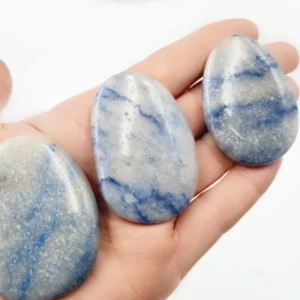
Blue Quartz Gets Its Colour From What Is Inside It
Blue Quartz is a lovely example of how inclusions can completely change the appearance of a familiar mineral.
The host mineral is Quartz, but tiny included minerals or microscopic structures can create blue, blue-grey or smoky blue colouring.
That means the blue is not one universal formula added to Quartz.
Different Blue Quartz material can owe its colour to different microscopic inclusions.
What Is Blue Quartz?
Blue Quartz is a naturally blue variety of Quartz, the silicon dioxide mineral with the formula:
SiO₂
The Quartz itself provides the host material.
The blue appearance is generally associated with tiny inclusions dispersed through the stone.
Depending on the specimen and locality, those inclusions may involve different minerals.
Dumortierite is one well-known cause of blue colouring in Quartz, but it is not the only possibility.
For HIH product descriptions, the safest approach is therefore to identify the material as Blue Quartz unless the actual inclusions have been supplier-confirmed or tested.
Is Blue Quartz the Same as Dumortierite Quartz?
Not always.
Dumortierite Quartz is a recognised form of blue Quartz in which Dumortierite occurs within the Quartz and contributes to the colour.
But naturally blue Quartz can also contain other blue mineral inclusions.
That means:
Dumortierite Quartz can be Blue Quartz
but
not every Blue Quartz should automatically be renamed Dumortierite Quartz.
That distinction is especially important when product data comes from commercial suppliers rather than laboratory identification.
What About the Name Sapphire Quartz?
Sapphire Quartz is an older or alternative name sometimes used for Blue Quartz.
It does not mean the stone contains Sapphire or Corundum.
The word refers to the sapphire-like blue colour rather than the presence of the gemstone Sapphire.
For customer clarity, Blue Quartz is the stronger primary product and category name.
“Sapphire Quartz” can remain as an alternative name where useful, provided it is not presented in a way that suggests actual Sapphire content.
Blue Quartz Versus Blue Aventurine
HIH currently keeps Blue Quartz and Blue Aventurine as separate categories.
That is sensible.
Blue Quartz is the broader mineral description for naturally blue Quartz material.
Blue Aventurine is a commercial aventurine-style name that implies a quartz-rich material with inclusion-related character and potentially a subtle aventurescent or reflective effect.
Trade naming can overlap, but the two should not be merged simply because both are blue and quartz-rich.
Product taxonomy should follow the supplier identification and the actual material.
Blue Quartz Palm Stones
HIH currently carries Blue Quartz in a polished palm-stone form.
Palm stones work especially well with this material because polishing makes subtle clouding, streaks, mottling and colour variation easier to see.
The smooth rounded shape also gives the stone a tactile quality that is quite different from a sharp Quartz point or rough specimen.
For other stones made in this comfortable polished format, browse the Palm Stones & Gallets collection.
Natural Blue Quartz Does Not Need to Be Uniform
One piece may be pale blue.
Another may lean towards slate blue, blue-grey or cloudy white-blue.
Some stones may show darker patches, wispy inclusions or uneven colour distribution.
Those differences are part of the material.
A natural Blue Quartz palm stone does not need perfectly even colour to be appealing.
When shopping online, look at the overall shade, polish and pattern rather than expecting every piece to match one ideal blue.
For a broader way to browse stones by mineral and trade name, visit the Crystal Names collection.
Blue Quartz Is Still Quartz
Despite its colour, Blue Quartz retains the basic physical identity of Quartz.
Quartz is known for being considerably harder than minerals such as Calcite or Selenite, which makes polished Quartz suitable for regular handling.
That does not mean it is impossible to chip or scratch.
A polished palm stone can still be damaged by hard impacts, rough storage or abrasive surfaces.
Ordinary gentle care is usually enough.
Blue Quartz in Crystal Traditions
Within crystal traditions, Blue Quartz is commonly associated with communication, calm reflection, clarity, self-expression and peaceful thought.
Its blue colouring also gives it a symbolic connection with the Throat Chakra in many modern metaphysical systems.
These are traditional spiritual associations rather than scientifically demonstrated effects of Quartz.
The stone can equally be appreciated for its colour, mineral inclusions and smooth polished form.
Caring for Blue Quartz
Use a soft cloth for everyday cleaning.
Avoid harsh household chemicals and abrasive scrubbing.
For polished palm stones, store them so they do not repeatedly knock against harder or sharp-edged objects.
There is no need for complicated care rituals.
A little sensible handling is enough to keep a polished Blue Quartz surface looking good.
Frequently Asked Questions
What is Blue Quartz?
Blue Quartz is a naturally blue variety of Quartz. Its colour is generally associated with microscopic mineral inclusions dispersed through the Quartz.
Is Blue Quartz the same as Dumortierite Quartz?
Not always. Dumortierite can cause blue colour in Quartz, but other inclusions can also produce naturally blue Quartz.
Does Sapphire Quartz contain Sapphire?
No. Sapphire Quartz is an alternative name used for some Blue Quartz material and refers to its blue appearance, not the presence of Sapphire.
Is Blue Quartz the same as Blue Aventurine?
Not automatically. The names can overlap commercially, but Blue Quartz is the broader Quartz variety name, while Blue Aventurine is an aventurine trade term.
What is Blue Quartz traditionally associated with?
Within crystal traditions, Blue Quartz is commonly associated with communication, calm reflection, clarity, peaceful thought and self-expression.