
Chrysoprase
Fresh apple-green colour gives Chrysoprase its instantly recognisable character. This green variety of chalcedony owes its colour to tiny nickel-bearing mineral inclusions and can range from softly translucent green to richer, more saturated shades. Within crystal traditions, Chrysoprase is commonly associated with optimism, emotional openness, compassion, renewal and heart-centred reflection.
Showing the single result
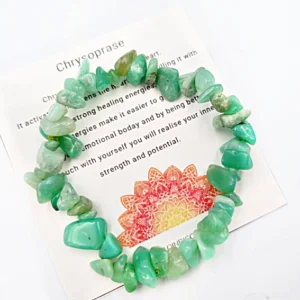
Chrysoprase Is Green Chalcedony With a Difference
Chrysoprase has one of those colours that can make a small stone surprisingly difficult to ignore.
Its green can range from soft and milky to fresh apple green, with finer material sometimes showing an appealing translucency when held towards the light.
The interesting part is where that colour comes from.
Chrysoprase is a variety of chalcedony, but its characteristic green is associated with tiny nickel-bearing mineral inclusions.
What Is Chrysoprase?
Chrysoprase is an apple-green to greenish variety of chalcedony.
Chalcedony is a very fine-grained form of silica belonging to the broader Quartz family, so Chrysoprase shares the fundamental silica chemistry associated with chalcedony.
What gives Chrysoprase its distinctive identity is its green colour.
Rather than being defined simply as “green Quartz”, Chrysoprase is recognised specifically as green chalcedony whose colour is associated with microscopic nickel-bearing layered silicates.
Those inclusions can be far too small to see individually, even though their effect on the appearance of the stone is obvious.
Why Is Chrysoprase Green?
Nickel is the key to the classic Chrysoprase colour story.
Tiny nickel-bearing silicate inclusions dispersed through the chalcedony contribute to its apple-green to greenish appearance.
This makes Chrysoprase interesting because the green colour is not necessarily produced by obvious visible crystals trapped inside the stone.
Instead, extremely fine mineral material can influence the overall colour of the chalcedony.
The result may be pale and cloudy, bright apple green or a richer green depending on the material.
Natural Variation Is Part of Chrysoprase
Chrysoprase does not need to look perfectly uniform.
Individual pieces may differ in:
Colour intensity — from pale green to stronger apple-green shades.
Translucency — some material allows noticeably more light through than others.
Patterning — cloudy zones, colour concentrations and natural matrix may occur.
Surface character — rough, polished and shaped pieces reveal the material differently.
A darker or more opaque area does not automatically make a piece inferior. What matters depends on whether you are choosing for colour, translucency, natural character or simply the piece that catches your eye.
Chrysoprase Is Not Jade
Green colour causes plenty of confusion in gemstone shopping.
Chrysoprase and Jade can both occur in attractive green shades, but they are not the same material.
Chrysoprase is a variety of chalcedony.
The materials conventionally recognised as Jade are jadeite jade and nephrite jade.
That means a green polished stone should never be categorised as Jade merely because its colour resembles it.
The mineral identification comes first.
Chrysoprase and Other Green Stones
The same principle applies to Aventurine, Malachite, Prehnite and other green materials.
Colour is useful for browsing, but it does not establish mineral identity.
Chrysoprase has its own combination of chalcedony structure, nickel-related colour and often attractive translucency.
That is enough to give it a dedicated identity rather than turning the page into a generic collection of green crystals.
For a broader way to browse stones by their mineral and trade names, visit the Crystal Names collection.
Choosing Chrysoprase
When comparing Chrysoprase, start with the actual piece rather than expecting one universal shade.
Look at the balance between colour, translucency, polish and natural patterning.
If the piece is polished, examine how evenly the surface reflects light.
With rough material, look at how the green runs through the stone and whether natural matrix or contrasting areas add character.
For jewellery, also consider the construction of the finished piece—beads, cord, wire, clasps and settings matter just as much as the gemstone itself.
Chrysoprase in Crystal Traditions
Within crystal traditions, Chrysoprase is commonly associated with optimism, compassion, emotional openness, renewal and heart-centred reflection.
Its green colouring also gives it a symbolic association with the Heart Chakra in many modern metaphysical practices.
These are spiritual and cultural associations rather than scientifically demonstrated effects of chalcedony.
Chrysoprase can equally be appreciated simply for its colour, translucency, mineral composition and natural variation.
Caring for Chrysoprase
Chrysoprase is chalcedony, so it is reasonably suitable for normal handling, but that does not make every piece impossible to damage.
Protect polished surfaces from hard knocks and abrasive materials.
Use a soft cloth and gentle cleaning rather than harsh household chemicals.
With jewellery, consider the whole item rather than only the stone. Elastic, cord, adhesives, wire and metal components may require more cautious cleaning.
Frequently Asked Questions
What is Chrysoprase?
Chrysoprase is an apple-green to greenish variety of chalcedony whose colour is associated with tiny nickel-bearing silicate inclusions.
Is Chrysoprase a type of Quartz?
Chrysoprase is a variety of chalcedony, which belongs to the broader microcrystalline Quartz family.
Is Chrysoprase the same as Jade?
No. Chrysoprase is chalcedony, while conventional Jade refers to jadeite jade or nephrite jade.
Is all Chrysoprase bright apple green?
No. Natural Chrysoprase can vary in colour intensity, translucency and pattern, from softer pale greens to richer apple-green material.
What is Chrysoprase traditionally associated with?
Within crystal traditions, Chrysoprase is commonly associated with optimism, compassion, emotional openness, renewal and heart-centred reflection.