
Dioptase
Brilliant emerald to blue-green colour makes Dioptase one of the most striking copper minerals to collect. Its small, intensely coloured crystals can look almost jewel-like, especially when contrasted against their natural matrix. Within crystal traditions, Dioptase is associated with compassion, emotional release, forgiveness and opening the heart to change.
Showing all 8 resultsSorted by latest
-
-
-
-
-
-
Dioptase Specimen S (12.2g)
Original price was: R899.00.R549.00Current price is: R549.00. Add to basketQuick View -
-
Dioptase Specimen O (10.9g)
Original price was: R819.00.R599.00Current price is: R599.00. Add to basketQuick View




Dioptase: The Intensely Green Copper Mineral
Some minerals need a large polished surface to show off their colour.
Dioptase doesn't.
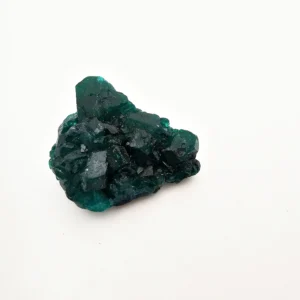
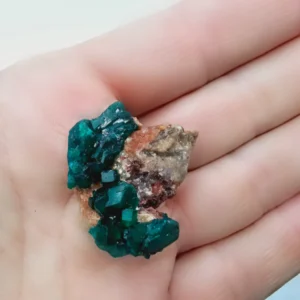
Even relatively small crystals can display remarkably intense emerald to blue-green colour, sometimes standing out dramatically against pale, brown or darker matrix.
Dioptase is a natural hydrated copper silicate mineral, and copper is central to the vivid colour that makes good specimens so immediately recognisable.
Its crystals can have a bright, glassy lustre that adds even more intensity under good light.
Browse our Crystal Names A–Z to discover more unusual minerals and stones by name.
Why Is Dioptase So Green?
Copper is responsible for some of the mineral world's most spectacular colours. Dioptase is an excellent example.
Its characteristic colour ranges from rich emerald green through blue-green and turquoise-leaning shades, creating crystals that can look remarkably gem-like.
That resemblance has occasionally caused confusion with Emerald.
But Dioptase and Emerald are completely different minerals.
Emerald is a green variety of Beryl. Dioptase is a hydrated copper silicate with different chemistry, crystal structure and physical properties.
Dioptase is also considerably softer, with a Mohs hardness of around 5.
So although an especially beautiful Dioptase crystal may have colour worthy of a gemstone, it has its own mineral identity.
A Name That Means “To See Through”
There's a clever mineralogical observation hidden inside the name Dioptase.
French mineralogist René Just Haüy named it in 1797 using Greek words relating to “through” and “to see.”
The name refers to internal cleavage planes that can be visible through transparent or translucent crystals.
In other words, the name isn't about its extraordinary green colour at all.
It's about being able to see inside the crystal.
That's a surprisingly appropriate detail for a mineral that later became symbolically associated with looking inward and confronting emotions honestly.
The mineralogy came first; the metaphysical interpretation came much later.
From Kazakhstan to Namibia
Dioptase has a fascinating geographic story.
Its type locality is the Altyn-Tyube deposit in Kazakhstan, where the mineral became known to European mineralogists in the late 18th century.
Today, however, collectors may also immediately associate spectacular Dioptase with Namibia.
Namibian localities have produced beautiful specimens with intensely coloured green crystals, sometimes standing dramatically against contrasting matrix.
Dioptase also occurs in other copper-rich mineral localities around the world.
Dioptase Meaning: Looking at What the Heart Is Holding
Within modern crystal traditions, Dioptase is strongly associated with the heart, compassion, forgiveness, emotional honesty and release.
Its reputation isn't simply about feeling calm or happy.
The symbolism is often more about acknowledging emotions that have been difficult to let go of.
Some practitioners choose Dioptase during periods of emotional change, particularly when working symbolically with grief, resentment, forgiveness or old patterns that continue to influence the present.
It is also associated with allowing yourself to move forward without pretending that difficult experiences never happened.
These are metaphysical traditions rather than scientifically established effects, but they give Dioptase a particularly distinctive place within contemporary crystal practice.
Dioptase and the Heart Chakra
With colour this intensely green, the Heart Chakra association is hardly surprising.
Within chakra traditions, green is strongly connected with the heart centre and themes of compassion, love, openness, forgiveness and emotional balance.
Dioptase is often chosen when the focus isn't simply romantic love, but the more complicated territory of self-compassion, relationships, boundaries and letting go.
Some practitioners use it during meditation, reflection or intention-setting when working with these themes.
For crystals and spiritual tools selected around chakra traditions, browse our Chakra Balance collection.
Dioptase Isn't Diopside
Their names are frustratingly similar. Their mineral identities are not.
Dioptase is a hydrated copper silicate famous for vivid emerald to blue-green crystals.
Diopside is a calcium-magnesium silicate belonging to the pyroxene mineral group. It can be green, but it also occurs in several other colours.
So:
Dioptase = copper-rich, intensely green mineral.
Diopside = pyroxene mineral with a much broader colour range.
Once you know what you're looking at, the distinction becomes considerably easier.
Choosing Dioptase
With Dioptase specimens, bigger isn't automatically better.
A small cluster of well-formed, intensely coloured crystals can be far more visually impressive than a larger piece with less crystal development.
Look at the depth of green, crystal formation, lustre and contrast with the surrounding matrix.
Some specimens may have individual crystals standing clearly above the matrix, while others show groups or crusts of smaller crystals.
Natural matrix, irregular growth and differences between individual crystals are part of the specimen rather than flaws that need to disappear.
For collectors who enjoy minerals in their natural form, explore more pieces in our Crystals collection.
Caring for Dioptase
Dioptase deserves gentle handling.
At around 5 on the Mohs hardness scale, it is considerably softer than Quartz and can be scratched by harder minerals.
It also has perfect cleavage, meaning a hard knock can damage or split a crystal along particular internal planes.
Avoid abrasive cleaning, harsh chemicals and vigorous scrubbing.
For delicate crystal specimens, gentle dusting with a soft brush is preferable to treating them like ordinary decorative stones.
Store Dioptase where its crystals won't repeatedly rub against harder specimens.
Frequently Asked Questions
Is Dioptase the same as Emerald?
No. Their vivid green colours can look surprisingly similar, but Emerald is a variety of Beryl while Dioptase is a copper silicate mineral. They have different compositions, crystal structures and hardness.
Is Dioptase the same as Diopside?
No. Despite their similar names, they are completely different minerals. Dioptase is a hydrated copper silicate, while Diopside belongs to the pyroxene mineral group.
What gives Dioptase its green colour?
Copper is responsible for Dioptase's characteristic intense emerald to blue-green colour.
Where is Dioptase found?
Its type locality is the Altyn-Tyube deposit in Kazakhstan. Dioptase has also been found at other copper deposits around the world, with Namibia particularly famous among collectors for spectacular specimens.
What is Dioptase traditionally associated with?
Within modern crystal traditions, Dioptase is associated with compassion, forgiveness, emotional honesty, release and the Heart Chakra.