
Galena
Heavy, metallic and naturally geometric, Galena is one of those minerals that feels as interesting as it looks. Its silver-grey crystals commonly form cubes and reveal remarkably neat cubic cleavage when broken. Within crystal traditions, Galena is associated with grounding, stability, protection and bringing scattered energy firmly back down to earth.
Showing the single result
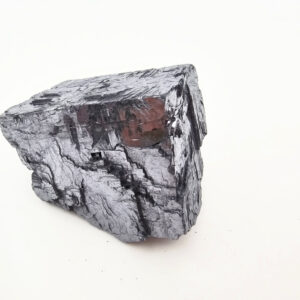
Galena: The Heavy Metallic Mineral That Loves Cubes
Pick up a piece of Galena and one of the first surprises may be its weight.
This metallic silver-grey mineral is unusually dense, so even a relatively small specimen can feel satisfyingly heavy in your hand.
Then there's the geometry.
Galena belongs to the cubic crystal system and is famous for forming cubes, octahedrons and combinations of geometric crystal faces. It also has perfect cubic cleavage, meaning it can naturally break along flat planes meeting at right angles.
Those sharp-looking forms aren't carved into the mineral.
They're part of Galena's natural crystal structure.
Browse our Crystal Names A–Z to discover more minerals and stones by name.
What Is Galena Made Of?
Galena is lead sulfide, with the chemical formula PbS.
It is the world's most important natural ore of lead and has been mined for centuries for the metal it contains.
Fresh Galena can have a bright metallic lustre, while exposed surfaces may gradually become duller or tarnished. Weathering can also produce other lead minerals, including Cerussite and Anglesite.
Galena can occur alongside minerals such as Pyrite, Sphalerite, Calcite, Quartz and Fluorite, creating particularly interesting multi-mineral specimens.
That means a Galena specimen doesn't need to be pure Galena to be collectible. Sometimes the relationship between several minerals is exactly what makes a piece interesting.
Why Does Galena Break Into Cubes?
This is one of Galena's best features.
Galena has perfect cleavage in three directions at 90 degrees.
Imagine an invisible three-dimensional grid running through the mineral. When Galena breaks along its preferred cleavage planes, the resulting surfaces can meet at neat right angles.
That's why broken Galena can sometimes look surprisingly engineered.
The geometry reflects the internal arrangement of atoms within the crystal.
Its softness makes this even more noticeable. Galena is only around 2.5 on the Mohs hardness scale, so it is considerably softer than Quartz despite looking solid and metallic.
Galena Is Surprisingly Heavy
Galena has a density of roughly 7.5–7.6 g/cm³.
For comparison, Quartz is only around 2.65 g/cm³.
That difference is immediately noticeable when you handle specimens of similar size.
The reason is simple: Galena contains a large proportion of lead, a very dense element.
Weight can therefore be one of the useful clues when identifying Galena alongside its metallic lead-grey colour, softness and cubic cleavage.
Galena and Pyrite Look Brilliant Together
Galena and Pyrite can occur within the same mineral deposits, creating specimens with contrasting metallic colours and crystal forms.
Galena tends towards silver-grey, while Pyrite is famous for its warmer brass-gold colour.
Both can form beautifully geometric crystals, but they're completely different minerals.
Pyrite is iron sulfide.
Galena is lead sulfide.
A specimen containing both gives you two very different metallic minerals side by side — and can make their colour differences much easier to see.
Galena Once Helped People Listen to the Radio
This is probably the most unexpected Galena fact.
Galena is a semiconductor.
In the early days of radio, Galena crystals were used in crystal radio receivers. A very fine wire, historically called a “cat's whisker”, was carefully positioned against the crystal to create a point-contact detector capable of extracting an audio signal from radio waves.
No modern powered amplifier was required for the basic detector.
So long before silicon became synonymous with electronics, people were using a natural mineral crystal to help receive radio broadcasts.
It's an extraordinary little meeting point between mineralogy and the history of technology.
Galena Meaning: Grounding, Stability and Weight
Within modern crystal traditions, Galena is associated with grounding, stability, protection and bringing attention back to the physical world.
It's easy to understand how some of that symbolism developed.
Galena is dense, heavy, metallic and visually solid.
Rather than being associated with airy or expansive energy, it is often chosen symbolically when someone wants to feel more anchored, organised or present.
Some practitioners also connect Galena with structure, personal boundaries and turning ideas into practical action.
These are metaphysical traditions rather than scientifically established effects, but Galena's unusual physical character makes its grounding symbolism particularly intuitive.
A Collector Mineral That Deserves Sensible Handling
Galena contains lead, so this is one mineral where sensible handling matters.
An intact specimen can be enjoyed and displayed, but wash your hands after handling it, particularly before eating or touching your face.
Do not lick Galena or put it in drinking water.
Avoid cutting, grinding, sanding, drilling or deliberately breaking specimens, because these activities can create lead-containing dust that should not be inhaled or ingested.
Keep Galena away from young children and pets who may put objects in their mouths.
For cleaning, avoid aggressive scrubbing. Galena is soft and brittle, and its crystal surfaces can be damaged relatively easily.
For more fascinating natural mineral pieces, browse our Crystals collection.
Choosing Galena
Look at crystal form, metallic lustre, associated minerals and matrix.
One specimen may show obvious cubic Galena crystals, while another might contain Galena nestled among Pyrite, Quartz or other minerals.
Fresh crystal faces can be brilliantly metallic, while older exposed surfaces may show natural tarnishing.
And remember the weight.
For such a visually compact mineral, Galena can feel surprisingly substantial — one of those specimens where picking it up adds another dimension to appreciating it.
Frequently Asked Questions
Why is Galena so heavy?
Galena is lead sulfide and has a density of roughly 7.5–7.6 g/cm³. Its high lead content makes even relatively small specimens noticeably heavy.
Does Galena naturally form cubes?
Yes. Galena belongs to the cubic crystal system and commonly forms cubic crystals. Its perfect cubic cleavage can also create flat surfaces meeting at 90-degree angles when the mineral breaks.
Is Galena the same as Pyrite?
No. Galena is lead sulfide and typically silver-grey, while Pyrite is iron sulfide and usually brass-gold. They can occur together in the same specimen.
Was Galena really used in radios?
Yes. Galena's semiconductor properties made it useful as a detector in early crystal radio receivers, long before modern semiconductor electronics.
How should I handle Galena?
Because Galena contains lead, wash your hands after handling it, don't put it in your mouth or drinking water, and avoid cutting, sanding, drilling or breaking it because these activities can produce lead-containing dust.