
Iolite
Violet-blue Iolite has a remarkable ability to show different colours when viewed from different directions. Also known mineralogically as Cordierite, this distinctive gemstone is traditionally associated with intuition, direction and inner vision. Explore Iolite jewellery that brings its shifting blue-violet colour into an easy-to-wear form.
Showing all 3 resultsSorted by latest

Iolite: A Gemstone That Changes Colour With Direction
At first glance, Iolite can resemble a beautiful blue or violet gemstone.
Turn it in your hand, however, and something unusual happens.
The colour can change dramatically depending on the direction from which you view the stone. Deep violet-blue can shift towards paler blue, grey, yellowish tones or almost colourless areas.
This isn't a treatment or a trick of the light.
It's one of Iolite's defining natural optical properties: pleochroism.
What Is Iolite?
Iolite is the gemstone name commonly used for transparent to translucent gem-quality Cordierite, a magnesium-aluminium silicate mineral.
The name Iolite comes from the Greek word ios, meaning violet — an appropriate reference to the beautiful violet-blue colour for which the gem is best known.
Iolite is generally around 7 to 7.5 on the Mohs hardness scale, making it reasonably durable, although its cleavage means it still deserves thoughtful handling.
Unlike many coloured gemstones, Iolite is also not typically treated to improve its colour, which adds to its appeal for people who enjoy naturally coloured gems.
Browse more individual stones through our Crystal Names A–Z.
Why Does Iolite Show Different Colours?
Iolite is strongly pleochroic.
Pleochroism occurs when a mineral absorbs light differently depending on the crystallographic direction through which it is viewed.
Iolite can show three distinct colours in three different crystal directions.
This can create striking changes between violet-blue, blue, pale yellow or nearly colourless appearances as the stone is turned.
It's such an important feature that gem cutters have to pay close attention to orientation.
Cut a transparent Iolite in the wrong direction and its most attractive blue colour may appear much weaker. Orient it well and the richer violet-blue can be positioned where it is most visible.
So with Iolite, direction really matters.
Is Iolite a Sapphire?
No.
Iolite has sometimes been called “Water Sapphire” because its violet-blue colouring can resemble Sapphire, but the two are completely different minerals.
Sapphire is Corundum.
Iolite is Cordierite.
The old trade name can therefore be misleading, and simply calling the gemstone Iolite is much clearer.
Fine Iolite can also resemble Tanzanite, particularly in its richer blue-violet colours, but again, they are different gemstones.
Did Vikings Really Use Iolite to Navigate?
One of Iolite's most famous stories connects it with Viking sailors.
According to legend, Viking navigators used thin slices of Iolite as polarising filters to help locate the position of the sun when clouds or haze made it difficult to see directly.
This is why Iolite is sometimes nicknamed the “Viking's Compass.”
It's a wonderful story — but it should be presented as a legend rather than established historical fact.
There is no need to turn the legend into certainty for it to add something to Iolite's character.
It also fits remarkably well with the stone's modern symbolism around direction, intuition and finding your way forward.
Iolite Meaning: Intuition, Direction & Inner Vision
Within modern crystal traditions, Iolite is associated with intuition, inner vision, self-discovery and direction.
Its natural pleochroism gives those associations an unusually fitting physical metaphor.
The same stone can look different when viewed from another direction.
Symbolically, Iolite can therefore represent changing perspective, looking at a situation differently and finding direction when the way forward isn't immediately obvious.
Its Viking navigation legend has also helped reinforce the modern idea of Iolite as a stone for finding your path.
These are traditional and metaphysical associations rather than scientifically established effects.
Iolite & the Third Eye Chakra
Iolite is most commonly associated with the Third Eye Chakra in contemporary crystal practice.
The Third Eye is traditionally connected with intuition, perception, awareness and inner understanding.
Iolite's violet-blue colour and dramatic directional colour changes make that association particularly natural.
Rather than simply symbolising “seeing more”, Iolite can represent seeing differently — recognising that a change in perspective may reveal something that wasn't obvious before.
Explore more stones and spiritual tools associated with chakra traditions in our Chakra Balance collection.
Choosing Iolite Jewellery
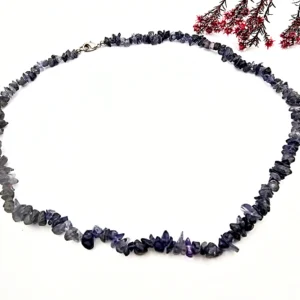
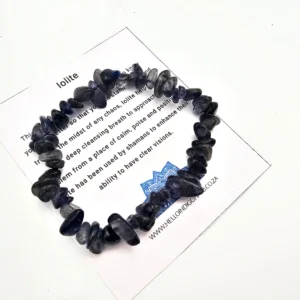
Colour is one of Iolite's most appealing features, but don't expect every stone or bead to look identical.
Individual pieces can vary from deeper violet-blue to softer blue-grey tones, and Iolite's pleochroism means its appearance can change with orientation, movement and lighting.
In chip and nugget jewellery, that natural variation can be particularly attractive because multiple differently oriented pieces sit alongside one another.
Move the jewellery and individual stones can catch the light differently.
Our current Iolite collection includes wearable bangles, while the range can change as different pieces become available.
Browse our wider Bangles & Bracelets collection for more gemstone and crystal jewellery.
Caring for Iolite
With a Mohs hardness of around 7 to 7.5, Iolite has reasonable scratch resistance for jewellery, but hardness isn't the whole story.
Iolite has cleavage, which means a sufficiently hard knock in the wrong direction can damage the stone.
Avoid dropping jewellery onto hard surfaces and keep it away from harsh chemicals and aggressive cleaning.
For everyday care, gentle cleaning and a soft cloth are usually sufficient.
For beaded bangles, remember that elastic, stringing and other jewellery components may require more careful treatment than the Iolite itself.
Frequently Asked Questions About Iolite
Why does Iolite look like different colours?
Iolite is strongly pleochroic, meaning it can display different colours when viewed along different crystal directions. This is a natural optical property of the gemstone.
Is Iolite the same as Cordierite?
Cordierite is the mineral name. Iolite is the name commonly used for transparent to translucent gem-quality Cordierite used as a gemstone.
Is Iolite a type of Sapphire?
No. Iolite has historically been called “Water Sapphire”, but it is Cordierite rather than Corundum and is mineralogically unrelated to Sapphire.
Is the Viking's Compass story true?
It is a famous legend associated with Iolite. Vikings are said to have used thin slices to help locate the sun during navigation, but the story has not been established strongly enough to present it as historical fact.
What is Iolite associated with spiritually?
Within modern crystal traditions, Iolite is associated with intuition, perception, inner vision, changing perspective and finding direction.