
Kambaba Jasper
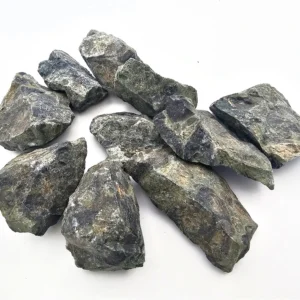
Deep green with distinctive black swirls, rings and eye-like patterns, Kambaba Jasper is instantly recognisable. Despite its name, this fascinating Madagascan stone is now better understood as an orbicular volcanic rock rather than true Jasper. Within crystal traditions, it is associated with grounding, tranquillity and a deep connection with nature.
Showing the single result
Kambaba Jasper: The Green Stone With Mysterious Black Eyes
Few stones have patterns quite like Kambaba Jasper.
Deep forest and mossy greens are broken by dark circles, swirling rings and almost eye-like formations, creating patterns that can look organic, reptilian or even otherworldly.
Those unusual markings are responsible for another name sometimes used in the crystal trade:
Crocodile Jasper.
But the patterns have also created one of the most persistent stories surrounding Kambaba Jasper — and this is where the geology becomes especially interesting.
Is Kambaba Jasper Really Fossilised Stromatolite?
For years, Kambaba Jasper has been widely described in the crystal trade as fossilised stromatolite containing the remains or structures of ancient cyanobacteria.
You'll still see that explanation repeated across crystal shops and websites.
Modern mineralogical examination, however, points towards a different origin.
The Madagascan material commonly sold as Kambaba Jasper is better described as an orbicular or spherulitic volcanic rock, associated with rhyolitic material.
Its circular “eyes” and swirling structures appear to be mineral-growth textures rather than fossilised microbial colonies.
So those dramatic rings aren't currently best understood as fossils of some of Earth's earliest life.
The older stromatolite story remains an important part of Kambaba Jasper's trade history, but it shouldn't be presented as established geology.
Is Kambaba Jasper Actually Jasper?
Here's the second surprise:
not in the strict mineralogical sense.
Jasper is generally an opaque, microcrystalline silica-rich material related to Chalcedony.
Kambaba Jasper is a commercial or trade name for a patterned rock rather than the formal mineralogical identity of the material.
The familiar name remains useful — it's how collectors, crystal shops and customers know the stone — so there's no reason to stop calling it Kambaba Jasper.
It's simply useful to know that the geology hiding behind the trade name is more complicated.
Explore more stones and minerals through our Crystal Names A–Z.
What Creates Kambaba Jasper's Circular Patterns?
Kambaba's extraordinary appearance comes from its orbicular mineral textures.
Orbicular rocks contain rounded or roughly circular structures that contrast with the surrounding matrix.
When the material is broken, cut or polished, different cross-sections through those structures can reveal circles, rings, swirls and eye-like patterns.
That means every piece can expose a different part of the original rock.
One may contain a bold dark circle surrounded by green rings, while another shows smaller spots, sweeping curves or irregular patches.
The patterns may look biological, but appearances can be deceptive.
In Kambaba, the better-supported geological interpretation connects them with mineral growth within volcanic material.
Kambaba Jasper From Madagascar
The Kambaba Jasper familiar in the crystal and lapidary trade is particularly associated with Madagascar.
Its rich green-and-black palette and distinctive orbicular structures make the material especially effective when polished, because polishing reveals the internal patterns with greater contrast.
Rough pieces have a different appeal.
Instead of presenting only a smooth finished pattern, they allow you to see more of the stone's natural surfaces, broken structures and colour variation before extensive shaping.
Browse more natural material in our Selected Rough Crystals.
Kambaba Jasper Meaning
Within modern crystal traditions, Kambaba Jasper is associated with grounding, tranquillity, patience and connection with nature.
Its dark greens naturally reinforce those associations.
The circular patterns can resemble forests viewed from above, moss-covered surfaces, ripples or ancient organic structures, which has helped give the stone a strong connection with Earth symbolism and the natural world.
Interestingly, losing the fossil-stromatolite story doesn't have to make Kambaba less meaningful.
Its patterns still represent geological processes taking place deep in Earth's history — just through volcanic and mineral formation rather than ancient microbial life.
For people drawn to the stone symbolically, it can represent slowing down, becoming grounded and remembering that change in nature often happens over timescales far longer than our own.
These are traditional and metaphysical associations rather than scientifically established effects.
Kambaba Jasper & the Heart and Root Chakras
Within contemporary crystal practice, Kambaba Jasper is commonly associated with both the Heart and Root Chakras.
Its green colouring connects naturally with the Heart Chakra and themes of compassion, emotional balance and connection.
Its darker tones and grounding reputation also connect it with the Root Chakra, traditionally associated with stability, security and feeling anchored.
That combination gives Kambaba a slightly different personality from many other green stones.
It isn't only about growth or opening the heart; its symbolism also centres on staying grounded while growth takes place.
Explore more crystals and spiritual tools through our Chakra Balance collection.
Choosing Rough Kambaba Jasper
With Kambaba Jasper, pattern is everything.
Look for the piece that catches your attention rather than expecting every specimen to resemble a perfect example online.
Colour can range through olive, moss, forest and grey-green alongside very dark green or black areas.
The characteristic orbs can be large and obvious or smaller and more fragmented depending on where the piece intersects the original structures.
Rough material may also reveal less obvious patterning than a highly polished sphere or palm stone.
That doesn't mean the pattern isn't there — polishing simply makes internal structures easier to see across a smooth surface.
Caring for Kambaba Jasper
For ordinary display and handling, keep care simple.
Avoid hard knocks, harsh household chemicals and aggressive cleaning methods. Rough pieces can contain irregular edges and natural fractures, so don't assume every projecting area will withstand a drop onto a hard surface.
A soft brush or cloth is generally sufficient for ordinary dust.
If you later add polished Kambaba pieces to your collection, store them so harder or sharp-edged specimens aren't repeatedly rubbing against their polished surfaces.
Frequently Asked Questions About Kambaba Jasper
Is Kambaba Jasper a fossil?
The traditional crystal-trade explanation describes it as fossilised stromatolite, but newer mineralogical interpretations identify the characteristic patterns as mineral textures within volcanic rock rather than fossilised microbial structures.
Why is it called Crocodile Jasper?
The nickname comes from its dark green-and-black circular and mottled patterns, which can resemble reptilian or crocodile skin.
Is Kambaba Jasper really a Jasper?
Kambaba Jasper is its established commercial name, but the material isn't considered true Jasper in the strict geological sense. It is better described as an orbicular volcanic rock.
Does every piece have obvious circles?
No. The appearance depends on how the original orbicular structures intersect the surface of each piece. Some show dramatic rings and “eyes”, while others have more irregular green-and-black patterning.
What is Kambaba Jasper associated with spiritually?
Within modern crystal traditions, Kambaba Jasper is associated with grounding, tranquillity, patience, nature and the Heart and Root Chakras.