
Libethenite
Deep green colour and unusual crystal formations make Libethenite a fascinating addition to a mineral collection. This copper phosphate mineral occurs as a secondary mineral within the oxidised zones of copper deposits and can range from olive green to almost blackish green. Within crystal traditions, Libethenite is associated with growth, reflection, transformation and connection with the natural world.
Showing the single result
-
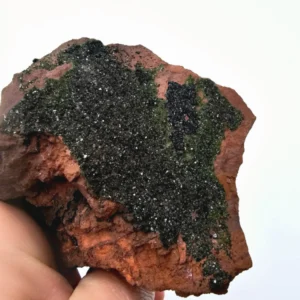
Libethenite on Ironstone Matrix D (356g) Rare
Original price was: R759.00.R329.00Current price is: R329.00. Add to basketQuick View
A Green Mineral Born From Copper Deposits
Libethenite may not have the instant name recognition of Quartz or Amethyst, but that is part of its appeal.
Its green colour, copper-rich chemistry and distinctive crystal formations make it particularly interesting for collectors who enjoy less familiar minerals.
Colours can range from light and olive green through deep green and almost blackish green, while the surface may show vitreous, resinous or subtly waxy-looking lustre.
What Is Libethenite?
Libethenite is a recognised copper phosphate mineral with the chemical formula Cu₂(PO₄)(OH).
It belongs to the Olivenite Group and crystallises in the orthorhombic crystal system.
Unlike many decorative stones whose names are based primarily on colour or commercial terminology, Libethenite is a formally recognised mineral species with its own defined mineralogical identity.
Its copper content is an important part of both its chemistry and geological story.
How Does Libethenite Form?
Libethenite is typically a secondary mineral.
Rather than crystallising directly from molten rock, it commonly develops within the oxidised zones of copper ore deposits.
Near the Earth's surface, existing copper-bearing minerals can be altered by oxygen-rich water and weathering processes. Under suitable conditions, copper can combine with phosphate and hydroxyl components to form Libethenite.
The phosphate involved may come from the alteration of phosphate-bearing minerals within the surrounding rocks.
This secondary formation explains why Libethenite can occur alongside other copper minerals.
What Does Libethenite Look Like?
Green is the colour most strongly associated with Libethenite, but there is no single compulsory shade.
Specimens can appear:
light green
olive green
dark green
blackish green
Crystal form can be equally interesting.
Libethenite crystals may be short and prismatic or more compact in appearance, sometimes developing distinctive wedge-shaped terminations.
Some specimens occur as groups of small crystals rather than one large isolated crystal.
That means colour, crystal size, matrix and overall formation can vary considerably between individual specimens.
For collectors, those differences are part of the attraction rather than imperfections.
Where Did Libethenite Get Its Name?
Libethenite has a particularly appropriate connection between its name and its discovery locality.
The mineral was named in 1823 after its type locality at Ľubietová in present-day Slovakia, historically known by the German name Libethen.
This is why the unusual word “Libethenite” does not describe its colour or chemistry—it preserves the historical name of the place from which the mineral was first described.
Libethenite Is a Copper Mineral
Libethenite contains copper as an essential part of its chemical composition.
That places it within a fascinating family of colourful secondary copper minerals found in altered copper deposits.
However, colour alone should never be used to identify one of these minerals.
Several copper minerals can be green, and Libethenite can occur in association with other species.
A green mineral found beside Malachite, for example, should not automatically be called Libethenite without reliable identification.
Choosing a Libethenite Specimen
With collector minerals, the individual specimen matters more than expecting every piece to look identical.
Consider:
Colour — from lighter olive tones to very dark green.
Crystal definition — clearly visible individual crystals can give a specimen extra visual interest.
Formation — look at how the crystals are arranged across the specimen or matrix.
Lustre — reflective surfaces can change considerably as the specimen is turned in the light.
Associated minerals — these can add contrast and geological interest when they have been reliably identified.
Natural condition — tiny crystals and exposed formations can be delicate, so small irregularities are normal.
For other natural mineral material organised by name, browse the Crystal Names collection.
Libethenite in Crystal Traditions
Within modern crystal traditions, Libethenite may be associated with growth, reflection, transformation and a deeper connection with nature.
These associations are metaphysical traditions rather than scientifically demonstrated properties of the mineral.
For many collectors, Libethenite needs no metaphysical story at all. Its genuine mineralogy—copper-rich chemistry, green colouring and formation within altered copper deposits—already makes it an intriguing specimen.
Caring for Libethenite
Libethenite has a Mohs hardness of approximately 4 and is described as brittle, so collector specimens deserve careful handling.
Avoid abrasive cleaning, hard brushes, knocks and unnecessary handling of exposed crystals.
A soft brush or gentle dusting is preferable for many specimens.
Do not soak a collector specimen or apply household chemicals simply to improve its appearance, particularly when other minerals or matrix material are present.
Because Libethenite is a copper-bearing mineral, it should be treated as a display specimen rather than something to place in drinking water, crystal elixirs or preparations intended for consumption.
Wash your hands after extended handling and keep mineral specimens away from small children or pets that may place them in their mouths.
Frequently Asked Questions
What is Libethenite?
Libethenite is a copper phosphate mineral with the formula Cu₂(PO₄)(OH). It is a member of the Olivenite Group and commonly forms as a secondary mineral in oxidised copper deposits.
What colour is Libethenite?
Libethenite commonly ranges from light or olive green through dark green and blackish green.
Is Libethenite the same as Malachite?
No. Both are copper-bearing minerals and can be green, but they have different chemical compositions and mineral identities.
Where does the name Libethenite come from?
Libethenite was named after its type locality at Ľubietová in Slovakia, historically known as Libethen.
Is Libethenite suitable for crystal water or elixirs?
It is better treated as a collector and display mineral. Because Libethenite contains copper, it should not be placed in drinking water or preparations intended for consumption.