
Libyan Desert Glass
Born from an extraordinary event nearly 29 million years ago, Libyan Desert Glass is a rare natural yellow glass found in the Great Sand Sea of the Sahara. Created when a meteorite impact generated immense heat and pressure, this mysterious material has even been found in jewellery from Tutankhamun’s tomb.
Showing all 3 resultsSorted by latest

Libyan Desert Glass: Born From a Meteorite Impact
Scattered across a remote part of the Sahara is an unusual pale yellow natural glass with an extraordinary origin.
Libyan Desert Glass formed approximately 29 million years ago, when an enormous extraterrestrial impact subjected silica-rich material at the Earth's surface to extreme heat and pressure.
The event melted terrestrial material into glass.
Millions of years later, pieces of that glass can still be found across the Great Sand Sea, a vast desert region spanning western Egypt and eastern Libya.
Unlike an ordinary crystal that slowly grew within the Earth, Libyan Desert Glass was created during an incredibly violent event that happened almost instantaneously on a geological timescale.
And remarkably, we still haven't found the crater responsible.
Where Is Libyan Desert Glass Found?
Despite its name, much of the known Libyan Desert Glass field lies in the remote Great Sand Sea of western Egypt, close to the Libyan border.
Fragments occur across a restricted desert region rather than being found all over the world.
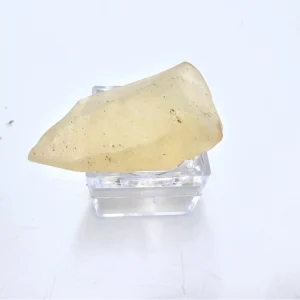
The glass is generally pale yellow to golden, although pieces can vary from almost colourless through cream, yellow and yellow-green to darker shades.
Its surfaces can be smooth in places and deeply sculpted or weathered in others after millions of years exposed to desert conditions.
Bubbles, flowing structures and mineral inclusions may also occur within the glass.
That combination of restricted locality, unusual formation and individual natural shapes is a large part of its collector appeal.
Browse more unusual natural materials by name in our Crystal Names A–Z.
Is Libyan Desert Glass a Tektite?
You'll often see Libyan Desert Glass described as a tektite, but scientifically the terminology is more complicated.
Tektites are natural glasses created during major extraterrestrial impacts, so the comparison makes sense. Moldavite, for example, is a famous green tektite.
However, modern scientific classifications commonly distinguish Libyan Desert Glass from true tektites because its characteristics and distribution differ from the classic tektite strewn fields.
The safer description is:
Libyan Desert Glass is a natural silica-rich impact glass.
Both Libyan Desert Glass and Moldavite owe their existence to extraordinary extraterrestrial impact events, but they are different materials with very different appearances and geological histories.
The Mystery of the Missing Crater
For decades, scientists debated exactly what created Libyan Desert Glass.
Ideas ranged from volcanic processes and lightning to a meteorite exploding above the desert in an enormous atmospheric airburst.
The meteorite connection became increasingly convincing, but one question remained:
Did the object explode in the atmosphere, or actually strike the Earth?
More recent microscopic research has identified minerals within Libyan Desert Glass that require not only extraordinary temperatures but also extreme pressure to form.
Those pressures are far more consistent with a meteorite striking the Earth's surface than with an atmospheric explosion alone.
So the evidence now points strongly towards an impact.
The strange part is that scientists still haven't conclusively identified the crater that produced the enormous field of glass.
Somewhere in this story, a major impact structure is still missing.
A Piece of Libyan Desert Glass Was Buried With Tutankhamun
Libyan Desert Glass isn't only a geological curiosity.
It also has a remarkable connection to ancient Egypt.
Among the treasures discovered in the tomb of Pharaoh Tutankhamun was an elaborate pectoral featuring a carved yellow scarab at its centre.
Research has identified the scarab material as Libyan Desert Glass.
That means ancient craftspeople collected this strange yellow material from the desert and worked it into an object worthy of a pharaoh thousands of years before anyone understood that the glass had been created by an extraterrestrial impact millions of years earlier.
The scarab itself was an important symbol in ancient Egyptian culture, closely associated with the rising sun, renewal and rebirth.
It's difficult to imagine a better meeting point between geology, archaeology and ancient Egyptian history.
A meteorite strikes the Earth.
Desert glass forms.
Millions of years pass.
Humans discover it, carve it into a scarab and place it among the treasures of a king.
If the gods, symbols and mythology of this remarkable civilisation fascinate you too, explore our Egyptian Statues collection.
Libyan Desert Glass Meaning
Unsurprisingly, Libyan Desert Glass has developed a strong metaphysical identity.
Within modern crystal traditions, it is associated with transformation, personal power, confidence, manifestation and major change.
Its golden-yellow colouring also connects it strongly with the Solar Plexus Chakra, traditionally associated with confidence, motivation, will and personal power.
Some modern metaphysical traditions place Libyan Desert Glass alongside Moldavite and other impact-related materials because of their extraordinary origin stories.
That doesn't mean the glass itself came from outer space.
The important distinction is that Libyan Desert Glass is terrestrial material transformed by an extraterrestrial event.
For people drawn to its symbolism, that makes transformation an especially fitting theme: familiar earthly material altered dramatically by an extraordinary event.
Explore more crystals and spiritual tools connected with chakra traditions in our Chakra Balance collection.
Choosing Libyan Desert Glass
Natural Libyan Desert Glass doesn't need to be perfectly clear or uniformly golden to be interesting.
Look at the colour, transparency, surface texture, shape, bubbles and internal structures.
One piece may be pale and translucent, while another is richer yellow or more heavily weathered.
Natural pits, grooves and irregular surfaces can be part of what makes an untouched piece so appealing.
If you're choosing between specimens, don't automatically assume the clearest or most evenly coloured piece is the “best”.
With a material this unusual, character matters.
Caring for Libyan Desert Glass
Although it formed during an extreme geological event, the finished glass still deserves ordinary sensible care.
Avoid dropping pieces onto hard surfaces or allowing them to knock repeatedly against harder stones.
Natural surface textures can also be part of a specimen's collector appeal, so aggressive polishing or abrasive cleaning isn't necessary.
Use a soft cloth and gentle cleaning when required, and store individual pieces so their natural surfaces aren't repeatedly rubbing against other minerals.
Frequently Asked Questions
Is Libyan Desert Glass really created by a meteorite?
Current evidence strongly supports formation during a meteorite impact with the Earth's surface. Extremely high-pressure mineral phases identified within the glass favour an impact rather than an atmospheric airburst alone.
How old is Libyan Desert Glass?
Libyan Desert Glass formed approximately 28–29 million years ago, long before humans existed.
Is Libyan Desert Glass actually from outer space?
No. The glass itself formed from terrestrial material that was melted and transformed during an extraterrestrial impact event.
Was Libyan Desert Glass really found in Tutankhamun's tomb?
Yes. The yellow scarab at the centre of one of Tutankhamun's famous pectorals was carved from Libyan Desert Glass, creating an extraordinary link between this ancient impact material and Egyptian history.
Is Libyan Desert Glass the same as Moldavite?
No. Both are natural impact-related glasses, but they formed during different impact events in different places and have different appearances and geological characteristics. Moldavite is a recognised tektite, while Libyan Desert Glass is more accurately described as a silica-rich natural impact glass.