
Limonite
Golden yellow, rusty brown and earthy iron-rich markings give Limonite specimens their distinctive character. Rather than one individual mineral species, Limonite is a field term for mixtures of iron oxides and hydroxides, commonly dominated by Goethite. HIH’s collection includes Limonite-associated Quartz clusters, often sold commercially as Golden Healer. Within crystal traditions, these stones are associated with grounding, vitality and personal growth.
Showing all 6 resultsSorted by latest


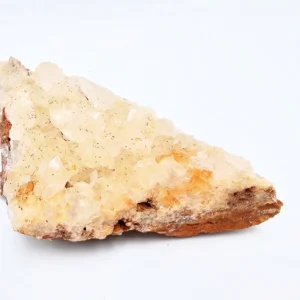


Where Golden Colour Meets Quartz
Limonite brings an earthy palette to the mineral world.
Yellow, ochre, golden brown, rusty orange and deeper brown tones can appear as coatings, staining, masses or material associated with other minerals.
At HIH, Limonite is particularly interesting where iron-rich material occurs with Quartz, producing the warm golden appearance often sold in the crystal trade under names such as Golden Healer Quartz.
What Is Limonite?
Limonite is a little different from familiar minerals such as Quartz or Calcite.
It is not one individual mineral species with one fixed chemical formula.
Instead, Limonite is a field and descriptive term used for naturally occurring mixtures of iron oxides and hydroxides.
Goethite is commonly a major component, while other iron minerals such as Hematite, Lepidocrocite and Maghemite can also be present.
Quartz, clays and other mineral impurities may occur as well.
This means two pieces described as Limonite do not necessarily have exactly the same mineral composition.
Why Is Limonite Yellow, Golden or Brown?
Iron is responsible for Limonite's wonderfully earthy colour palette.
Depending on composition, structure and the way iron-rich material occurs, specimens may appear yellow-brown, ochre, golden, rusty brown or considerably darker.
These colours are one reason Limonite-associated Quartz has become popular in the crystal trade.
Warm iron-rich coatings and inclusions can visually transform otherwise colourless or pale Quartz into golden, honeyed and rusty formations.
Limonite and Golden Healer Quartz
“Golden Healer” is a commercial and metaphysical name rather than the name of a formally recognised mineral species.
The term is commonly used for Quartz displaying yellow-to-golden iron-rich colouring.
HIH currently uses Golden Healer in the names of its Limonite clusters.
That makes the term useful for shoppers, but it should not replace accurate mineral information.
A clearer description is:
Quartz associated with iron-rich Limonite material, commercially known as Golden Healer Quartz.
This also avoids suggesting that “Golden Healer” is a separate mineral species.
Browse more natural formations in the Crystal Clusters collection.
Limonite, Goethite and Hematite
These names are related, but they are not interchangeable.
Goethite is an individual iron oxyhydroxide mineral species.
Hematite is an iron oxide mineral species.
Limonite is a broader field term for iron oxide and hydroxide mixtures, often dominated by Goethite but potentially containing several iron minerals.
This is why identifying every golden or rusty area as one specific iron mineral purely from appearance can be misleading.
For retail specimens without analytical testing, it is often more accurate to retain the established Limonite identification rather than becoming unnecessarily specific.
Choosing a Limonite or Golden Healer Cluster
Natural clusters should be compared as individual specimens rather than expected to look identical.
Consider:
Golden colour — pale yellow staining can create a very different appearance from deeper ochre and rusty brown material.
Quartz formation — look at the size, arrangement and clarity of the Quartz crystals.
Iron-rich coverage — some pieces may have subtle colouring while others show much stronger coatings or inclusions.
Crystal condition — natural points can contain irregularities, contacts and small imperfections resulting from growth and extraction.
Overall formation — the balance between Quartz, iron-rich colour and the shape of the complete cluster often creates the specimen's character.
Natural differences are part of what makes individual mineral specimens interesting.
You can also browse stones and minerals alphabetically through the Crystal Names collection.
Limonite in Crystal Traditions
Within crystal traditions, Limonite and Golden Healer Quartz are commonly associated with grounding, vitality, confidence, personal growth and connection between physical and spiritual awareness.
Golden Healer Quartz is also traditionally associated with energy work and chakra practices.
These are metaphysical traditions rather than scientifically demonstrated effects of Limonite or Quartz.
The word “healer” in Golden Healer should therefore be understood as part of the stone's established commercial and metaphysical name—not as a medical claim.
Caring for Limonite Quartz Clusters
Clusters deserve more careful handling than their overall hardness might suggest.
Quartz itself is relatively hard, but exposed crystal points can still chip or break when knocked.
Iron-rich coatings and associated material may also behave differently from the Quartz beneath them.
Avoid harsh chemicals, aggressive scrubbing and prolonged soaking unless the exact mineral composition of a specimen is known.
For dusty clusters, gentle dry cleaning with a soft brush is usually a sensible starting point.
Most importantly, don't try to scrub away every yellow, golden or rusty mark. With Limonite-associated Quartz, that iron-rich material may be exactly what gives the specimen its distinctive appearance.
Frequently Asked Questions
Is Limonite a mineral?
Not technically as a single mineral species. Limonite is a field term for mixtures of iron oxides and hydroxides, commonly dominated by Goethite.
Is Limonite the same as Goethite?
No. Goethite is a recognised mineral species, while Limonite is a broader term that may contain Goethite along with other iron minerals and impurities.
What is Golden Healer Quartz?
Golden Healer is a commercial and metaphysical name commonly used for Quartz with yellow-to-golden iron-rich colouring. It is not a separate mineral species.
Why is Limonite yellow or brown?
Its earthy yellow, ochre, golden and brown appearance comes from iron-rich oxide and hydroxide material.
What is Limonite traditionally associated with?
Within crystal traditions, Limonite is commonly associated with grounding, vitality, confidence and personal growth, while Golden Healer Quartz has additional modern metaphysical associations with energy and spiritual awareness.