
Morganite
Soft pink, peach and blush tones give Morganite its gentle beauty. This pink variety of Beryl belongs to the same mineral family as Emerald and Aquamarine, yet has a character entirely its own. Traditionally associated with love, compassion and the Heart Chakra, Morganite is especially beautiful worn as gemstone jewellery.
Showing all 4 resultsSorted by latest
Morganite: The Pink Member of the Beryl Family
Soft blush pink, peach, salmon and delicate rose tones make Morganite one of the gentler-looking coloured gemstones.
Its mineral family, however, may surprise you.
Morganite is a variety of Beryl — which means it belongs to the same mineral family as two considerably more famous gemstones: Emerald and Aquamarine.
Different trace elements and geological conditions give members of this family remarkably different colours.
Morganite, Emerald & Aquamarine Are Related
Beryl has the chemical formula Be₃Al₂Si₆O₁₈.
When Beryl develops particular colours, some of those varieties receive their own gemstone names.
Green Beryl coloured strongly enough by chromium or vanadium can be known as Emerald.
Blue to greenish-blue Beryl is Aquamarine.
Pink to orange-pink Beryl is Morganite.
So despite looking completely different, Morganite, Emerald and Aquamarine are mineral relatives.
Explore another member of the family in our Aquamarine collection.
What Makes Morganite Pink?
Morganite's delicate colour is associated with trace amounts of manganese within the Beryl.
Natural Morganite doesn't have to be bubblegum pink.
In fact, untreated material can have a noticeable orange component, producing beautiful peach, salmon and orangy-pink colours alongside softer pink and purplish-pink shades.
Strongly saturated pink Morganite is less common than the pale pastel colours for which the gemstone is best known.
This natural colour range is worth understanding when choosing Morganite jewellery. A peachy piece isn't somehow “less Morganite” than a cool pink one — it can simply represent another part of the gemstone's natural palette.
Is Morganite Heat Treated?
Morganite can be heat treated to modify its colour.
Heat is commonly used to reduce yellow or orange components, leaving a purer pink appearance.
This is an accepted treatment within the gemstone trade and doesn't turn Morganite into a different mineral.
It does, however, mean that colour alone can't tell you whether an individual Morganite has been treated.
Unless treatment information is available for a particular piece, we wouldn't assume either treated or untreated simply from its appearance.
Who Was Morganite Named After?
Morganite has a much more modern name than many famous gemstones.
Following the discovery of rose-coloured Beryl in Madagascar, gemologist George Frederick Kunz proposed the name Morganite at a meeting of the New York Academy of Sciences on 5 December 1910.
He chose the name to honour J.P. Morgan, the American financier who was also an important gem collector and supporter of museums, arts and sciences.
Morgan's gemstone collection was partly assembled with the involvement of Kunz and Tiffany & Co.
So Morganite wasn't named after a place, colour or ancient word.
It was named after a person.
Did You Know? Morganite Can Form Enormous Crystals
The delicate pastel colour can make Morganite seem like a dainty gemstone, but Beryl crystals can grow to impressive sizes.
Morganite crystals weighing more than 10 kilograms have been found in Brazil.
An especially famous specimen discovered in Maine in 1989 was nicknamed the Rose of Maine. The well-formed orangy Morganite crystal weighed just over 50 pounds.
It's a wonderful contrast: a gemstone associated with softness and romance can occur naturally as an enormous crystal.
Browse more individual stones and minerals through our Crystal Names A–Z.
Morganite Meaning
Within modern crystal traditions, Morganite is associated with love, compassion, emotional openness and gentle strength.
Its pink colouring naturally connects it with themes of affection and the heart, but Morganite symbolism isn't limited to romantic love.
It is also chosen around intentions involving self-love, kindness, emotional honesty and maintaining an open heart in relationships with others.
Its softer peach and pink colouring gives it a different visual character from deeper red stones traditionally associated with passion and intensity.
Morganite symbolism tends to centre more on gentleness, understanding and loving connection.
These are traditional and metaphysical associations rather than scientifically established effects.
Morganite & the Heart Chakra
Morganite is strongly associated with the Heart Chakra within contemporary crystal traditions.
The Heart Chakra is traditionally linked with love, compassion, connection and emotional balance.
Pink stones are frequently connected with this chakra, making Morganite's natural colouring an intuitive fit.
Explore more crystals and spiritual tools traditionally associated with the heart and other energy centres in our Chakra Balance collection.
Choosing Morganite Jewellery
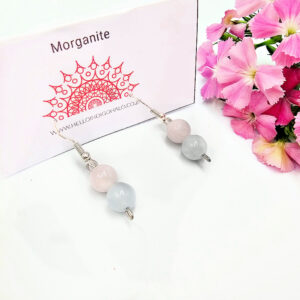
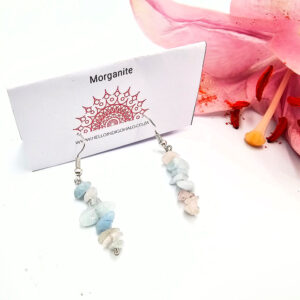
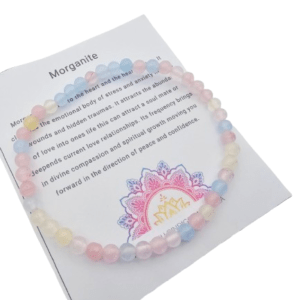
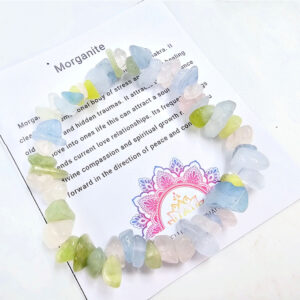
Morganite jewellery can look surprisingly different from piece to piece.
Look for variations in pink, peach, salmon and blush tones, along with the individual character of each stone.
Chip and beaded jewellery naturally emphasises this variation because several pieces of Morganite sit alongside one another rather than presenting one uniformly cut gemstone.
That can create a lovely mixture of paler and stronger colours within the same piece.
Our Morganite collection includes wearable gemstone jewellery, while individual styles can change as new pieces become available.
Browse more gemstone styles in our Earrings collection.
Caring for Morganite
Morganite has a Mohs hardness of approximately 7.5 to 8, giving it good resistance to scratching for a coloured gemstone.
It is nevertheless still a natural gemstone and shouldn't be treated as indestructible.
Avoid hard impacts, harsh household chemicals and unnecessarily aggressive cleaning.
Warm water, mild soap and gentle cleaning are suitable for ordinary care in many cases, although the construction and other materials in a finished piece of jewellery should always be considered too.
Frequently Asked Questions About Morganite
Is Morganite related to Emerald?
Yes. Morganite and Emerald are both varieties of Beryl. Morganite is pink to orange-pink, while Emerald is the famous green member of the Beryl family.
Is Morganite related to Aquamarine?
Yes. Aquamarine is the blue to greenish-blue variety of Beryl, while Morganite is the pink to orange-pink variety.
Is Morganite naturally peach coloured?
It can be. Natural Morganite may be pink, orangy-pink, salmon or peachy in appearance. Heat treatment is also commonly used to reduce orange or yellow tones and produce a purer pink.
Is Morganite sometimes called Pink Emerald?
You may encounter the name “Pink Emerald”, but it isn't considered an appropriate gemological name. Morganite and Emerald are related because both are Beryl, but the pink gemstone should be called Morganite or pink Beryl.
Why is Morganite called Morganite?
Gemologist George Frederick Kunz proposed the name in 1910 in honour of American financier, gem collector and museum benefactor J.P. Morgan.