
Moss Agate
Moss Agate looks as though tiny forests have been captured inside stone, with green, branching and cloud-like inclusions moving through translucent chalcedony. Browse Moss Agate tumble stones, crystal bracelets and earrings, each showing its own natural patterning. Within crystal traditions, Moss Agate is associated with grounding, growth, abundance and a calm connection to the natural world.
Showing all 4 resultsSorted by latest
A Crystal That Looks as Though Something Is Growing Inside It
Moss Agate gets its name from the green, branching and feathery patterns that can make a polished stone look like a miniature landscape. Some pieces resemble moss-covered ground, others look more like underwater plants, tiny trees or wisps of forest suspended inside translucent stone.
The surprise is that there is no moss inside it.
Moss Agate is a variety of chalcedony, part of the quartz family. Its distinctive appearance comes from mineral inclusions, which can include green minerals such as chlorite or hornblende, together with darker dendritic markings formed by iron or manganese oxides.
That makes Moss Agate a fascinating member of the wider Agate collection, but visually it has a character very much of its own.
No Two Little Landscapes Are Alike
Moss Agate is a stone where natural variation is part of the attraction.
One piece may be mostly translucent with delicate green threads passing through it. Another can have dense patches of green, cream, grey or earthy brown. Some show fine branching formations while others have broader cloudy areas.
These patterns are natural mineral formations rather than printed or painted designs, so customers choosing Moss Agate should expect each piece to have its own distribution of colour, transparency and markings.
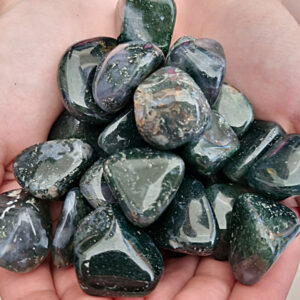
That individuality becomes especially noticeable in polished Tumbled Stones, where smoothing the surface makes it easier to look into the stone and appreciate the inclusions.
Hold one up to the light and you may suddenly notice details you did not see at first glance.
Moss Agate in Jewellery
The organic patterning of Moss Agate works particularly well in jewellery because every bead or chip contributes something slightly different.
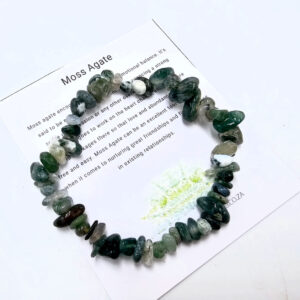
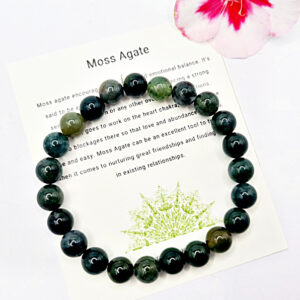
A round-bead bracelet creates a more regular silhouette while allowing the colour and internal markings of each bead to vary. Chip jewellery has a looser, more natural appearance because the individual pieces are less uniform in shape.
Our current collection includes both styles, including a classic round-bead Moss Agate bracelet and a more irregular chip bangle. If you enjoy that free-form gemstone look, browse the wider Gem Chips Bangle collection.
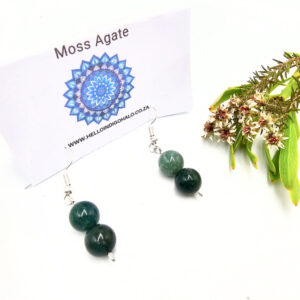
Moss Agate also appears in earrings, where smaller stones bring the green and earthy tones into jewellery without needing a large statement piece. Browse our broader Earrings collection to compare Moss Agate with other gemstone styles.
Growth, Grounding and Green Energy
It is easy to understand why a stone that looks so botanical has become strongly linked with nature.
Within modern crystal traditions, Moss Agate is associated with growth, grounding, renewal, abundance and emotional balance. It is also commonly connected with the Heart Chakra, particularly where the intention centres around harmony, friendships, personal growth and a stronger sense of connection with the natural world.
Its symbolism makes it popular for periods of change or new beginnings: starting a project, developing a new habit, growing something creatively or simply wanting a crystal with calm, earthy energy.
The stone's traditional meaning and its physical appearance fit together unusually well. Moss Agate does not merely carry associations with nature — it genuinely looks as though a tiny natural landscape has formed inside it.
Moss Agate or Another Agate?
Agate is a broad gemstone family with an enormous range of appearances.
Some varieties are prized for dramatic banding. Others reveal colourful layers, orb-like patterns, lace-like markings or geode centres. Moss Agate is recognised primarily for its green mineral inclusions and dendritic, plant-like patterns rather than obvious traditional bands.
So if you are choosing between Agate varieties, think visually first.
Choose Moss Agate if you like translucent stone, organic greens and unpredictable landscape-like markings. Look towards other Agates when bands, stronger colour contrasts or more graphic patterns are what catch your attention.
For an even broader view of stones arranged by their individual mineral or trade names, browse our Crystal Names collection.
Frequently Asked Questions
Does Moss Agate actually contain moss?
No. The moss-like appearance comes from natural mineral inclusions rather than preserved plants. Green inclusions may include minerals such as chlorite or hornblende, while darker branching dendrites can involve iron or manganese oxides.
Why does every piece of Moss Agate look different?
The inclusions form naturally inside the chalcedony, so their density, shape, colour and distribution vary. One stone may have delicate green wisps while another may contain much denser patches or branching patterns.
Is Moss Agate part of the quartz family?
Yes. Moss Agate is a variety of chalcedony, and chalcedony is a microcrystalline form of quartz.
What is Moss Agate traditionally associated with?
Within modern crystal traditions, Moss Agate is commonly associated with grounding, abundance, growth, emotional balance and connection with nature. It is also frequently linked with the Heart Chakra.
How do I choose between a Moss Agate tumble stone and jewellery?
Choose a tumble stone if you want to appreciate the stone as a crystal specimen, pocket stone or meditation piece. Choose jewellery if you prefer to wear Moss Agate regularly. Round beads create a more uniform look, while chip jewellery tends to feel more organic and irregular.