
Pink Tourmaline
From delicate blush and candy pink to richer raspberry and purplish tones, Pink Tourmaline shows just how colourful the Tourmaline family can be. Natural inclusions and colour zoning can give individual stones even more character, while manganese plays an important role in many pink and red varieties. Browse Pink Tourmaline for its distinctive colour and natural variation. Within crystal traditions, it is associated with compassion, love and emotional balance.
Showing all 2 resultsSorted by latest
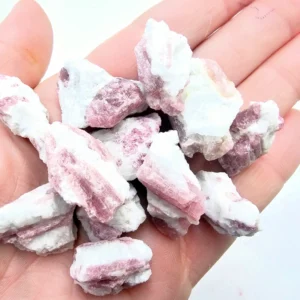

More Than One Shade of Pink
Pink Tourmaline doesn't come in one compulsory bubblegum shade.
Its colour can move from delicate pale pink and warm rose through to vivid raspberry, purplish pink and deeper reddish tones. Natural inclusions, differences in transparency and areas of colour zoning can make individual stones even more distinctive.
That variety is part of Pink Tourmaline's appeal.
What Is Pink Tourmaline?
Tourmaline is a complex group of related minerals, famous for occurring in an unusually wide range of colours.
Gem-quality pink material is commonly associated with Tourmaline species such as Elbaite, although a product should not automatically be labelled as a specific Tourmaline species unless its identification is known.
For shopping purposes, Pink Tourmaline remains the clearest description for Tourmaline whose dominant appearance is pink.
Why Is Pink Tourmaline Pink?
Manganese plays an important role in producing many of Tourmaline's pink and red colours.
The complete colour story can be more complicated, however. Tourmaline has variable chemistry, and colour can also be influenced by oxidation states and colour centres created by natural or laboratory irradiation.
That means it is better to describe Pink Tourmaline as naturally varied than to give every stone one oversimplified colour formula.
Pink Tourmaline or Rubellite?
You'll often encounter the name Rubellite when looking at pink and red Tourmaline.
The terms overlap, but they aren't necessarily perfect synonyms.
Rubellite is a traditional trade name used for strongly coloured pink, red and purplish-red Tourmaline. Exactly where ordinary Pink Tourmaline ends and Rubellite begins isn't universally agreed within the gem trade.
For HIH, keeping Pink Tourmaline as the main category name is the clearest approach.
Use Rubellite for an individual product only when that identification is genuinely appropriate rather than automatically renaming every pink stone.
Natural Inclusions Are Normal
Pink Tourmaline doesn't need to be perfectly clear to be attractive.
Eye-visible inclusions are not unusual in pink Tourmaline, particularly in richer colours.
Depending on the stone, inclusions can appear as fine tubes, internal lines, tiny crystals, fractures or other natural features formed during growth.
For collectors and crystal shoppers, these can become part of the individuality of the piece.
For faceted fine jewellery, clarity can influence value more strongly, so the intended use of the gemstone matters when deciding what characteristics you prefer.
Look for Colour Zoning
Tourmaline has another fascinating habit: a single crystal can contain more than one colour.
Changes in chemistry during crystal growth can produce distinct colour zones.
Pink may occur beside green, blue, colourless or other tones, and the famous Watermelon Tourmaline combination typically features a pink centre surrounded by green.
A stone containing both pink and green shouldn't automatically be moved out of Pink Tourmaline taxonomy, but a strongly zoned Watermelon Tourmaline may deserve its own product description or category if the actual material and range justify it.
Pink Tourmaline and October
Tourmaline is one of the traditional modern birthstones for October, alongside Opal.
That gives Pink Tourmaline an additional gifting connection without changing what the gemstone actually is.
For an October birthday, Pink Tourmaline can be especially appealing when the person loves colourful gemstones but prefers rosy shades over Green or Black Tourmaline.
Tourmaline is also traditionally associated with the eighth wedding anniversary.
Choosing Pink Tourmaline
Natural variation makes Pink Tourmaline particularly enjoyable to compare.
Consider:
Colour — pale blush, rose, vivid pink and deeper reddish tones each create a different appearance.
Clarity — decide whether you prefer clearer material or stones with visible natural inclusions.
Colour zoning — some pieces are relatively even while others show fascinating changes in colour.
Transparency — Pink Tourmaline can range considerably in how much light passes through it.
Shape and finish — rough crystals show natural growth character, while polished and faceted stones emphasise colour and light.
Individual character — inclusions and colour variation are expected in natural Tourmaline and don't automatically indicate poor quality.
Choose the stone that appeals to you rather than expecting every natural piece to look identical.
Pink Tourmaline in Crystal Traditions
Within crystal traditions, Pink Tourmaline is commonly associated with love, compassion, emotional balance, kindness, confidence and the Heart Chakra.
Its colour has also inspired symbolic connections with affection, friendship and emotional openness.
These are metaphysical traditions rather than scientifically demonstrated effects of Tourmaline.
Avoid promises that Pink Tourmaline treats anxiety, heals trauma or produces a guaranteed emotional outcome.
Its unusual mineralogy, varied colour and natural crystal character already give it a compelling story.
Caring for Pink Tourmaline
Tourmaline is reasonably durable for jewellery and ordinary handling, but it still deserves sensible care.
Clean gently with mild soap, lukewarm water and a soft cloth or brush when appropriate.
Avoid harsh chemicals, hard knocks and sudden extreme temperature changes.
Pieces containing natural fractures, inclusions or delicate crystal terminations require extra care.
For jewellery, also consider the setting, wire, cord or metal surrounding the stone rather than caring only for the Tourmaline itself.
Frequently Asked Questions
What is Pink Tourmaline?
Pink Tourmaline is naturally pink material from the Tourmaline mineral group. Gem-quality pink Tourmaline is often associated with Elbaite, although exact mineral-species identification should not be assumed for every retail stone.
What gives Pink Tourmaline its colour?
Manganese is an important cause of red and pink colour in Tourmaline, although Tourmaline colour chemistry can be complex.
Is Pink Tourmaline the same as Rubellite?
Not exactly. Rubellite is a trade name used for strongly coloured pink to red Tourmaline, but there is no universally agreed boundary separating Rubellite from other Pink Tourmaline.
Is Pink Tourmaline an October birthstone?
Yes. Tourmaline is recognised as an October birthstone alongside Opal.
Are inclusions normal in Pink Tourmaline?
Yes. Visible inclusions can occur naturally in Pink Tourmaline and are not unusual, particularly in strongly coloured material.