
Polychrome Jasper
Swirls of rust red, ochre, cream, grey, brown and soft pink make Polychrome Jasper look almost like a painted landscape. Also known as Desert Jasper, this colourful material comes from Madagascar and is traditionally associated with grounding, creativity, vitality and embracing change. Every polished piece reveals a completely individual pattern.
Showing all 3 resultsSorted by latest
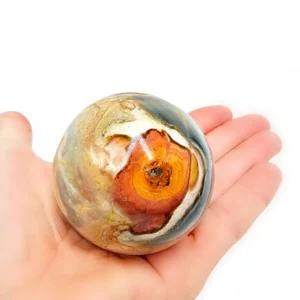


Polychrome Jasper: Madagascar's Colourful Desert Jasper
Rust red can flow into mustard yellow. Cream can meet grey, dusty pink, chocolate brown or muted blue-grey. Circular forms can sit beside sweeping bands that look almost like distant hills, dunes or abstract paintings.
That's the appeal of Polychrome Jasper.
Also known as Desert Jasper, this colourful material comes from Madagascar and is especially striking when polished, because each cut reveals a completely different arrangement of colour and pattern.
What Is Polychrome Jasper?
Polychrome Jasper is the commercial name given to colourful Jasper material from Madagascar.
The word polychrome simply means many-coloured — an unusually straightforward name for a crystal-trade material.
Jasper belongs to the broad microcrystalline Quartz and Chalcedony family and is generally opaque because of the mineral matter contained within it.
Polychrome Jasper is recognised particularly for its earthy mixtures of reds, browns, creams, greys, pinks, yellows and other muted colours.
Rather than occurring as neat stripes or one uniform shade, those colours can flow into one another in sweeping patches, circles and irregular bands.
Browse more individual stones and minerals through our Crystal Names A–Z.
Why Is Polychrome Jasper Called Desert Jasper?
Desert Jasper is another established trade name for Polychrome Jasper.
The name suits both its origin and appearance.
Commercial material comes from Madagascar, where Polychrome Jasper has been recovered from surface and alluvial deposits. Its warm ochres, reds, creams and browns can also create patterns remarkably reminiscent of desert landscapes.
So Polychrome Jasper and Desert Jasper aren't two different crystals in this context.
They are two names used for the same colourful Madagascan material.
What Creates All Those Colours?
Jasper can contain a mixture of microscopic mineral matter and impurities that influence its colour.
Iron-bearing minerals are particularly important in producing many of the reds, yellows and browns associated with Jasper.
Polychrome Jasper, however, can contain a much broader palette.
Rather than assuming that one mineral creates every colour in every piece, it is more accurate to appreciate Polychrome Jasper as naturally variable material whose appearance reflects differences within the original rock.
Those variations are exactly what make individual specimens collectible.
Why Do Polychrome Jasper Spheres Look So Different?
A sphere is one of the most interesting ways to see Polychrome Jasper.
The original material contains colours and patterns extending through three dimensions.
When it is shaped into a sphere, different portions of those structures are exposed all the way around the surface.
Turn the sphere and a broad cream area can disappear into rust-red swirls. A circular marking on one side may become a band as it continues around the stone.
This is why photographs of only one side never tell the whole story.
With a good Polychrome Jasper sphere, part of the enjoyment is simply turning it around and finding the other landscapes hidden within it.
Browse more polished forms in our Crystal Shapes collection.
Polychrome Jasper vs Ocean Jasper
Both come from Madagascar and both can contain beautiful circular and flowing patterns, but Polychrome Jasper and Ocean Jasper aren't interchangeable names.
Ocean Jasper is particularly famous for its orbicular and spherulitic structures, with circles and “eyes” produced by distinctive mineral growth.
Polychrome Jasper is better known for its broad multicoloured fields, sweeping bands and landscape-like patterns.
Some individual pieces may look surprisingly similar, which is why provenance and supplier identification can be more reliable than trying to identify every Jasper solely from a photograph.
Compare the distinctive orbicular material in our Ocean Jasper collection.
Polychrome Jasper vs Picture Jasper
These two names can also cause confusion.
Both stones can produce patterns that resemble landscapes.
Picture Jasper is particularly famous for scenic-looking lines and markings that can resemble mountains, horizons and desert views.
Polychrome Jasper earns its name more directly from its multiple colours, which often appear in larger flowing areas, swirls and rounded patterns.
The important thing is not to assume that every brown landscape-like Jasper is automatically the same variety.
Polychrome Jasper Meaning
Within contemporary crystal traditions, Polychrome Jasper is associated with grounding, stability, creativity, vitality and adaptability.
Its earthy colours make grounding an intuitive association, while its flowing mixture of different colours has encouraged symbolism around change, movement and allowing different parts of life to exist together rather than needing everything to be uniform.
It is also commonly chosen when someone wants a stone that feels earthy without being visually dark or sombre.
These are traditional and metaphysical associations rather than scientifically established effects.
Polychrome Jasper & the Chakras
Polychrome Jasper is most commonly associated with the Root Chakra, traditionally connected with grounding, stability and feeling secure.
Its red, orange and golden areas can also lead to associations with the Sacral and Solar Plexus Chakras, particularly around creativity, motivation and confidence.
Because individual Polychrome Jasper pieces can contain such different colours, there is no need to force every specimen into exactly the same chakra interpretation.
Explore more stones and spiritual tools through our Chakra Balance collection.
Choosing Polychrome Jasper
With Polychrome Jasper, pattern is everything.
Some pieces have dramatic red and cream contrasts. Others are dominated by muted browns, grey, ochre or dusty pink. You may find sweeping bands, rounded forms, bold patches or subtle transitions from one colour into another.
When choosing an individually photographed sphere or polished piece, look beyond which one appears most colourful.
Sometimes the most interesting specimen is the one whose markings create an unusual landscape, horizon or abstract pattern.
There is no single “correct” Polychrome Jasper appearance.
Its variety is the point.
Caring for Polychrome Jasper
Polychrome Jasper is silica-rich material suitable for normal handling and display, but polished pieces can still scratch, chip or fracture if knocked against harder materials or dropped.
Use a soft cloth for ordinary cleaning and avoid harsh household chemicals.
For spheres, a secure stand is particularly important. A polished stone that rolls from a shelf can be damaged regardless of how durable the material itself may be.
Frequently Asked Questions About Polychrome Jasper
Is Polychrome Jasper the same as Desert Jasper?
Yes. Desert Jasper is another commonly used trade name for the colourful Madagascan material sold as Polychrome Jasper.
Where does Polychrome Jasper come from?
The material known commercially as Polychrome or Desert Jasper is associated with Madagascar, including deposits in the country's northwest.
What does “polychrome” mean?
Polychrome simply means many-coloured, referring to the mixture of colours that makes this Jasper so distinctive.
Is Polychrome Jasper the same as Ocean Jasper?
No. Both are colourful Madagascan materials, but Ocean Jasper is particularly known for orbicular and spherulitic structures, while Polychrome Jasper is characterised by broad multicoloured patterns and flowing colour fields.
Why does every Polychrome Jasper piece look different?
Its colours and patterns extend through the original material in irregular three-dimensional structures. Cutting and polishing expose different sections, so no two pieces need to display the same arrangement.