
Red Hematoid
Showing all 3 resultsSorted by latest
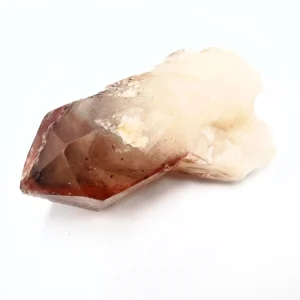


Red Hematoid Quartz: Hematite Captured Inside Quartz
Red, rust and deep crimson markings suspended inside Red Hematoid Quartz can look like smoke, clouds, flakes or even miniature landscapes.
The material itself is Quartz.
What creates its dramatic appearance is Hematite, an iron oxide mineral occurring as inclusions within the Quartz.
That is why Red Hematoid is better understood as Hematite-included Quartz rather than as a separate mineral species.
The name Fire Quartz is also commonly used commercially for similar red Hematite-bearing Quartz.
Browse the wider Crystal Names A–Z collection for more unusual stones and minerals.
What Is Red Hematoid Quartz?
Red Hematoid consists of Quartz (SiO₂) containing iron-rich inclusions, most importantly Hematite.
Hematite has the chemical formula Fe₂O₃ and can occur in red, reddish-brown, steel-grey and metallic forms.
Inside Quartz, very fine Hematite can create brilliant red colouring that looks completely different from the silvery metallic Hematite many people recognise in polished stones.
That contrast makes Red Hematoid particularly interesting:
the host crystal is Quartz, but much of the colour comes from Hematite trapped within it.
Explore the mineral responsible for those red inclusions in our Hematite collection.
Why Is Red Hematoid Also Called Fire Quartz?
Fire Quartz is a trade name commonly used for Quartz containing vivid red, orange or brown iron-oxide inclusions.
The name isn't a formal mineral classification.
It describes the appearance.
When Hematite forms wisps, clouds or streaks inside transparent or translucent Quartz, the colours can resemble glowing embers or flames trapped within the crystal.
That makes “Fire Quartz” a useful alternative name for customers, while Red Hematoid Quartz remains a clear description of the material itself.
What Is a Phantom in Red Hematoid Quartz?
Some Red Hematoid crystals contain one of Quartz's most fascinating growth features:
phantoms.
A phantom is an internal outline that records an earlier stage of the Quartz crystal's growth.
Quartz begins forming and develops a crystal face.
Growth then slows or pauses, allowing another mineral — in this case often Hematite — to settle across that surface.
Later, the Quartz begins growing again and covers the earlier crystal face.
The result is an internal shape that mirrors the crystal's earlier form.
It looks almost like a crystal preserved inside another crystal.
Two of the current Hello Indigo Halo specimens are specifically identified as Red Hematoid pieces with phantoms, making this especially relevant to the collection.
Did You Know? A Phantom Records the Crystal's Growth History
A phantom isn't simply a decorative red patch.
It can preserve evidence of different stages in the growth of the Quartz crystal.
Each internal layer represents an earlier boundary where crystal growth changed, paused or interacted with other minerals before continuing.
In well-defined examples, the Hematite traces the older crystal termination so clearly that you can see one pointed Quartz shape suspended inside another.
That makes phantom Quartz almost like a geological time capsule.
Red Hematoid vs Clear Quartz
Both materials are fundamentally Quartz.
The difference is what is present inside them.
Clear Quartz is valued for transparency and clarity, although natural specimens can contain inclusions.
Red Hematoid Quartz is specifically prized for visible iron-rich inclusions that create its characteristic red, rust or brown patterns.
Those inclusions don't make it “less Quartz”.
They are part of what makes the specimen mineralogically and visually interesting.
A Common Misidentification: Hematite vs Lepidocrocite
You may see red inclusions in Quartz marketed online as Lepidocrocite.
That label should be treated cautiously.
Mindat notes that red inclusions in Quartz frequently sold as Lepidocrocite have generally proved to be Hematite when analysed, and states that it is unaware of analytically confirmed examples of the familiar translucent red scaly “Lepidocrocite in Quartz” sold in the crystal trade.
For HIH, I would therefore avoid casually describing Red Hematoid as:
“Quartz with Hematite and Lepidocrocite”
unless an individual specimen has actual analytical evidence.
For most material, Hematite-included Quartz is the safer and better-supported description.
Red Hematoid Meaning
Within contemporary crystal traditions, Red Hematoid Quartz is associated with grounding, focus, vitality, motivation and emotional steadiness.
Its symbolism often combines themes traditionally linked with its two component minerals:
Quartz is associated with clarity, focus and amplification.
Hematite is associated with grounding, strength and stability.
Together, Red Hematoid is often chosen by people who want something that feels both clear-headed and anchored rather than purely calming or purely energising.
These are metaphysical traditions rather than scientifically established effects.
Red Hematoid & the Chakras
Red Hematoid is most commonly associated with the Root Chakra because of its Hematite content and red colouring.
Its stronger red-orange specimens may also be connected with the Sacral Chakra, particularly around motivation, creative action and vitality.
Clearer Quartz-dominant pieces are sometimes used more broadly because Quartz itself is used across many chakra traditions.
Explore more crystals and spiritual tools through our Chakra Balance collection.
Choosing Rough Red Hematoid
Red Hematoid is a category where the individual internal pattern matters far more than perfect uniformity.
Look for differences in:
red intensity, Hematite distribution, translucency, natural crystal faces, phantom outlines and surface texture.
One specimen may contain a bold red internal phantom, while another has finer clouds or scattered iron-rich markings.
With rough material, natural fractures, uneven bases and irregular crystal surfaces are normal.
If you enjoy crystals where geology is visible rather than polished away, browse our Selected Rough Crystals.
Caring for Red Hematoid Quartz
Because the host material is Quartz, Red Hematoid has a Mohs hardness of around 7.
That makes it considerably harder than many softer collector minerals, but crystal points and rough edges can still chip if dropped or knocked.
For normal cleaning, use a soft cloth or brush and mild lukewarm water where appropriate.
Avoid harsh chemicals and aggressive scrubbing, particularly with rough specimens where other associated minerals may be present.
Frequently Asked Questions About Red Hematoid
Is Red Hematoid the same as Fire Quartz?
The names are commonly used for closely overlapping material. Fire Quartz is a trade name for Quartz containing red to brown iron-rich inclusions, most commonly Hematite.
Is Red Hematoid a separate mineral?
No. It is Quartz containing visible Hematite or other iron-rich material rather than a formally recognised mineral species called Red Hematoid.
What causes the red colour in Red Hematoid?
Hematite inclusions are the principal cause of the characteristic red, rust and reddish-brown colouring in well-documented Hematoid Quartz.
What is a phantom in Red Hematoid Quartz?
A phantom is an internal outline marking an earlier stage of the Quartz crystal's growth. Hematite can settle on an earlier crystal face before later Quartz growth encloses it.
Is the red inclusion Lepidocrocite?
Usually that claim should be treated cautiously. Mineralogical sources note that many red inclusions sold as Lepidocrocite in Quartz have instead proved to be Hematite when examined analytically.