
Strawberry Quartz
Speckled with delicate pink, red and rosy inclusions, Strawberry Quartz is named for its wonderfully fruit-like appearance. Genuine natural material is Quartz coloured by abundant microscopic mineral inclusions, often including Hematite. Beautiful in polished jewellery, Strawberry Quartz is traditionally associated with love, joy, emotional warmth and positive energy.
Showing all 5 resultsSorted by latest


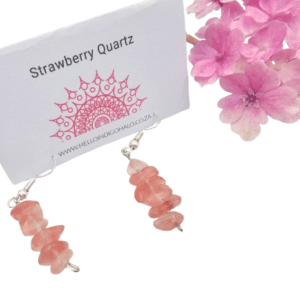


Strawberry Quartz: Pink Quartz With a Speckled Secret
At first glance, Strawberry Quartz simply looks beautifully pink.
Look closer and the reason for its name begins to appear.
Fine red, pink or rusty inclusions can be scattered throughout transparent to translucent Quartz, producing a speckled appearance reminiscent of tiny strawberry seeds suspended inside the stone.
The colour isn't simply painted onto the surface.
In genuine natural Strawberry Quartz, those tiny inclusions developed within the Quartz itself.
Explore more fascinating natural materials in our Crystal Names collection.
What Is Strawberry Quartz?
Strawberry Quartz is a commercial name for included Quartz, rather than a separate formally recognised mineral species.
The host crystal is Quartz, with the chemical formula SiO₂.
What gives Strawberry Quartz its distinctive character is the abundance of tiny reddish mineral inclusions distributed through the otherwise clear, pale or pinkish Quartz.
Hematite is particularly well documented in genuine Strawberry Quartz, although other iron-bearing minerals have also been reported in material sold under the name.
This means Strawberry Quartz is best understood as Quartz whose inclusions create its characteristic strawberry-like appearance.
What Makes Strawberry Quartz Pink?
The colour comes primarily from the tiny mineral inclusions inside the Quartz rather than from Quartz simply being naturally pink throughout.
In well-developed material, microscopic red flakes and particles can be distributed through the crystal in sufficient numbers to give the entire stone a soft pink, strawberry-red or reddish appearance.
Under magnification, some inclusions can appear as tiny plates, flakes, needles or other delicate structures.
Their size, colour and concentration vary naturally, which is why Strawberry Quartz can range from softly pink to much richer reddish tones.
Is the Red Mineral Always Hematite?
Not necessarily.
This is an area where crystal descriptions often become too definite.
Hematite is very well documented in natural Strawberry Quartz, including material where the inclusions have been analytically identified.
However, other specimens historically described as Strawberry Quartz have been reported with Goethite and Lepidocrocite, and the commercial name itself isn't governed by one strict mineralogical definition.
For that reason, we don't automatically identify every red inclusion in every Strawberry Quartz specimen as one particular mineral without testing.
The accurate broader description is natural Quartz containing abundant reddish mineral inclusions.
Strawberry Quartz vs Rose Quartz
They're both pink and they're both Quartz, but they aren't the same material.
Rose Quartz usually has a more even cloudy, translucent pink appearance. Its colour is associated with microscopic inclusions and structural colour centres rather than the obvious red speckling characteristic of Strawberry Quartz.
Strawberry Quartz, by contrast, is valued for visible reddish inclusions that can give the stone its distinctive seeded or speckled appearance.
The difference becomes particularly easy to appreciate in polished beads.
If you love softer pink Quartz, browse our Rose Quartz collection.
Why Strawberry Quartz Looks Beautiful in Jewellery
Polishing allows light to enter the Quartz and interact with the inclusions inside it.
In a bead, every movement reveals a slightly different view.
One area may appear almost clear with scattered red flecks, while another can look considerably pinker because more inclusions overlap through the depth of the stone.
This gives Strawberry Quartz jewellery a natural variation that works particularly well across a string of beads.
Instead of every bead being perfectly identical, slight differences in colour and inclusion density create a more organic finished piece.
Explore more natural stone styles in our Bangles & Bracelets collection.
Natural Strawberry Quartz & Lookalikes
Strawberry Quartz is one category where accurate naming matters.
Because the commercial term isn't strictly defined, the name has also been applied over the years to manufactured glass and other imitation materials with pink or red effects.
That doesn't mean genuine Strawberry Quartz doesn't exist.
It absolutely does.
Natural included Quartz specimens have been documented from several localities and studied gemologically.
It simply means that colour alone isn't enough to identify a piece with certainty.
Natural-looking variation, genuine internal mineral inclusions and reliable supplier information are much more meaningful than a perfectly uniform strawberry-pink colour.
Strawberry Quartz Meaning
Within contemporary crystal traditions, Strawberry Quartz is associated with love, joy, emotional warmth, gratitude and positive energy.
Its pink colouring naturally connects it with many of the modern traditions surrounding love and emotional openness, while its livelier red inclusions give it a slightly more energetic character than softer pink stones.
It is often chosen around intentions involving appreciating what is already good in life, strengthening loving connections and approaching relationships with greater warmth and openness.
These are traditional and metaphysical associations rather than scientifically established effects.
Strawberry Quartz & the Heart Chakra
Strawberry Quartz is most commonly associated with the Heart Chakra.
Within modern Chakra traditions, pink stones are widely connected with love, compassion, relationships and emotional openness.
The deeper red and pink inclusions in Strawberry Quartz also give it a visual warmth that distinguishes it from paler pink stones.
Explore more stones and spiritual tools through our Chakra Balance collection.
Choosing Strawberry Quartz
Look beyond the overall pink colour.
One of the pleasures of Strawberry Quartz is examining the inclusions inside the stone.
Some pieces may have extremely fine, evenly distributed speckles, while others show more obvious reddish flakes or concentrated areas.
Individual beads can also vary in transparency.
These natural differences give Strawberry Quartz its character rather than making one piece inherently better than another.
Caring for Strawberry Quartz Jewellery
Because the host material is Quartz, Strawberry Quartz has a hardness of around 7 on the Mohs scale.
It is reasonably durable for jewellery, but can still chip or fracture after a hard impact.
Clean polished pieces gently with lukewarm water, mild soap when necessary and a soft cloth.
For bangles and earrings, remember that elastic, wire and metal components may require gentler handling than the Quartz itself.
Frequently Asked Questions About Strawberry Quartz
Is Strawberry Quartz a real natural stone?
Yes. Genuine natural Strawberry Quartz exists and consists of Quartz containing abundant reddish mineral inclusions. However, manufactured materials have also been sold under the same commercial name.
Is Strawberry Quartz the same as Rose Quartz?
No. Both are varieties or commercial forms of Quartz with pink colouring, but Strawberry Quartz is particularly known for its visible reddish inclusions and speckled appearance.
Does Strawberry Quartz contain Hematite?
Many well-documented natural Strawberry Quartz specimens contain Hematite, but the trade name isn't defined by one inclusion mineral alone. Other iron-bearing inclusions have also been reported.
Why does each Strawberry Quartz bead look different?
Natural variations in the concentration, size and distribution of inclusions can change the colour and pattern from one area of Quartz to another.
Is Strawberry Quartz naturally pink?
Natural Strawberry Quartz can develop a pink-to-red overall appearance because numerous tiny reddish mineral inclusions are distributed throughout the Quartz.