
Vivianite
Delicate blades and extraordinary blue-green colour make Vivianite a fascinating collector mineral. Surprisingly, fresh Vivianite can begin almost colourless before oxidation deepens its colour through green, blue-green and darker shades. Within crystal traditions, Vivianite is associated with emotional renewal, compassion, growth and gently bringing buried feelings into awareness.
Showing all 5 resultsSorted by latest

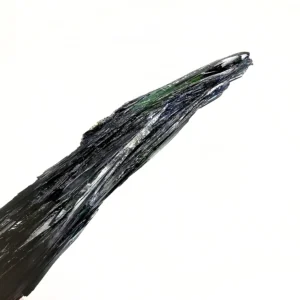


Vivianite: The Mineral That Changes Colour
The deep green, blue-green and almost inky colours of Vivianite hide something surprising.
Fresh Vivianite can be nearly colourless.
Vivianite is a hydrated iron phosphate mineral, and changes involving the iron within its structure cause its colour to deepen after formation and exposure. Pale material can gradually develop green, blue-green and deeper blue shades, while heavily altered material can become extremely dark.
So the extraordinary colour collectors associate with Vivianite isn't necessarily how the mineral began.
That transformation is one of the most fascinating parts of its story.
Browse our Crystal Names A–Z to discover more unusual minerals and stones by name.
Why Does Vivianite Turn Blue and Green?
Iron is central to Vivianite's changing appearance.
Its mineral formula contains iron in the ferrous, or Fe²⁺, state. As oxidation takes place, some of that iron changes towards the ferric, or Fe³⁺, state.
That chemical change is accompanied by a change in colour.
Vivianite can move through pale green and greenish-blue into increasingly deep blue-green shades. This helps explain why two genuine Vivianite specimens can look remarkably different.
One may be translucent green, another intensely blue-green and another so dark that parts appear almost black.
Colour isn't the only attraction either. Vivianite can develop beautiful elongated, flattened or bladed crystals, giving well-formed specimens a delicate and distinctive appearance.
Vivianite Blades
Vivianite can occur as small crystals, earthy masses and radiating formations, but its elongated and flattened crystals are especially appealing to mineral collectors.
These are often described as Vivianite blades.
Look along a blade and you may see changes in transparency, lustre and colour depending on the thickness of the crystal and the direction of the light.
A small, beautifully formed blade can therefore be every bit as interesting as a much larger specimen.
For more minerals kept close to their natural formation, browse our Selected Rough Crystals.
Vivianite Can Form on Dead Bodies
This is where Vivianite's story becomes considerably stranger.
Vivianite can form in waterlogged, oxygen-poor environments where iron and phosphate are available — and decomposing bodies can provide the phosphate.
As bones, teeth and other organic remains break down, phosphate can become available in the surrounding environment. If the conditions are right and iron is also present, Vivianite can begin to form.
That means Vivianite has been discovered in association with animal remains, human bones, graves and archaeological burials.
In some archaeological cases, blue or blue-green Vivianite has actually developed directly on human skeletal remains.
It isn't that Vivianite somehow requires a dead body to form. Most Vivianite certainly isn't “made from people”.
The fascinating part is that the chemistry of decomposition can occasionally create exactly the sort of environment Vivianite needs.
And because freshly formed Vivianite may initially be extremely pale, the characteristic blue-green colour can become more apparent as the material is exposed and oxidises.
It's an extraordinary intersection of mineralogy, chemistry and decomposition — and one of the more unusual natural formation stories in the crystal world.
A Mineral Found in Mud, Peat and Ancient Burials
The burial connection makes more sense when you look at the environments in which Vivianite forms.
Vivianite favours conditions where iron, phosphate, water and low oxygen come together.
It has been documented in clay, peat, lake and marine sediments, boggy environments and other places rich in organic material.
Phosphate doesn't have to come from a body. It can enter these environments through a variety of geological and biological processes.
But bones are naturally rich in phosphate, which explains why archaeological remains can sometimes become sites for Vivianite formation.
So while the beautiful blades sold as collector specimens may look as though they belong in a sparkling mineral cavity, Vivianite's wider mineral story can be surprisingly muddy — and occasionally rather macabre.
Vivianite Meaning: Bringing Buried Things to the Surface
Within modern crystal traditions, Vivianite is associated with emotional renewal, compassion, growth and acknowledging feelings that have been buried or avoided.
There is an unusually fitting parallel between that symbolism and the mineral itself.
Vivianite can physically form in hidden, oxygen-poor environments and may begin almost colourless before developing much richer colour.
Its geological behaviour doesn't prove its metaphysical meaning, of course, but the imagery is powerful:
something hidden becoming visible, something pale gaining colour, and something new forming from what has broken down.
For some people, that makes Vivianite particularly symbolic of processing difficult experiences, releasing old emotional patterns and allowing life or enthusiasm to return after a challenging period.
These are metaphysical traditions rather than scientifically established effects, but Vivianite's unusual natural history gives those associations considerably more depth than a generic “stone of healing” description.
Vivianite and the Heart Chakra
Vivianite's rich greens naturally connect it with Heart Chakra traditions.
The Heart Chakra is symbolically associated with compassion, love, emotional openness and our relationships with ourselves and others.
Its bluer shades can also suggest communication and expression, creating a natural connection between what is felt internally and what is eventually expressed.
For crystals and spiritual tools organised around chakra traditions, browse our Chakra Balance collection.
Why Vivianite Needs Thoughtful Display
Vivianite is a collector mineral that deserves more care than Quartz or Agate.
It is extremely soft, measuring only around 1.5–2 on the Mohs hardness scale.
That means harder crystals can easily scratch it, while thin blades may be damaged by knocks or rough handling.
Its colour can also continue changing as oxidation progresses.
For collectors, a conservative approach is sensible: keep Vivianite away from prolonged strong light and heat, handle delicate blades as little as necessary and display them somewhere they won't be knocked or rubbed against harder specimens.
Don't scrub a Vivianite blade or treat it like a robust polished stone.
Part of collecting Vivianite is accepting that it is a delicate, naturally changing mineral.
Choosing a Vivianite Specimen
With Vivianite, don't choose purely by size or weight.
Look at the blade formation, colour, translucency, surface and overall character.
Thin areas may reveal lighter green or blue-green tones when light passes through them, while thicker areas can look dramatically darker.
Natural edges, irregularities and colour differences are part of the mineral.
For a collector, those details are often precisely what makes one Vivianite blade different from another.
Frequently Asked Questions
Can Vivianite really form on dead bodies?
Yes. Vivianite has been documented on and around decomposed human and animal remains, including archaeological burials. Bones can provide phosphate which, under suitable iron-rich, waterlogged and low-oxygen conditions, can contribute to Vivianite formation. This doesn't mean all Vivianite forms from remains — it is simply one particularly fascinating environment in which the mineral can develop.
Is Vivianite naturally blue-green?
Yes, although very fresh Vivianite can initially be almost colourless. Changes involving oxidation of iron within the mineral are associated with its development of green, blue-green and increasingly dark colours.
What is a Vivianite blade?
Vivianite can form elongated, flattened crystals commonly described as blades. These natural formations can show particularly interesting changes in colour and transparency.
Is Vivianite a soft mineral?
Very. Vivianite has a Mohs hardness of only around 1.5–2, so it should be handled much more gently than harder crystals such as Quartz.
What is Vivianite traditionally associated with?
Within modern crystal traditions, Vivianite is associated with compassion, emotional renewal, growth and bringing buried or difficult feelings into awareness. Its natural transformation has also made it a particularly evocative symbol of change and renewal.