
Agatized Coral
Part fossil, part mineral transformation, Agatized Coral preserves the patterns of ancient coral while silica-rich chalcedony replaces or fills the original structure. Browse polished tumble stones, palm stones and wearable nugget jewellery with naturally varied fossil patterning. Within crystal traditions, Agatized Coral is commonly associated with grounding, stability, connection to the past and steady personal growth.
Showing all 2 resultsSorted by latest

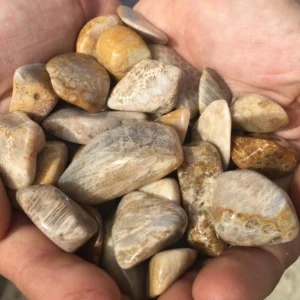
When Coral Becomes Stone
Agatized Coral is one of those materials that makes the line between fossil and crystal particularly interesting.
It begins with coral.
Over geological time, the original coral material can be replaced or filled by silica-rich chalcedony, preserving parts of the structure while transforming the material into stone.
The result can show small cells, branching shapes, flower-like forms, circles or irregular fossil patterns that still hint at the living coral that came first.
That is why Agatized Coral does not look like ordinary banded Agate.
Its pattern began as biology.
What Does “Agatized” Actually Mean?
The word agatized refers to the replacement or infilling of original material by agate or chalcedony.
Agatized Coral is therefore not simply coral with a shiny coating.
The mineralisation happens through the fossilisation process, with silica becoming a major part of what remains.
Mineralogically, Agatized Coral belongs closely with chalcedony and agate, both forms of silica.
If you would like to compare it with Agate that formed without an original coral structure, browse our wider Agate collection.
The difference is especially easy to appreciate when you compare Agatized Coral’s organic-looking cells and fossil textures with classic Agate banding.
A Fossil You Can Actually Wear
The current HIH assortment moves beyond loose specimens.
Agatized Coral appears as tumble stones, a polished palm stone and a nugget bangle.
That gives you several ways of appreciating the same material.
A tumble stone makes the fossil pattern compact and smooth enough to carry or add to a mineral collection.
A palm stone gives the pattern more surface area, making the structure easier to study.
A nugget bangle breaks the fossil material into irregular polished beads, so every section around the wrist can show a slightly different pattern.
If the palm-stone format appeals to you, browse the wider Palm Stones & Gallets collection.
Why Does Every Piece Look Different?
Because the pattern was never manufactured in the first place.
The original coral structure varies, and the later mineral replacement can preserve different amounts of that structure.
Some stones may show clear flower-like or cellular shapes.
Others can be more mottled, clouded or irregular.
Colour can also vary according to the surrounding minerals and staining present during formation.
You may see creams, beige, greys, browns, reddish tones and other earthy variations.
That does not mean one piece is “wrong” because it does not match another.
Natural variation is one of the main reasons Agatized Coral is worth choosing piece by piece.
Agatized Coral, Fossil Coral and Ordinary Coral
These names can become confusing.
Living coral is a biological organism.
Fossil coral refers broadly to coral that has been preserved through geological processes.
Agatized Coral refers more specifically to fossil coral whose original structure has been replaced or infilled by chalcedony or agate-like silica.
So Agatized Coral is a type of fossil material, but not every fossil coral specimen necessarily has the same kind of silicification.
That distinction matters because the word “coral” on its own can suggest modern organic coral material.
Agatized Coral is stone.
Is Agatized Coral the Same as Agate?
Not exactly.
They are closely related mineralogically because the agatized material is chalcedony or agate.
But Agatized Coral has an additional identity: its structure is inherited from coral.
Classic Agate is often recognised for bands, concentric layers and cavity-filling patterns formed through silica deposition.
Agatized Coral can instead preserve traces of the original coral structure.
One is primarily a mineral growth pattern.
The other carries a fossil story with it.
For shoppers who prefer small polished pieces, compare the current Agatized Coral tumble stones with the wider Tumbled Stones collection.
Patterns That Look Almost Floral
One of the most attractive features of Agatized Coral is how surprisingly decorative fossil anatomy can become once polished.
Small repeating cells can resemble flowers, stars or tiny circular rosettes.
That does not mean actual flowers are trapped inside the stone.
Those shapes come from the original coral structure and the way it was preserved or replaced during mineralisation.
A good polished surface simply makes that structure easier to see.
This is particularly noticeable in palm stones and flat polished areas where more of the internal pattern is exposed.
Agatized Coral in Jewellery
Nugget jewellery suits this material particularly well because it does not try to force every bead into a perfectly identical shape.
Irregular polished pieces preserve more of the fossil's natural character.
The current HIH Agatized Coral nugget bangle therefore makes sense as a wearable form: each bead can display different colours, markings and pieces of fossil pattern.
For alternative crystal and gemstone wrist jewellery, browse our wider Bangles & Bracelets collection.
If exact matching is important to you, remember that natural fossil and gemstone beads will not look machine-identical.
That is part of the material rather than a defect.
Ancient Structure, Modern Symbolism
Within modern crystal traditions, Agatized Coral is commonly associated with grounding, stability, patience, resilience and connection to ancient or ancestral energy.
Its fossil origin naturally contributes to themes of time, continuity and the past.
Some crystal practitioners also associate it with steady growth and adapting through change — a fitting symbolic interpretation for material that began as living coral and eventually became stone.
These are metaphysical traditions rather than geological properties.
The geology tells us how the material formed.
The symbolism is the human meaning later attached to it.
Choosing Agatized Coral
Choose a tumble stone when you want something small, smooth and easy to carry.
Choose a palm stone when you want more surface area to appreciate the fossil pattern.
Choose a nugget bangle if you want the material in wearable form and enjoy irregular beads rather than perfectly round ones.
Then look at the pattern.
Some shoppers will prefer bold, obvious coral cells.
Others may be drawn to subtler earthy textures.
There is no requirement for every Agatized Coral stone to show a perfect little flower.
Nature did not make them for product photography.
Caring for Agatized Coral
Because the agatized portion is silica-rich chalcedony, it is relatively durable compared with many softer fossil materials.
Even so, polished pieces and jewellery should be treated sensibly.
Avoid hard knocks that can chip edges, especially on irregular nugget beads.
Keep jewellery away from harsh household chemicals and avoid stretching elastic bracelets unnecessarily.
For cleaning, a soft cloth is usually sufficient for polished pieces.
And if your specimen shows natural pits, cavities or irregular fossil texture, avoid aggressive brushing that could catch on fragile areas.
Frequently Asked Questions
Is Agatized Coral a fossil or a crystal?
It can reasonably be described as both fossil material and silicified mineral material. The original coral provides the fossil structure, while chalcedony or agate-like silica replaces or fills that structure over geological time.
Is Agatized Coral made from living coral?
No. Agatized Coral is ancient fossilised and mineralised material, not modern living coral.
Is Agatized Coral the same as Agate?
No. They are closely related because Agatized Coral contains chalcedony or agate-like silica, but its distinctive structure comes from the original coral.
Why does Agatized Coral sometimes look like flowers?
The flower-like shapes are usually sections through the original coral structure. Polishing can reveal those repeating fossil patterns particularly clearly.
What is Agatized Coral traditionally associated with?
Within crystal traditions, Agatized Coral is commonly associated with grounding, patience, stability, resilience, connection to the past and steady personal growth.