
Emerald
From mossy greens to richer jewel tones, Emerald is one of the world’s most recognisable gemstones. This green variety of Beryl has been prized for thousands of years and is also the traditional birthstone for May. Within crystal traditions, Emerald is associated with love, abundance, growth, compassion and the Heart Chakra.
Showing the single result
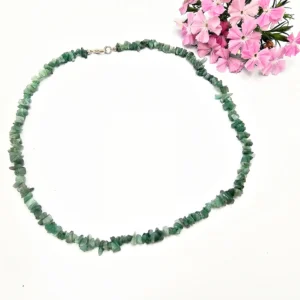
Emerald: The Famous Green Variety of Beryl
Few gemstone names are as instantly recognisable as Emerald.
Its colour can range through softer natural greens into deeper, more saturated green and slightly blue-green tones. Some pieces are translucent, others more opaque, and natural inclusions and internal patterns can give each stone a very individual appearance.
Mineralogically, Emerald is the green to bluish-green variety of Beryl.
That puts it in the same mineral family as Aquamarine, despite the two gemstones looking completely different.
What Makes an Emerald Green?
Pure Beryl is colourless.
Emerald gets its famous colour from small amounts of elements such as chromium and vanadium within the crystal structure.
These trace elements can create remarkably rich green colour without making up a large proportion of the stone itself.
Not every green Beryl is automatically classified as Emerald, however. Gemmologists consider the strength and saturation of the green when distinguishing Emerald from lighter material described simply as Green Beryl.
For everyday jewellery and crystal collecting, the important thing is that natural Emerald can show considerable variation.
One stone may be bright grassy green, another darker and earthier, while another may contain visible inclusions, cloudy areas or changes in colour.
Emerald and Aquamarine Are Mineral Cousins
Emerald has an unexpectedly colourful family.
Both Emerald and Aquamarine are varieties of Beryl, but different trace elements create their distinctive colours.
Emerald is green to bluish green.
Aquamarine is blue to blue-green.
Other Beryl varieties can be yellow, pink, red or colourless.
It's a wonderful example of how relatively small chemical differences can completely change the appearance — and eventually the name — of a gemstone.
Those Inclusions Are Part of the Story
Perfectly clear Emerald isn't the only kind worth appreciating.
Natural Emerald commonly contains inclusions, tiny fractures, growth features and other internal characteristics.
Gem dealers have traditionally used the French word jardin, meaning garden, to describe the mossy, branching or garden-like internal world visible in some Emeralds.
It's a lovely way of looking at them.
Instead of expecting every natural Emerald to resemble flawless green glass, look closely at the particular pattern inside your stone.
Especially in more affordable natural Emerald jewellery, those inclusions can be an important part of its character.
Emerald Has Been Fascinating People for Thousands of Years
Emerald's history stretches far beyond modern jewellery.
Ancient Egyptian sources became famous for Emerald mining, and Cleopatra has become closely associated with the gemstone in later accounts of Egyptian royal life.
Emeralds also became enormously important in South America.
After the Spanish conquest, Colombian Emeralds entered European and international trade in large quantities, and Colombia eventually became one of the places most strongly associated with exceptional Emerald.
Different deposits produce Emerald under different geological conditions, so origin can influence the inclusions, chemistry and appearance of individual stones.
Unless the provenance of a particular HIH piece is confirmed, however, we shouldn't assign it an Egyptian, Colombian, Zambian or other origin simply from appearance.
Emerald Meaning: Love That Grows
Within crystal traditions, Emerald is strongly associated with love, compassion, abundance, harmony, growth and renewal.
Its symbolism isn't limited to romantic love.
Emerald is also connected with friendship, loyalty, openness and nurturing relationships that have room to develop over time.
The green colour naturally reinforces themes of growth and renewal, making Emerald a popular symbolic choice for new chapters, positive intentions and things someone hopes to cultivate in their life.
These are traditional and metaphysical associations rather than scientifically established effects, but they have followed Emerald through a remarkably long cultural history.
Emerald and the Heart Chakra
Emerald is one of the classic stones associated with the Heart Chakra.
Within chakra traditions, green represents the heart centre and themes such as love, compassion, emotional openness, connection and balance.
Emerald's long-standing symbolism around love and its natural green colour make that association particularly strong.
Some people wear Emerald jewellery as a personal symbol of love or growth, while others choose it during meditation, intention-setting or periods when relationships and emotional connection are particularly important.
Explore more crystals and spiritual tools associated with this tradition in our Chakra Balance collection.
Emerald Is the May Birthstone
Emerald is the traditional birthstone for May.
That gives Emerald jewellery another layer of meaning beyond colour or crystal symbolism.
It can make a thoughtful birthday gift for someone born in May, while its traditional associations with love and growth also make it appealing for anniversaries, relationships and personal milestones.
You certainly don't need a May birthday to wear it, though.
Sometimes the green is reason enough.
Emerald in Everyday Jewellery
Emerald doesn't have to mean a large, transparent, faceted gemstone surrounded by diamonds.
More included and opaque natural Emerald can be beautiful in beads, chips, cabochons and small polished pieces, allowing the gemstone's natural greens and internal patterns to become part of more relaxed jewellery designs.
That suits the current HIH collection particularly well.
Small Emerald pieces can bring genuine natural gemstone colour into jewellery without needing the formal appearance traditionally associated with fine Emerald jewellery.
Browse more wearable stones in our Gem & Crystal Necklaces.
Choosing Emerald
Start with the green that appeals to you.
Don't assume darker automatically means better for the kind of Emerald jewellery you're choosing.
Look at colour, natural inclusions, pattern, polish and the overall personality of the stone.
With chip jewellery, differences between individual pieces create texture and variation. In a larger polished stone, you may be able to see much more of the internal pattern.
If you're choosing Emerald according to crystal traditions, love, growth, abundance and compassion are among its strongest associations.
If you're choosing it because you're born in May, that's easy too.
And if you simply love green, you don't need a more complicated reason.
Caring for Emerald
Emerald is relatively hard, around 7.5–8 on the Mohs scale, but hardness isn't the whole story.
Natural Emerald commonly contains fractures and inclusions, and some gem-quality Emeralds are treated with oils or resins to improve the appearance of surface-reaching fractures.
For that reason, avoid harsh chemicals, ultrasonic cleaning and sudden temperature changes unless you know exactly how a particular Emerald has been treated.
For ordinary jewellery, gentle cleaning with a soft cloth is the safer approach.
Frequently Asked Questions
Is Emerald the same mineral as Aquamarine?
Yes and no. Both are varieties of the mineral Beryl, but Emerald is the green to bluish-green variety while Aquamarine is blue to blue-green. They belong to the same mineral family but are recognised as different gemstone varieties.
Why do natural Emeralds have inclusions?
Inclusions and internal fractures commonly develop during Emerald's natural formation. These features can create distinctive internal patterns and are extremely common in natural stones.
What does jardin mean in an Emerald?
Jardin is a traditional gemstone term meaning “garden” in French. It describes the garden-like appearance created by certain inclusions and internal features visible inside some Emeralds.
What month is Emerald the birthstone for?
Emerald is the traditional May birthstone and is one of the world's best-known birthstones.
What is Emerald traditionally associated with?
Within crystal traditions, Emerald is associated with love, compassion, abundance, harmony, growth and renewal. Its green colour also gives it a particularly strong connection with the Heart Chakra.