
Snowflake Obsidian
Black volcanic glass scattered with pale, snowflake-like patterns makes Snowflake Obsidian instantly recognisable. Its distinctive markings are clusters of Cristobalite that developed as parts of the glass began to crystallise. Available in natural rough and polished forms, Snowflake Obsidian is traditionally associated with grounding, balance, protection and self-reflection.
Showing all 7 resultsSorted by latest
-
-

-
-
-
-
Snowflake Obsidian Tumble Stones
Original price was: R35.00.R28.00Current price is: R28.00. Add to basketQuick View -
Snowflake Obsidian: Volcanic Glass That Started to Crystallise
At first glance, Snowflake Obsidian looks as though somebody scattered tiny snowflakes across black glass.
Those pale patterns aren't painted on, and they aren't simply random white spots.
They are clusters of Cristobalite, a crystalline form of silica, that developed within the dark volcanic glass.
That makes Snowflake Obsidian particularly interesting: you're looking at natural glass in which parts of the material have begun to crystallise.
Explore more unusual stones and natural materials in our Crystal Names collection.
How Does Snowflake Obsidian Form?
Obsidian forms when silica-rich molten rock cools rapidly enough to produce natural volcanic glass rather than a fully crystalline rock.
Snowflake Obsidian begins with that same glassy foundation.
But within the Obsidian, small areas undergo partial crystallisation.
Cristobalite develops in clusters that grow outward into the surrounding dark glass, producing the rounded, radiating grey-white markings we recognise as snowflakes.
So Snowflake Obsidian captures an interesting geological moment.
Most of the material remained glassy.
Small areas didn't.
Those crystalline patches became the pattern.
What Are the White Snowflakes?
The pale markings are primarily associated with Cristobalite.
Cristobalite has the same basic chemical formula as Quartz — SiO₂ — but it has a different crystal structure.
That makes Cristobalite and Quartz polymorphs: materials with the same chemical composition arranged into different crystal structures.
This means the little “snowflakes” aren't simply white Quartz dots trapped in Obsidian.
They represent another crystalline form of silica developing within volcanic glass.
That's considerably more interesting than actual snow.
Why Does Every Snowflake Look Different?
Cristobalite doesn't develop in one perfectly controlled pattern.
Some pieces of Snowflake Obsidian contain tiny, densely packed pale spots.
Others develop larger rounded flowers or radiating snowflakes.
One specimen may be almost completely covered, while another remains predominantly black with widely spaced markings.
Cutting also changes what we see because we're viewing different cross-sections through three-dimensional crystalline growths inside the glass.
That's why a tumble, sphere and rough chunk can show surprisingly different versions of the same material.
Rough vs Polished Snowflake Obsidian
Snowflake Obsidian is particularly interesting to compare in rough and polished forms.
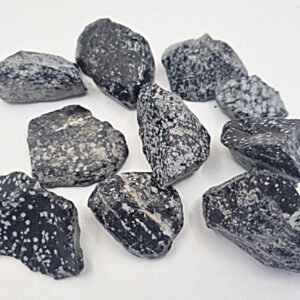
Rough pieces preserve the irregular volcanic character of the material and can show broken glassy surfaces alongside the pale Cristobalite pattern.
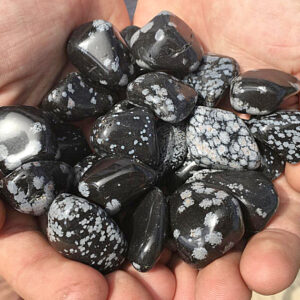
Polishing creates stronger contrast between glossy black Obsidian and the softer grey-white markings.
Tumble stones are easy to turn in the hand and compare from several angles, while spheres reveal the pattern continuously around the stone.
If you enjoy crystals closer to their natural form, browse our Selected Rough Crystals collection.
Snowflake Obsidian vs Black Obsidian
Both begin with natural volcanic glass.
Black Obsidian is valued for its deep, glossy dark appearance.
Snowflake Obsidian contains visible Cristobalite growths that interrupt the black glass with pale patterns.
The difference therefore isn't simply that someone has given two colours of Obsidian different names.
Snowflake Obsidian records partial crystallisation inside the volcanic glass.
If you prefer Obsidian in its classic dark form, explore our Black Obsidian collection.
A Stone Caught Between Glass & Crystal
This is perhaps the best way to understand Snowflake Obsidian.
Obsidian itself is amorphous volcanic glass, meaning its atoms don't have the long-range ordered crystal structure of a mineral such as Quartz.
The snowflakes are crystalline.
So within one piece, you can have predominantly non-crystalline volcanic glass containing clearly visible areas where crystalline material has developed.
Snowflake Obsidian is therefore a lovely example of geology refusing to fit neatly into the labels we use in everyday crystal shopping.
Snowflake Obsidian Meaning
Within contemporary crystal traditions, Snowflake Obsidian is associated with grounding, protection, balance and self-reflection.
Its black-and-white appearance has also inspired symbolism around recognising opposites — light and shadow, challenge and growth, what we understand about ourselves and what still needs attention.
It is often chosen when the intention is to look at recurring patterns more clearly while remaining grounded.
There is something rather fitting about that symbolism in a stone whose most recognisable feature is literally a pattern emerging from darkness.
These are traditional and metaphysical associations rather than scientifically established effects.
Snowflake Obsidian & the Root Chakra
Snowflake Obsidian is most commonly associated with the Root Chakra, reflecting the wider Obsidian traditions of grounding, stability and protection.
Its contrasting black-and-white appearance also gives it a strong modern association with balance.
Rather than forcing it across every Chakra, its clearest metaphysical identity remains grounded awareness and reflection.
Explore more stones and tools used in contemporary energy traditions through our Chakra Balance collection.
Choosing Snowflake Obsidian
With this stone, pay attention to the pattern.
You may prefer predominantly black material with a handful of distinct pale snowflakes, or a piece densely covered in grey-white markings.
On larger rough specimens, look at several faces because the pattern can change considerably across the stone.
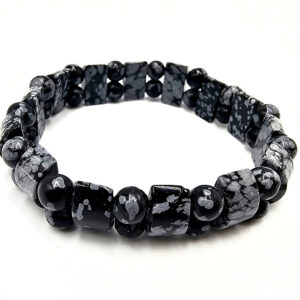
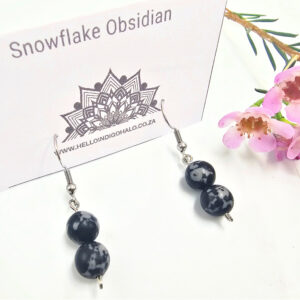
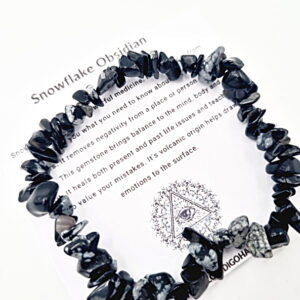
With jewellery, the differences between individual beads become part of the design rather than something that needs to match perfectly.
There is no ideal number of snowflakes.
Choose the pattern you like.
Caring for Snowflake Obsidian
Although Snowflake Obsidian can take a beautiful polish, remember that its foundation is natural volcanic glass.
Obsidian can chip and fracture, and freshly broken edges can become extremely sharp.
Handle large rough specimens thoughtfully and display them somewhere stable.
For polished stones and jewellery, use a soft cloth with mild soap and lukewarm water when necessary. Avoid hard impacts and harsh household chemicals.
Frequently Asked Questions About Snowflake Obsidian
Are the snowflakes in Snowflake Obsidian natural?
Yes. The pale patterns form naturally as Cristobalite develops within the volcanic glass.
Is Snowflake Obsidian actually Obsidian?
Yes. It is natural Obsidian containing characteristic pale Cristobalite crystal patterns.
Is Snowflake Obsidian a crystal?
Obsidian itself is natural volcanic glass rather than a crystalline mineral. However, the pale snowflake patterns contain crystalline Cristobalite.
Why doesn't every Snowflake Obsidian have the same pattern?
The size, density and arrangement of the Cristobalite growths vary naturally, while cutting or polishing reveals different sections through those internal structures.
Is Snowflake Obsidian the same as Black Obsidian?
They are closely related, but Snowflake Obsidian contains visible pale Cristobalite growths that give it its characteristic patterned appearance.