
Tourmilated Quartz
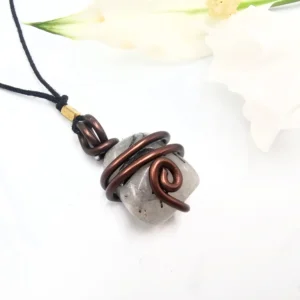
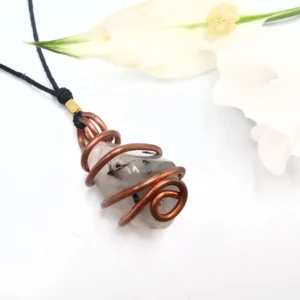
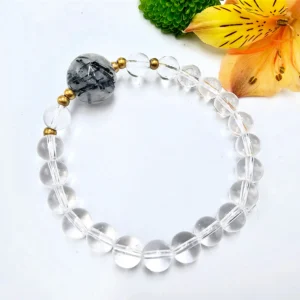
Clear to milky Quartz threaded with dramatic dark Tourmaline inclusions gives Tourmalinated Quartz its wonderfully distinctive appearance. Fine needle-like strands, bold streaks and naturally varied patterns can make every piece look different. Browse Tourmalinated Quartz stones for the fascinating contrast between Quartz and included Tourmaline. Within crystal traditions, this striking combination is associated with grounding, clarity, balance and energetic protection.
Showing all 7 resultsSorted by latest
-
-
-
-
-

-
-
Tourmalinated Quartz Chips Bangle
Original price was: R129.00.R99.00Current price is: R99.00. Add to basketQuick View


Quartz With a Darker Side
Tourmalinated Quartz brings two remarkably different-looking minerals together.
Clear, translucent or milky Quartz can be crossed by dark Tourmaline inclusions, creating everything from delicate needle-like lines to dense black streaks and dramatic internal patterns.
No two pieces need to follow the same design.
That unpredictability is one of the reasons Tourmalinated Quartz is so fascinating to collect.
What Is Tourmalinated Quartz?
Tourmalinated Quartz is Quartz containing inclusions of Tourmaline.
It isn't a separate mineral species with its own unique chemical formula.
The host Quartz is silicon dioxide, while Tourmaline belongs to a complex group of borosilicate minerals.
This distinction matters because a piece of Tourmalinated Quartz is essentially a natural mineral combination: Tourmaline crystals or needles have become enclosed within Quartz during the minerals' geological development.
The resulting patterns can remain clearly visible after the Quartz is polished.
Why Are There Black Lines Inside the Quartz?
The dark lines, needles and streaks are Tourmaline inclusions.
Some can be extremely fine, appearing almost like hairs suspended inside the Quartz. Others are thicker, broken or clustered together.
Their orientation can also vary.
A polished tumble stone might contain a few isolated dark needles, a network of crossing lines or a much denser concentration of Tourmaline.
Rather than treating these inclusions as imperfections, they're the defining feature of the material.
Is the Black Tourmaline Always Schorl?
Black Tourmaline is commonly associated with Schorl, an iron-rich member of the Tourmaline group.
However, Tourmaline is a group containing numerous related mineral species, and appearance alone doesn't always establish the precise species of a dark inclusion.
For general retail material, “black Tourmaline inclusions” is therefore a sensible description when that is how the stone has been identified by the supplier.
Only use the more specific mineral name Schorl when the material has been identified sufficiently to support it.
That keeps the description interesting without becoming more precise than the evidence allows.
Clear Quartz or Milky Quartz?
Tourmalinated Quartz doesn't have to be perfectly transparent.
The Quartz surrounding the Tourmaline may range from clearer areas to cloudy, translucent or milky sections.
Internal fractures, veils and other natural features can also influence how the piece looks.
This can create very different visual styles.
Clearer material can make individual black needles stand out dramatically, while milkier Quartz can produce a softer monochrome appearance.
Neither automatically makes the stone more authentic than the other.
Tourmalinated Quartz or Rutilated Quartz?
These two materials are easily confused because both can contain dramatic needle-like inclusions.
The difference is the included mineral.
Tourmalinated Quartz contains Tourmaline.
Rutilated Quartz contains Rutile.
Rutile needles are often golden, reddish, coppery, silvery or dark, while Tourmalinated Quartz is particularly recognised for its contrasting black Tourmaline inclusions.
Colour alone shouldn't be the only identification method, but the distinction is important for accurate product naming and shop taxonomy.
Choosing Tourmalinated Quartz
This is a wonderful material to choose visually because the inclusions create so much natural variation.
Consider:
Quartz clarity — compare clearer pieces with softer, milkier material.
Tourmaline pattern — look for fine needles, thicker streaks, crossing lines or dense clusters.
Contrast — some stones have dramatic black-and-clear patterning while others are subtler.
Polish — a smooth polished surface can make internal inclusions easier to see.
Natural features — internal veils, fractures and cloudy areas can be part of the stone rather than defects.
Individuality — don't expect a batch of tumble stones to match one another perfectly.
Turn a polished piece beneath the light and look through it from different directions. Patterns hidden from one angle can become much more noticeable from another.
Tourmalinated Quartz in Crystal Traditions
Tourmalinated Quartz has developed an interesting place within modern crystal traditions because practitioners symbolically combine associations given to both Quartz and Black Tourmaline.
It is commonly associated with grounding, clarity, balance, focus and energetic protection.
Some traditions view Quartz as amplifying intention while Black Tourmaline is associated with grounding and protection, making their natural combination particularly appealing to crystal collectors.
These are metaphysical traditions rather than scientifically demonstrated effects of the minerals.
The genuine natural relationship between contrasting Quartz and Tourmaline already gives the stone plenty of character without needing to promise physical, emotional or spiritual outcomes.
Caring for Tourmalinated Quartz
Simple, gentle care is best.
For polished pieces, use lukewarm water, mild soap when necessary and a soft cloth. Avoid harsh chemicals, abrasive cleaners and hard impacts.
Because you're dealing with a natural combination containing inclusions and potentially internal fractures, avoid sudden temperature changes and unnecessarily rough handling.
For tumble stones, store them so polished surfaces aren't continually rubbing against significantly harder or abrasive materials.
Frequently Asked Questions
What is Tourmalinated Quartz?
Tourmalinated Quartz is natural Quartz containing visible Tourmaline inclusions, often appearing as dark needles, strands or streaks within clear to milky Quartz.
Is Tourmalinated Quartz the same as Black Tourmaline?
No. Black Tourmaline can occur as the included material, but Tourmalinated Quartz consists of Quartz containing those Tourmaline inclusions.
Is Tourmalinated Quartz the same as Rutilated Quartz?
No. Tourmalinated Quartz contains Tourmaline inclusions, while Rutilated Quartz contains inclusions of the mineral Rutile.
Does every Tourmalinated Quartz stone look the same?
No. Quartz clarity and the quantity, thickness and arrangement of Tourmaline inclusions can vary considerably between individual pieces.
What is Tourmalinated Quartz traditionally associated with?
Within crystal traditions, Tourmalinated Quartz is commonly associated with grounding, clarity, balance, focus and energetic protection.